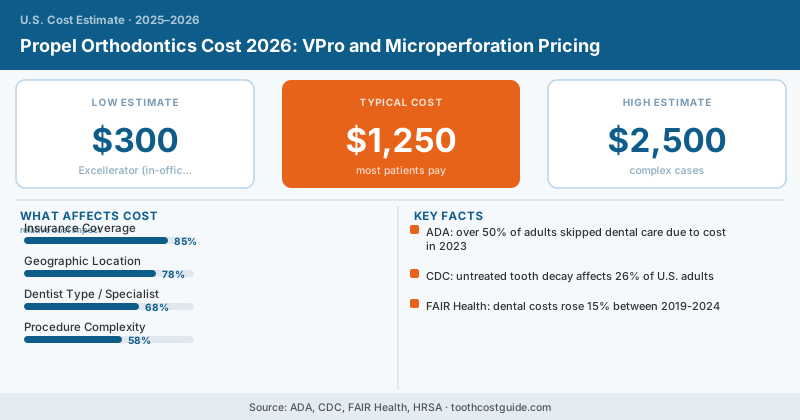
What if you could trim months off your braces just by biting on a buzzing mouthpiece for five minutes a day? That’s the promise Propel built its brand on — and it’ll cost you somewhere between $300 and $2,000 depending on which Propel product your orthodontist offers.
Propel isn’t a type of braces. It’s a suite of acceleration tools designed to bolt onto whatever treatment you’re already getting, whether that’s brackets or clear trays. Two names come up most: the VPro vibration device and the Excellerator microperforation tool.
| Propel Product | Typical Added Cost | How It Works |
|---|---|---|
| VPro / VPro5 (at-home vibration) | $300–$1,200 | 5 min/day high-frequency vibration |
| Excellerator (in-office microperforation) | $500–$2,000 | Orthodontist creates micro-perforations in bone |
| Combined protocol | $1,000–$2,500 | Both methods together |
The Two Propel Methods
The VPro is the consumer-friendly side. You pop it in, bite down, and it vibrates at high frequency for five minutes. The theory is that cyclic loading helps teeth move through bone more efficiently and seats clear aligners more fully against the teeth. It’s the lower-cost, lower-commitment option.
The Excellerator is the clinical heavy lifter. Your orthodontist uses it to make tiny perforations in the bone around your teeth — a quick in-office procedure — which jump-starts the bone-remodeling process. More invasive, more expensive, but with a stronger theoretical case for speed.
You can’t buy Propel by itself. It rides on top of your braces or Invisalign plan. So always price your base treatment first, then ask what Propel adds. A $5,000 aligner case plus a $1,500 Propel protocol is a $6,500 commitment.
Does It Actually Speed Things Up?
This is where you should keep your expectations grounded. The American Association of Orthodontists has flagged that the evidence for at-home vibration devices is inconsistent — some patients see benefit, controlled studies often don’t show dramatic gains. Microperforation has somewhat better support for accelerating tooth movement, but it’s not magic either.
A point worth sitting with: the single biggest predictor of finishing on time is patient compliance. The CDC’s oral-health research consistently shows that consistent care beats gadgets. If you wear your aligners 22 hours a day and never break a bracket, you might match a non-compliant patient who paid extra for Propel. The device can’t out-perform good habits.
What Moves the Price
Your orthodontist sets the Propel fee, and there’s wide variation. Some bundle the VPro into a premium treatment package at little visible extra cost. Others charge separately and itemize it. The Excellerator’s in-office procedure costs more in high-rent metro markets.
Your base treatment still dominates the total. Adding Propel to a discreet lingual braces case — already a premium option at $8,000–$13,000 — barely moves the percentage. Adding it to a budget ceramic braces plan is a bigger relative jump.
And as always, the retainer is non-negotiable at the end. Budget $150–$500 for a retainer regardless of how fast Propel got you there.
How to Pay
Insurance won’t reimburse Propel as a standalone item. Your orthodontic benefit — typically a $1,000–$2,500 lifetime cap if you have one — applies to the core treatment only.
The practical workaround is pre-tax money. An FSA for dental expenses covers orthodontic acceleration tied to active treatment, and a CareCredit dental plan can finance the combined cost across monthly installments.
Don’t let a Propel upsell distract from the basics. If an orthodontist pushes a $2,000 acceleration package before discussing whether you even need it, ask for the realistic time savings in your specific case — and what happens if it doesn’t deliver. Get the answer in writing.
Should You Buy In?
For a patient on a tight deadline with a moderate-to-complex case, the Excellerator microperforation may justify its cost. For the average person, the VPro is a nice-to-have that often doesn’t pay for itself. Bring it up at your orthodontist consultation and ask your provider for their own before-and-after data — not the brochure.
Frequently Asked Questions
Propel VPro typically costs between $300 and $800 as an add-on to your existing orthodontic treatment, though some practices may charge up to $1,200 depending on your location and provider. The device uses micro-vibrations to accelerate tooth movement and is used for just 5 minutes daily during treatment.
Most dental insurance plans do not cover Propel devices since they are considered cosmetic or elective add-ons rather than necessary orthodontic treatment. You can expect to pay the full cost out-of-pocket, typically $300–$2,000 depending on which Propel product your orthodontist uses.
Propel users typically see treatment shortened by 25–50%, which can mean 3–8 months faster results depending on your case complexity and consistent use of the device. You must use the device as directed (usually 5 minutes daily) for the acceleration benefits to take effect during your overall treatment timeline.