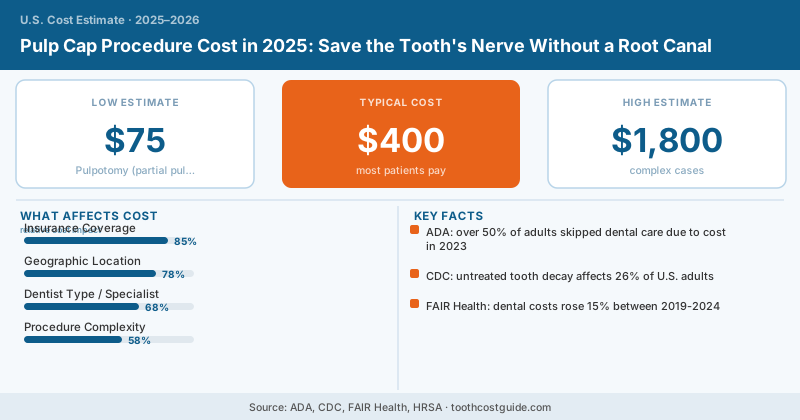
What if your dentist could save your tooth’s nerve — and spare you a root canal — for a few hundred dollars instead of a few thousand? That’s exactly what a pulp cap does in the right situation. It’s one of the most underutilized cost-saving procedures in dentistry, and a lot of patients never hear about it until it’s too late.
Here’s what pulp capping actually costs, when it works, and when it doesn’t.
Pulp Cap Costs
| Procedure | Typical Cost |
|---|---|
| Indirect pulp cap | $75–$200 |
| Direct pulp cap | $150–$500 |
| Pulpotomy (partial pulp removal, partial alternative) | $200–$600 |
| Root canal (if pulp cap fails) | $700–$1,800 |
| MTA or Biodentine material (often bundled) | Included in most quotes |
What Is a Pulp Cap?
The dental pulp is the soft tissue inside your tooth — the nerves and blood vessels that keep the tooth alive. When deep decay or a trauma incident gets close to (or touches) the pulp, you’re at risk of infection that typically requires a root canal.
A pulp cap places a medicated material directly on or near the exposed/nearly exposed pulp to:
- Stimulate the pulp to form a dentin bridge (a protective barrier)
- Maintain pulp vitality
- Avoid the need for root canal therapy
There are two types:
Indirect Pulp Cap ($75–$200)
Used when decay comes very close to the pulp but hasn’t reached it. The dentist removes most of the decay but intentionally leaves a thin layer of affected dentin over the pulp to avoid exposing it. A medicated liner (calcium hydroxide, glass ionomer, or MTA) is placed over that thin layer, then a filling or crown seals the tooth.
The goal: the remaining decay arrests and remineralizes under the liner. The pulp is never exposed. Success rates for indirect pulp caps in asymptomatic teeth with no pulp symptoms are consistently high — research published in the Journal of Endodontics shows success rates above 90% with proper case selection.
Direct Pulp Cap ($150–$500)
Used when the pulp is actually exposed — either by a small mechanical exposure during cavity preparation or by trauma (a chip that exposes the pulp). A medicated material is placed directly on the pulp exposure, then the tooth is restored.
The gold-standard material today is MTA (mineral trioxide aggregate) or its newer equivalents like Biodentine. Studies comparing MTA-based caps to older calcium hydroxide caps show meaningfully better long-term outcomes with MTA.
Yes. Older direct pulp caps used calcium hydroxide (Ca(OH)₂), which is inexpensive but leads to internal resorption and failure at higher rates over time. MTA is more biocompatible and produces better dentin bridge formation. If your dentist recommends a direct pulp cap, ask specifically whether they’re using MTA or Biodentine — these materials justify the higher cost of the procedure.
When Pulp Capping Works (and When It Doesn’t)
Good candidates for pulp capping:
- Deep decay with no symptoms (no spontaneous pain, no nighttime aching)
- Recent traumatic pulp exposure (less than 24 hours old is ideal)
- Small exposure site (≤ 1–2mm)
- Tooth with no periapical pathology on X-ray
- Young patients with open, developing root apices (apexogenesis)
Poor candidates:
- Teeth with irreversible pulpitis (spontaneous, lingering pain)
- Existing periapical abscess or bone loss around the root tip
- Large or contaminated exposure site
- Teeth with necrotic pulp tissue
The ADA and the American Association of Endodontists both emphasize that patient symptoms and pulp vitality tests are critical to case selection. A pulp cap on a tooth with irreversible pulpitis will almost certainly fail — and you’ll still need the root canal, plus the cost of the failed cap.
Why This Procedure Is Underused
In a survey of general dentists, researchers found that many practitioners default to root canal treatment even in situations where pulp capping is clinically appropriate — partly from uncertainty about outcomes and partly from familiarity. If you have a tooth with deep decay and no pain symptoms, it’s reasonable to ask your dentist: “Is there any chance a pulp cap would work here before we commit to a root canal?”
Insurance Coverage
Indirect pulp caps are often covered (or partially covered) as part of a restorative procedure under dental insurance. Direct pulp caps are billed under CDT code D3110 and are typically covered at 50–80% after deductible, similar to root canal therapy.
What Happens If the Pulp Cap Fails
Failure usually shows up within 6–24 months — the tooth develops symptoms, an abscess forms, or X-rays show changes at the root tip. At that point, a root canal is required. You’ve spent an extra $150–$500 on the cap, but you’ve also gained months of monitoring and preserved the option.
For some patients, particularly younger ones with developing teeth, even a temporary win from a pulp cap has long-term value by allowing the root to finish developing before root canal therapy is needed.
A pulp cap is not a substitute for a root canal in a tooth that already has irreversible pulpitis. If you’re experiencing spontaneous, lingering tooth pain — pain that stays for 30+ seconds after a stimulus is removed — that’s a sign of irreversible pulpitis, and a cap won’t resolve it. Root canal therapy is the appropriate treatment.
The Bottom Line
Pulp capping runs $75–$500 versus $700–$1,800 for a root canal. In the right patient, it’s a legitimate and well-evidenced treatment that preserves the tooth’s vitality and defers or avoids root canal entirely. Ask your dentist whether you’re a candidate before defaulting to the more expensive procedure.
Frequently Asked Questions
A pulp cap typically costs between $75 and $500, depending on whether it's a direct pulp cap (around $75–$200) or an indirect pulp cap (around $200–$500). The exact price varies by dentist, location, and the complexity of your tooth, but it's significantly less expensive than a root canal, which averages $1,000–$3,000.
Most dental insurance plans do cover pulp capping as a restorative procedure, typically at 70–80% after your deductible, though some plans classify it under major services at 50% coverage. Your out-of-pocket cost will depend on your specific plan and deductible, so contact your insurer before treatment to confirm coverage and your expected costs.
A pulp cap can prevent a root canal in many cases when the pulp is exposed or nearly exposed but still vital (living), with success rates of 70–90% depending on the situation. However, if the pulp is already infected or if the pulp cap fails, you will likely need a root canal later, making it important to catch the problem early and follow your dentist's recommendations for monitoring.