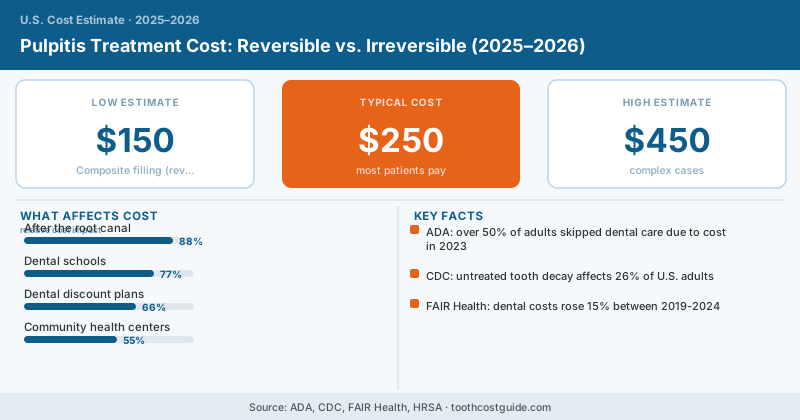
That sharp zing when you sip cold coffee — or the deep, throbbing ache that won’t quit at 2 a.m. — those are your tooth’s pulp screaming for attention. Pulpitis is the inflammation of the soft tissue inside your tooth, and it’s one of the most common reasons people end up in the dental chair unexpectedly.
Here’s the thing: not all pulpitis is created equal. The treatment your dentist recommends — and the bill you’ll face — depends entirely on whether your pulp can recover or not.
What Is Pulpitis?
Your tooth’s pulp is the living core: nerves, blood vessels, and connective tissue housed in the chamber beneath your enamel and dentin. When bacteria from a cavity, a crack, or trauma irritate that pulp, it becomes inflamed. That’s pulpitis.
There are two types:
- Reversible pulpitis — The pulp is irritated but still healthy enough to recover. Fix the underlying cause (usually a cavity), and the pain goes away.
- Irreversible pulpitis — The inflammation is too severe. The pulp can’t heal on its own, and without treatment, the nerve will die and infection can spread.
What Does Pulpitis Treatment Cost?
| Treatment Type | Low | Typical | High |
|---|---|---|---|
| Composite filling (reversible) | $150 | $250 | $450 |
| Amalgam filling (reversible) | $100 | $175 | $300 |
| Pulp capping (borderline cases) | $200 | $350 | $600 |
| Root canal – front tooth | $700 | $900 | $1,200 |
| Root canal – molar | $900 | $1,200 | $1,800 |
| Crown after root canal | $1,000 | $1,400 | $2,000 |
Total out-of-pocket for irreversible pulpitis: $1,500–$3,500+ when you factor in the root canal, buildup, and crown together.
Reversible Pulpitis: What You’ll Pay
If your dentist catches the problem early — say, a cavity that hasn’t yet reached deep into the pulp — you’re looking at a standard filling. Composite (tooth-colored) fillings run $150–$450 depending on the number of surfaces involved. Amalgam costs less, typically $100–$300.
Some cases fall in a gray zone. A direct pulp cap — where the dentist places a protective material directly on an exposed pulp — can cost $200–$600 and may save you from needing a root canal. It works best in younger patients with healthy pulps and no signs of infection.
Your dentist will test the tooth with cold, heat, and percussion. Reversible pulpitis hurts with cold but the pain stops quickly. Irreversible pulpitis lingers — that aching after the stimulus is removed is the telltale sign. They’ll also take an X-ray to look for bone changes around the root tip.
Irreversible Pulpitis: The Root Canal Route
Once the pulp is beyond saving, you need either a root canal or an extraction. Root canal therapy removes the inflamed or dead pulp, cleans and shapes the canals, and seals the tooth. According to the American Dental Association, root canal treatment has a success rate above 95% and typically allows the tooth to last for decades.
The cost depends on which tooth is involved:
- Front teeth (incisors/canines): $700–$1,200, typically done by a general dentist
- Premolars: $800–$1,400
- Molars: $900–$1,800, often referred to an endodontist (specialist)
Endodontists charge 20–30% more than general dentists, but they have specialized training and equipment — microscopes, rotary instrumentation — that can make the procedure faster and more predictable.
After the root canal, your tooth needs protection. A post-and-core buildup ($200–$500) and a crown ($1,000–$2,000) are typically required for molars and premolars, since the tooth becomes more brittle without its nerve. Front teeth sometimes just need a permanent filling or bonding.
What If You Skip Treatment?
Don’t. Untreated irreversible pulpitis progresses to pulp necrosis (the nerve dies), then periapical abscess (infection at the root tip), and potentially a spreading dental infection that can require emergency hospitalization. The CDC reports that dental infections cause approximately 800,000 emergency department visits per year in the United States — many preventable with timely care.
Ignoring it also doesn’t get cheaper. An abscess may require antibiotics, drainage, and a more complex root canal or extraction — plus an implant or bridge if you lose the tooth.
Does Insurance Cover Pulpitis Treatment?
Most dental insurance plans cover:
- Fillings: 80% after deductible (basic procedure)
- Root canals: 50–80% after deductible (major procedure)
- Crowns: 50% after deductible, subject to annual maximum
A typical plan with a $1,500 annual max might cover $750–$900 of a molar root canal, leaving you $300–$900 out of pocket. Add the crown co-pay and you could still owe $1,000–$1,500 total.
Watch your annual maximum. If you’ve already used benefits earlier in the year, a root canal + crown could blow past your remaining coverage. Ask your dentist’s office to run a pre-authorization estimate before you schedule treatment.
Ways to Lower Your Costs
Dental schools: Endodontic residents perform root canals under faculty supervision at 40–60% less than private practice rates. Wait times may be longer, but quality is closely supervised.
Dental discount plans: Membership plans ($100–$200/year) offer 15–30% off listed fees at participating dentists — useful if you’re uninsured or if your plan has a low annual maximum.
Community health centers: Federally Qualified Health Centers (FQHCs) offer sliding-scale fees based on income. Search HHS.gov’s finder tool for locations near you.
Act early: A cavity treated with a filling today costs $200. The same tooth with irreversible pulpitis costs $2,500+. The ADA’s 2023 Health Policy Institute data shows that adults who visit the dentist regularly spend significantly less on restorative care over time.
Quick Answers
Can pulpitis go away on its own? Reversible pulpitis sometimes resolves when the irritant is removed. Irreversible pulpitis does not — the pulp will die without treatment, and infection follows.
How long can I wait? For irreversible pulpitis, the discomfort may actually diminish as the nerve dies. That’s not a good sign — it means the tooth is getting worse, not better. Don’t mistake the quiet for recovery.
Is a root canal painful? With modern anesthetics, most patients report little to no pain during the procedure. Post-procedure soreness for 2–3 days is normal and manageable with over-the-counter pain relievers.
What’s the cheapest fix for irreversible pulpitis? Extraction ($150–$400 for a simple pull) costs less upfront, but replacing the tooth with an implant ($3,000–$5,000) or bridge ($2,500–$6,000) usually makes saving it the smarter long-term investment.
Bottom Line
Pulpitis treatment costs range from a $150 filling to $3,500 or more for a root canal, buildup, and crown. The earlier you catch it, the cheaper the fix. If you’re having tooth sensitivity — especially pain that lingers after a cold stimulus — don’t wait. That window where a filling can solve the problem closes faster than most people realize.
Frequently Asked Questions
Reversible pulpitis treatment typically costs $150–$400 and usually involves fluoride application or a filling, while irreversible pulpitis requiring a root canal runs $1,000–$1,800 depending on tooth location and complexity. Emergency visits or after-hours treatment may add $100–$300 to these base costs.
Most dental insurance plans cover 80% of endodontic treatment (root canals) for irreversible pulpitis after you meet your deductible, leaving you with 20% coinsurance typically ranging from $200–$360. Preventive or reversible pulpitis treatment is often covered at 100%, but you should verify your specific plan's endodontic coverage limits and annual maximums, which often cap at $1,000–$1,500 per year.
Yes — reversible pulpitis can be managed with a simple filling, fluoride treatment, or crown replacement, which costs $150–$400 and takes one to two visits. However, if the inflammation progresses to irreversible pulpitis (indicated by persistent pain that doesn't respond to these treatments within 1–2 weeks), a root canal becomes necessary and costs significantly more.