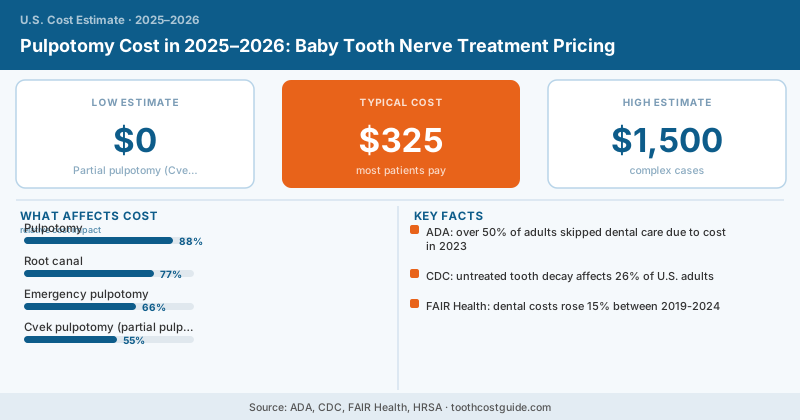
“Your child needs a pulpotomy on the baby molar.” Most parents hear this and immediately think “root canal” — and quietly panic. The terms sound similar, the anatomy is similar, but pulpotomies are faster, simpler, and significantly cheaper. Here’s what they cost and when you actually need one.
Pulpotomy Cost
| Patient and Situation | Typical Cost |
|---|---|
| Pediatric pulpotomy (primary/baby tooth) | $100–$500 |
| Pediatric pulpotomy + stainless steel crown | $300–$800 total |
| Adult pulpotomy (emergency, permanent tooth) | $200–$700 |
| Partial pulpotomy (Cvek pulpotomy, trauma) | $150–$500 |
| Full root canal (for comparison) | $700–$1,500 |
| With dental insurance (pediatric) | $0–$200 out of pocket |
| Without dental insurance | Full fee applies |
The most common scenario is a baby tooth with decay that’s reached the pulp (nerve). A pulpotomy removes the infected portion of the pulp in the crown of the tooth, leaves the healthy root pulp intact, seals the space with a medicated material, and protects the tooth with a stainless steel crown. Total procedure and crown combined: $300–$800 depending on your area.
Pulpotomy vs. Root Canal — The Key Difference
Both procedures deal with infected or damaged pulp tissue. The difference is how much pulp is removed.
Pulpotomy — Only the coronal pulp (the pulp in the crown of the tooth above the roots) is removed. Root pulp remains intact. Faster and simpler. Works when infection is limited to the crown portion.
Root canal — All pulp tissue is removed from both the crown and roots. The root canals are shaped and filled with gutta-percha. More complex, more expensive. Required when infection has spread into the root canals.
For baby teeth, pulpotomies work well because the roots are shorter and the tooth will eventually fall out anyway. The goal is to keep the baby tooth functional until the permanent tooth is ready to erupt — removing it early can cause spacing and alignment problems.
Parents sometimes ask: “Why spend money on a baby tooth that’s going to fall out anyway?” The answer is timing. The AAPD (American Academy of Pediatric Dentistry) notes that primary molars typically remain until ages 10–13. Losing them early can cause:
- Neighboring teeth to shift and block the permanent tooth’s eruption path
- Need for space maintainers ($300–$600)
- Orthodontic problems requiring treatment later
- Difficulty chewing, which can affect nutrition and speech development
In most cases, treating the baby tooth costs far less than correcting the downstream orthodontic problems caused by early loss.
When a Pulpotomy Is the Right Call
Your dentist recommends a pulpotomy when:
- Decay has reached or is very close to the pulp
- The tooth has been traumatically exposed (a chip or crack that exposes the pulp)
- The child has tooth pain especially to hot/cold or spontaneous pain
- X-ray shows pulp involvement without evidence of abscess or bone loss around the roots
If infection has spread beyond the coronal pulp into the roots — or if there’s a visible abscess, significant bone loss around the root tips, or internal/external root resorption — a pulpotomy isn’t appropriate. That tooth either needs a full pulpectomy (root canal on a baby tooth, $200–$700) or extraction ($100–$300).
The Stainless Steel Crown That Usually Follows
A pulpotomy on a baby tooth is almost always followed immediately by a stainless steel crown (SSC). After removing the coronal pulp, the remaining tooth structure is weak and prone to fracture. The SSC protects it.
This is often where the sticker shock comes from. Quotes for the “pulpotomy and crown” together run $300–$800. The crown alone adds $200–$400 to the pulpotomy cost. Stainless steel crowns are prefabricated, snapped into place, and cemented — much faster than lab-fabricated adult crowns.
Some parents ask about tooth-colored crowns for baby molars (zirconia pediatric crowns). They’re available and aesthetically superior to stainless steel, but cost $200–$400 more per tooth and aren’t covered by most plans.
What About Permanent Teeth?
Pulpotomies aren’t just for baby teeth. Two situations call for pulpotomies on permanent teeth:
Emergency pulpotomy — When a patient presents with severe tooth pain and an inflamed pulp, an emergency pulpotomy removes the coronal pulp to provide immediate pain relief. It’s a stopgap while the patient arranges a full root canal. Cost: $200–$400. Usually credited toward the full root canal fee.
Cvek pulpotomy (partial pulpotomy) — Used when a permanent tooth has been traumatically exposed but the pulp is otherwise healthy. A small amount of pulp tissue is removed from the exposure site, a calcium hydroxide or MTA (mineral trioxide aggregate) dressing is placed, and the tooth is sealed and monitored. Cost: $150–$500. This technique allows the tooth to potentially keep a vital pulp long-term.
An emergency pulpotomy is not a substitute for a root canal on a permanent tooth. It provides pain relief but doesn’t remove all infected tissue. Most dentists will tell you explicitly: “This is a temporary measure — you need to complete the root canal within 2–4 weeks.” Delaying the completion allows remaining pulp to re-infect, potentially leading to abscess and more complex treatment.
Does Insurance Cover Pulpotomies?
Yes — pediatric pulpotomies are well-covered by most dental plans. Baby teeth pulpotomies typically fall under “basic restorative” at 70–80% after deductible, sometimes even higher under pediatric plans.
The accompanying stainless steel crown is usually covered separately as a pediatric restorative crown — often at 80–100% for children under 14.
CHIP (Children’s Health Insurance Program) covers pulpotomies and stainless steel crowns in virtually all states. If your child qualifies for Medicaid, coverage is comprehensive. The ADA reported in 2024 that Medicaid now provides dental coverage for all children nationally as a required benefit under CHIP.
Adults getting emergency pulpotomies: coverage depends on your plan’s restorative category. Some plans cover it as “basic,” others as “major.” If it’s being credited toward a root canal, it may be bundled.
- Baby tooth pulpotomies are typically covered at 70–80% — confirm your plan’s rate
- The stainless steel crown that follows is billed separately (D2930 for primary teeth)
- CHIP/Medicaid covers both procedures at low or no cost for qualifying children
- If your plan has a waiting period, check whether pediatric services are exempt — many plans waive waiting periods for children
- Some plans limit the number of pulpotomies per year — verify before scheduling if your child needs multiple
Finding Lower-Cost Options
Dental schools with pediatric departments — Programs that train pediatric dental residents offer pulpotomies and stainless steel crowns at 40–60% of private practice rates. The procedures are supervised by licensed pediatric dentists. Quality is excellent and wait times are manageable in most programs.
Community health centers — Federally Qualified Health Centers offer sliding-scale pediatric dentistry based on income. For families without insurance, this is often the most accessible path.
Dental discount plans — If you don’t have insurance, a dental discount plan ($8–$20/month) provides negotiated rates at member dentists, typically 20–40% off procedures including pediatric pulpotomies.
Bottom Line
A pulpotomy costs $100–$500 for a baby tooth, typically $300–$800 including the stainless steel crown that follows. It’s not a root canal — it’s faster, simpler, and designed to preserve a tooth for its remaining functional lifespan. Insurance covers it well for children. And the cost of not treating it — early tooth loss, space problems, future orthodontic expense — almost always exceeds what the pulpotomy would have cost.
Frequently Asked Questions
A pulpotomy on a baby tooth typically costs $100–$500, depending on the tooth location, dentist experience, and whether sedation is needed. Permanent tooth pulpotomies are more expensive, ranging from $200–$700, since they require more complex treatment to preserve the tooth long-term.
Most dental insurance plans cover pulpotomies as a basic or major restorative procedure, typically paying 50–80% of the cost after your deductible is met. Out-of-pocket costs usually fall between $50–$250 for a baby tooth pulpotomy, depending on your plan's coverage level and annual maximum.
No—a pulpotomy removes only the coronal pulp (nerve tissue in the crown) and is used primarily on baby teeth, while a root canal removes the entire pulp system and is standard for permanent teeth. Recovery from a pulpotomy is quick with minimal discomfort; your child can eat soft foods within a few hours and return to normal activities the next day.