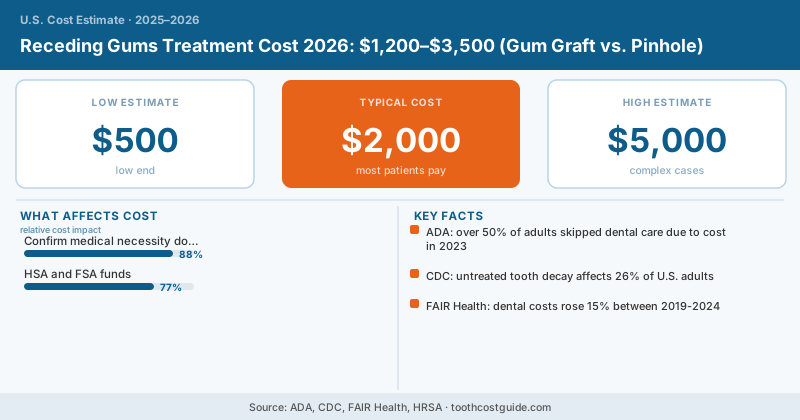
The CDC’s periodontal disease data tells a stark story: nearly half of American adults over 30 have some form of periodontal disease, and gum recession is among the most common consequences. That means millions of people are walking around with exposed roots — sensitive to cold, vulnerable to decay — and many don’t realize surgical options exist until the recession is severe.
Here’s what treating it actually costs in 2026, and which procedure makes sense for your situation.
What Causes Gum Recession
Recession happens when gum tissue pulls away from the tooth, exposing the root below the enamel line. Causes include aggressive brushing, periodontal disease, thin gum tissue genetics, teeth grinding, orthodontic movement, and trauma. It doesn’t reverse on its own. Once the tissue is gone, it needs to be surgically replaced — or the root stays exposed.
If your recession is caused by periodontal disease, your periodontist will require a deep cleaning (scaling and root planing) before performing any graft. SRP costs $150–$350 per quadrant, typically $600–$1,400 total. You can’t graft over an infected site — the graft won’t attach. Budget for SRP as a prerequisite.
Treatment Options and Costs
Connective Tissue Graft (CTG)
The most common gum grafting procedure. The periodontist takes a thin layer of tissue from under the palate (roof of your mouth), then stitches it over the exposed root. It heals well, blends naturally, and is the gold standard for recession coverage.
- Cost per tooth: $600–$1,200
- Per quadrant (3–4 adjacent teeth): $1,500–$2,800
- Recovery: 1–2 weeks of dietary restriction; palate is tender for 7–10 days
- Coverage rate: 80–95% root coverage when done by an experienced periodontist
Free Gingival Graft (FGG)
Instead of tunneling under the palate, the surgeon removes a full-thickness strip directly from the palate surface. This procedure is better for adding keratinized (toughened) tissue rather than covering root surfaces — used when recession is severe or the gum tissue is too thin to hold a crown margin.
- Cost per tooth: $500–$1,000
- Better for: Adding tissue thickness at molars; patients prone to recession near dentures or implants
- Looks: Less cosmetically precise than CTG; palate healing is more involved
Pinhole Surgical Technique (PST)
A minimally invasive alternative developed by Dr. John Chao. No donor site needed — the periodontist makes a small pinhole in the gum and uses special instruments to loosen and reposition existing tissue over the exposed roots, then holds it in place with collagen strips.
- Cost per session: $1,500–$3,500 (covers multiple teeth in one visit)
- Best for: Multiple teeth in one arch treated simultaneously
- Advantages: No palate donor wound, faster recovery (1–3 days), less post-op discomfort
- Limitations: Fewer providers are trained; not ideal for severe recession or very thin tissue
| Procedure | Per Tooth | Per Session (Multi-Tooth) | Recovery |
|---|---|---|---|
| Connective tissue graft | $600–$1,200 | $1,500–$2,800/quad | 1–2 weeks |
| Free gingival graft | $500–$1,000 | $1,200–$2,400/quad | 1–2 weeks |
| Pinhole surgical technique | $375–$700 (est.) | $1,500–$3,500/arch | 2–4 days |
| Scaling and root planing (prerequisite) | — | $600–$1,400 total | 2–3 days |
Cost by Number of Teeth
Treating one tooth is straightforward but rarely how recession presents. Most patients have recession across several adjacent teeth, and treating them together in one surgical session is both clinically better and more cost-efficient than multiple separate appointments.
A realistic cost example for moderate recession across the lower front teeth (4 teeth):
- Scaling and root planing (lower arch): $300–$500
- Connective tissue graft (4 teeth, one session): $1,800–$3,200
- Total: $2,100–$3,700
With PPO insurance at 50% coverage after a $100 deductible: $1,000–$1,850 out of pocket. But most plans cap at $1,500–$2,000 annual maximums — meaning you’ll likely need to spread treatment across two plan years to maximize coverage.
Periodontist vs. General Dentist
Most general dentists don’t perform gum grafts. This is periodontist territory. Periodontists charge more than general dentists for the procedures they share, but for grafting, they’re essentially the only option. Budget for specialist pricing.
In high cost-of-living cities (New York, Boston, Los Angeles, Seattle), expect the upper end of every range — sometimes beyond it. In smaller metros and suburban practices, costs trend 20–30% lower.
Avoid “gum regrowth” products marketed online. No topical gel or oil reverses recession. Gum tissue is connective and vascular — it doesn’t regenerate from external application. The only proven treatments are the surgical procedures described here. Waiting while using unproven products lets recession advance.
Reducing Your Out-of-Pocket Costs
Spread treatment across two calendar years. If you need four teeth grafted, consider treating one side in November–December and the other side in January–February. You get two full plan-year maximums applied.
Confirm medical necessity documentation. Your periodontist’s claim needs to include recession measurements in millimeters, X-rays showing bone levels, and documentation of symptoms. Vague submissions get denied. Ask the office to include all clinical notes.
Dental schools with periodontics residencies offer grafting at 40–60% of private practice fees. Residents are supervised by attending periodontists. Treatment takes longer, but outcomes are comparable for routine cases.
HSA and FSA funds cover gum grafts as a qualified medical expense. If you have a high-deductible health plan, max out HSA contributions before scheduling — it’s effectively a 25–35% discount (your marginal tax rate).
Frequently Asked Questions
A connective tissue graft (the most common type) costs $600–$1,200 per tooth at a periodontist. Free gingival grafts run $500–$1,000 per tooth. Pinhole surgical technique costs $1,500–$3,500 for a multi-tooth session and is often cheaper per tooth when treating 4+ teeth simultaneously. Costs are higher at periodontists in major metro areas.
Most PPO dental plans cover gum grafts at 50–80% when medically necessary — meaning recession is causing sensitivity, root exposure, or bone loss, not purely cosmetic. Your dentist or periodontist will need to submit X-rays and documentation of recession depth. Purely cosmetic grafts (minor recession, no symptoms) are typically denied. Out-of-pocket after a 50% plan coverage might be $400–$700 per tooth, depending on your annual maximum.
Untreated recession exposes root surfaces, which have no protective enamel. Exposed roots are vulnerable to decay (root caries), temperature sensitivity, and bacterial attack at the gumline. As recession worsens, bone loss follows — eventually threatening the tooth itself. Early treatment at $600 per tooth is significantly cheaper than tooth replacement at $3,000–$6,000.