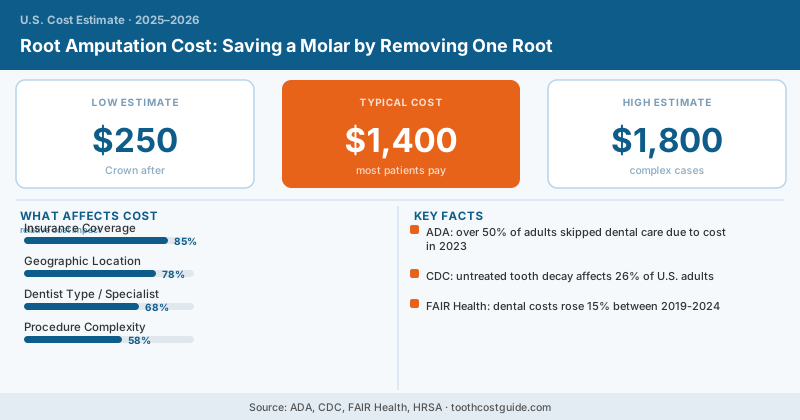
Here’s a question most patients never think to ask: can you save a molar by removing just one of its roots? Yes — it’s called root amputation, and it costs $800–$1,500 without insurance. The surgeon cuts away a single diseased root while leaving the crown and the healthy roots intact.
Molars have multiple roots — usually two or three. When infection or a deep crack destroys one root but spares the others, amputating the bad one can preserve a tooth that would otherwise be lost. It’s a niche procedure, but for the right molar it beats full extraction.
What Root Amputation Costs
| Item | Detail | Cost (No Insurance) |
|---|---|---|
| Root amputation | Remove one root surgically | $800–$1,500 |
| Prior root canal | Usually required first | $1,000–$1,800 |
| Crown after | Stabilize the tooth | $1,000–$1,800 |
| CBCT scan | Map the roots | $250–$600 |
The American Association of Endodontists includes root amputation among the surgical options for retaining natural teeth, alongside apicoectomy and hemisection. The AAE consistently emphasizes that saving a natural tooth, when feasible, supports better long-term function than removal and replacement.
The Full Sequence
Root amputation almost never happens in isolation. First, the tooth usually needs a root canal so the remaining roots are sealed. Then comes the amputation surgery. Finally, a dental crown caps the now-weakened tooth. Each step is a separate fee, so the true cost is the sum, not just the amputation line.
A 3D CBCT scan ($250–$600) shows exactly which root is diseased and whether the others are healthy enough to carry the tooth alone. Without it, the surgeon is guessing. The scan is what determines whether amputation is even viable versus full tooth extraction — so it’s money well spent.
When It’s Worth It
Root amputation makes sense when one root is failing but the tooth is otherwise strategically valuable — say it anchors a dental bridge, or it’s your last molar on that side. If all the roots are compromised, amputation won’t help and extraction is the realistic call.
Root-amputated molars demand excellent oral hygiene. The cut area is harder to clean and can harbor bacteria. If you can’t commit to careful daily care, the saved tooth may fail anyway — and you’ll have paid for surgery that didn’t last. Be honest with yourself about your home care.
Insurance Coverage
Coverage is hit-or-miss because root amputation is uncommon. Some plans fold it under surgical or endodontic benefits at 50% to 80%; others deny it. Pre-authorization is strongly advised. A quick refresher on how dental insurance works helps you confirm the code before committing.
Keeping It Affordable
No coverage? University dental and endodontic programs perform root amputations at reduced rates. A dental savings plan trims 15% to 25% off specialist fees, and financing options spread the multi-step bill over interest-free months.
Bottom Line
Root amputation is a precision rescue: lose one root, keep the tooth. It only works when the remaining roots are solid and your hygiene is dependable. Done right, it can save a molar for a fraction of what full removal and a dental implant would run — but it’s not a fix for a tooth that’s failing across the board.
Frequently Asked Questions
Root amputation typically costs $800–$1,500 without insurance, depending on the complexity of the case and your geographic location. This procedure is usually less expensive than a full tooth extraction followed by tooth replacement with an implant or bridge, which can exceed $3,000–$6,000 total.
Most dental insurance plans classify root amputation as a surgical procedure and cover 50–80% of the cost after your deductible, though coverage varies by plan. You should contact your insurance provider before the procedure, as some plans may deny coverage if they deem the tooth non-restorable or require pre-authorization from your dentist.
The surgical procedure itself typically takes 30–60 minutes, with most patients able to resume normal activities within 3–5 days. Mild swelling and discomfort are common for the first few days; your dentist will prescribe pain medication and antibiotics to prevent infection during the healing process.