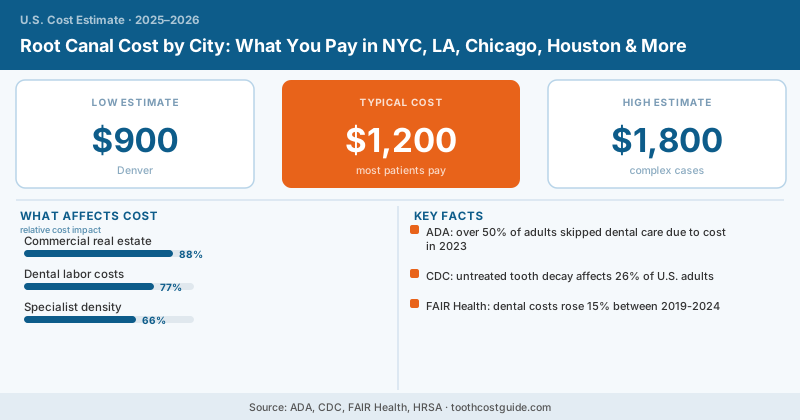
What does a root canal actually cost? That depends almost entirely on where you live. The same molar root canal performed by an equally qualified endodontist runs about $1,000 in Houston and $1,700 in Manhattan. That $700 difference isn’t quality — it’s rent, labor, and the cost of running a dental practice in that particular city.
The national average for a root canal is $700–$900 for front teeth, $800–$1,100 for premolars, and $1,000–$1,800 for molars. But those averages smooth over significant real variation. Here’s a city-by-city breakdown of what you’ll actually pay, why endodontists charge more than general dentists, and where to find lower-cost options in major markets.
Root Canal Cost by City: Comparison Table
| City | Front Tooth (1 canal) | Premolar (1–2 canals) | Molar (3–4 canals) |
|---|---|---|---|
| New York City (Manhattan) | $950–$1,300 | $1,100–$1,500 | $1,400–$1,800+ |
| Los Angeles | $850–$1,200 | $1,000–$1,400 | $1,300–$1,700 |
| San Francisco | $900–$1,250 | $1,050–$1,450 | $1,350–$1,750 |
| Chicago | $750–$1,050 | $900–$1,250 | $1,100–$1,550 |
| Washington DC | $800–$1,150 | $950–$1,300 | $1,200–$1,600 |
| Boston | $800–$1,100 | $950–$1,300 | $1,200–$1,600 |
| Seattle | $750–$1,050 | $900–$1,200 | $1,100–$1,500 |
| Denver | $700–$950 | $800–$1,100 | $1,000–$1,400 |
| Dallas / Fort Worth | $650–$900 | $750–$1,050 | $950–$1,300 |
| Houston | $650–$900 | $750–$1,000 | $950–$1,300 |
| Atlanta | $650–$900 | $750–$1,050 | $1,000–$1,350 |
| Phoenix | $650–$900 | $750–$1,050 | $950–$1,300 |
| Miami | $700–$950 | $800–$1,100 | $1,050–$1,400 |
| Minneapolis | $650–$900 | $750–$1,050 | $950–$1,300 |
| Nashville | $600–$850 | $700–$1,000 | $900–$1,250 |
These are procedure-only fees for the root canal itself, performed by a general dentist or endodontist. They do not include the crown almost always needed afterward ($800–$1,800 extra) or any post/core buildup.
Why the City You Live In Changes Your Root Canal Cost So Much
The American Dental Association’s 2023 Health Policy Institute survey data is clear: dental practice overhead costs track closely with commercial real estate costs and local wage levels. A Manhattan endodontist pays $15,000–$40,000 per month in rent. A Nashville endodontist pays $3,000–$7,000. That difference flows directly to patients.
Commercial real estate is the dominant driver. The correlation between a city’s office rental rates and its dental procedure fees is tight across markets.
Dental labor costs compound it. Dental hygienists and assistants in New York and California earn 25–35% more than their counterparts in Texas or Tennessee, per Bureau of Labor Statistics occupational wage surveys. Those labor costs are a major portion of practice overhead.
Specialist density matters too. Cities with more endodontists have more competition, which moderates fees. Cities with fewer endodontists have less competitive pressure and higher fees — particularly in suburban and rural markets where the nearest specialist is 30+ miles away.
Endodontists are root canal specialists. They do nothing else. They use CBCT 3D imaging to map root anatomy before starting, operate under dental microscopes at 12–25x magnification, and handle complex cases general dentists refer out — calcified canals, curved roots, previously failed root canals.
The premium: $200–$500 more than a general dentist for the same tooth.
When it’s worth it: molar root canals, retreatments of previously treated teeth, calcified roots, or any case your dentist hesitates about. When it may not be: a straightforward front tooth or premolar root canal with simple anatomy.
The Crown Adds to the Total: What You Actually Pay
A root canal without a crown on a back tooth is an incomplete treatment. Root-canal-treated molars and premolars are brittle — high risk of fracture without the crown’s structural support. Most people ultimately pay for both.
Here’s the real total cost by city (root canal + crown, molar case):
| City | Root Canal (molar) | Crown | Total |
|---|---|---|---|
| New York City | $1,400–$1,800 | $1,200–$2,000 | $2,600–$3,800 |
| Los Angeles | $1,300–$1,700 | $1,100–$1,800 | $2,400–$3,500 |
| Chicago | $1,100–$1,550 | $1,000–$1,700 | $2,100–$3,250 |
| Houston | $950–$1,300 | $900–$1,500 | $1,850–$2,800 |
| Miami | $1,050–$1,400 | $1,000–$1,600 | $2,050–$3,000 |
| Nashville | $900–$1,250 | $800–$1,400 | $1,700–$2,650 |
These totals assume private practice, no insurance. With PPO insurance covering root canal at 50–80% and crown at 50%, out-of-pocket can drop to $700–$1,500 for the whole case — if you haven’t already used your annual maximum.
General Dentist vs. Endodontist: City-Specific Impact
In high-density cities (NYC, LA, Chicago, SF), the general dentist vs. endodontist fee gap is larger in absolute terms but smaller as a proportion of total cost, because even general dentist root canal fees in these cities are elevated by overhead.
In lower-cost cities (Nashville, Phoenix, Houston), the gap is narrower in absolute dollars but can represent a bigger proportional jump — an endodontist might charge $1,300 for a molar where a general dentist charges $900, a 44% premium.
The takeaway: wherever you are, a straightforward front-tooth or premolar case is fine with a competent general dentist. A complex molar case is worth the endodontist premium regardless of city.
How to Find Lower-Cost Root Canals in Your City
Dental school endodontic clinics. Every major city has a dental school, and nearly all of them have graduate endodontic programs where supervised residents perform root canals at 40–60% below private practice rates. This is the most reliable cost-reduction strategy in any market.
In NYC: NYU College of Dentistry and Columbia University Dental. In LA: USC Herman Ostrow and UCLA. In Chicago: UIC College of Dentistry. In Houston: UTHealth Houston School of Dentistry.
Expect longer appointment times and a slower overall process, but clinical supervision is rigorous. See our dental school clinics guide for how to navigate these programs.
Ask your general dentist to refer to an endodontist and compare fees. In competitive markets, some endodontists offer package pricing or negotiate for referred patients. It doesn’t hurt to ask.
Timing across insurance plan years. If your case involves root canal in one month and a crown the next, strategic scheduling across a December/January boundary can use two annual insurance cycles — doubling the potential insurance contribution for a single tooth.
Predetermination requests. Before any root canal, have your dentist’s office submit a predetermination to your insurer. They’ll respond in writing with exactly what they’ll cover. Takes 5–10 business days, completely free, prevents billing surprises.
“Can I just pull it?” is a fair question. A simple extraction runs $150–$350 in most markets. But extracting a tooth without replacing it starts a chain: neighboring teeth shift, opposing teeth over-erupt, bite changes over years. Replacing with a dental implant costs $3,000–$6,000. A bridge replacing one tooth runs $2,500–$5,000.
The math: root canal + crown ($1,800–$3,500 nationally) is almost always cheaper than extraction + implant ($3,500–$6,500+). Save the tooth when the structure is intact. Our root canal cost guide covers the extraction comparison in detail.
What Insurance Actually Covers by City
Root canal coverage by a PPO plan doesn’t change based on which city you’re in — the percentage covered is written into your plan regardless of geography. What changes is the dollar amount your insurance pays, because the procedure cost itself varies.
In a high-cost market like NYC: insurance at 80% of a $1,600 molar root canal saves you $1,280. Your out-of-pocket is $320, but only if you haven’t hit your annual maximum yet.
In Houston: insurance at 80% of a $1,100 molar root canal saves you $880. Out-of-pocket: $220.
The catch is identical in both cities: standard annual maxima of $1,000–$2,000 are quickly exhausted when a root canal and crown land in the same benefit year. Check your remaining benefit before scheduling, and plan the split-year approach if you can.
If a provider quotes you a root canal price that seems significantly below the ranges above, ask specifically whether the quote includes post-treatment x-rays and is comprehensive for the specific tooth involved. Some practices quote a low “base” price and charge separately for each x-ray, per canal, or for retreatment if a previous root canal is involved. An honest quote names the tooth, the number of canals expected, and all included services.
Bottom Line
Root canal costs vary by $300–$800 for the same procedure depending on which major US city you’re in — a real difference, even if not as dramatic as the implant price spread. High-cost coastal metros (NYC, LA, San Francisco) consistently run $200–$600 above mid-size inland markets (Houston, Nashville, Phoenix) for comparable procedures. The drivers — commercial real estate and labor costs — are structural and unlikely to change.
The consistent advice for every city: get the root canal (and the crown), use your dental school clinic if cost is a significant concern, and don’t let the expense of an incomplete quote convince you that extraction is cheaper. In the long run, it almost never is.
Frequently Asked Questions
Front teeth root canals typically cost $700–$900 nationally, while premolars range from $800–$1,100, and molars are the most expensive at $1,000–$1,700 depending on your location. Your actual cost will be significantly higher in major cities like Manhattan (often over $1,800 for molars) compared to Houston (around $700 for the same procedure).
Most dental insurance plans cover root canals at 50–80% after you meet your deductible, though some plans classify it as a major procedure with a separate deductible. You should expect to pay 20–50% out-of-pocket after insurance, which typically means $150–$900 depending on your plan and the tooth location.
A typical root canal takes 30 minutes to 2 hours depending on tooth complexity and which endodontist performs it. You should avoid chewing on the treated tooth for at least one week and stick to soft foods; you can usually resume normal eating once your permanent crown is placed, typically 2–4 weeks after the initial treatment.