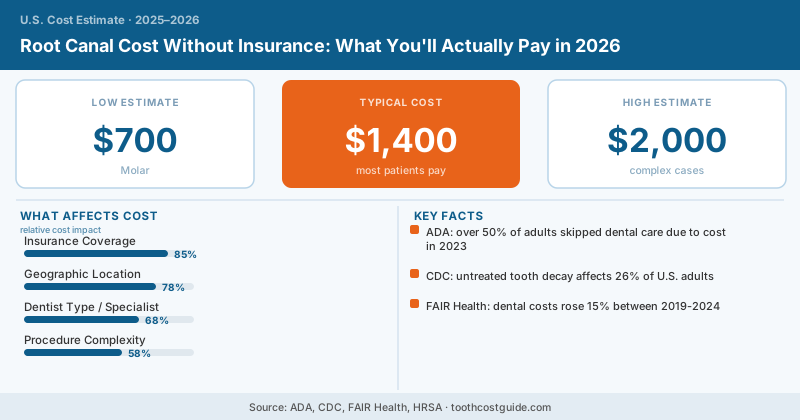
Front tooth or back molar? That single fact swings your root canal bill by more than $1,000. A root canal on an incisor with one straightforward canal might run $700, while the same procedure on a lower molar with four twisting canals can hit $1,800 before you’ve even scheduled the crown.
Without insurance, that spread matters enormously — and there are real, legitimate ways to close the gap that most patients never ask about.
| Tooth Type | Root Canal Cost (No Insurance) | Crown (Usually Needed After) |
|---|---|---|
| Front tooth (incisor) | $700–$1,100 | $800–$1,800 |
| Premolar | $800–$1,400 | $900–$2,000 |
| Molar | $1,000–$1,800 | $1,000–$2,500 |
| Retreatment (redo of failed root canal) | $1,000–$2,000 | Same as above |
Why Molars Cost So Much More
A front tooth typically has a single, relatively straight root canal. A molar usually has three or four canals, often curved and branching in ways that require significantly more time under the microscope to clean, shape, and fill completely. The American Association of Endodontists notes that molar root canals frequently take 60-90 minutes of chair time versus 30-45 minutes for a front tooth — and time is the primary cost driver in any dental fee.
Some general dentists refer complex molar cases to an endodontist (root canal specialist), which tends to cost somewhat more per procedure but comes with higher success rates for difficult anatomy — a trade worth considering for a tooth you want to keep long-term.
The Crown You’ll Probably Need
Here’s the cost most people don’t budget for upfront: after a root canal, the tooth is hollowed out and structurally weaker, especially on back teeth that absorb heavy chewing forces. Most dentists recommend a crown to protect against fracture, and skipping it is a common reason root canal-treated teeth eventually need extraction anyway — an expensive way to lose the tooth you just paid to save.
Front teeth sometimes get away with a large filling instead of a full crown if enough natural structure remains, but molars almost always need the crown.
Dental schools perform root canals at 40-60% below private practice rates, taught by students under close faculty supervision — a realistic option if your case isn’t a same-day emergency. Endodontist-only practices sometimes offer package pricing that bundles the root canal and a temporary filling, which can be cheaper than paying a general dentist for the procedure and a separate lab fee.
Payment Options Without Insurance
In-house payment plans: Most dental offices will split a root canal plus crown into 3-6 monthly payments interest-free, directly through the practice — always ask before assuming you need outside financing.
CareCredit and similar medical credit cards: Offer 6-24 month 0% promotional periods, but read the fine print on deferred interest — missing the payoff deadline can trigger retroactive interest on the entire original balance.
Dental discount plans: Membership plans (typically $100-200/year) that offer 15-50% off negotiated fees at participating dentists, with no annual maximum and no waiting period — useful specifically because they apply immediately, unlike insurance.
When Extraction Might Actually Make More Sense
If the tooth has extensive decay below the gumline, a vertical root fracture, or severe bone loss around it, a root canal may have a poor long-term prognosis regardless of cost. In these cases, extraction followed by an implant, bridge, or partial denture might be the more sensible investment — ask your dentist directly for their honest prognosis on saving versus replacing the tooth before committing to either path.
Don’t delay a root canal once it’s recommended, hoping the pain will subside on its own. An infected tooth left untreated can develop into an abscess that requires emergency drainage, and the infection can spread beyond the tooth into surrounding bone and tissue — turning a $700-$1,800 planned procedure into a much larger, more urgent bill.
The Bottom Line
Without insurance, a root canal runs $700-$1,800 depending on the tooth, and the crown that typically follows adds $800-$2,500 more. Dental schools, endodontist package pricing, and discount plans are the most reliable ways to bring that number down. Compare it honestly against extraction plus replacement — in almost every case, saving the natural tooth remains the better value over time.
Frequently Asked Questions
Without insurance, a root canal costs $700-$1,800 depending on which tooth is treated — front teeth are cheapest since they have a single canal, while molars cost the most because they typically have three or four canals to clean and fill.
Yes, in most cases — especially for back teeth that bear heavy chewing force. A crown adds $1,000-$2,500 on top of the root canal fee, since the tooth is now hollowed out and more prone to fracture without a protective cap.
Extraction alone costs less upfront ($150-$450 versus $700-$1,800 for a root canal), but you'll then need a replacement tooth — an implant or bridge — which costs $2,000-$6,000. Over time, saving the natural tooth with a root canal is almost always the more cost-effective choice.