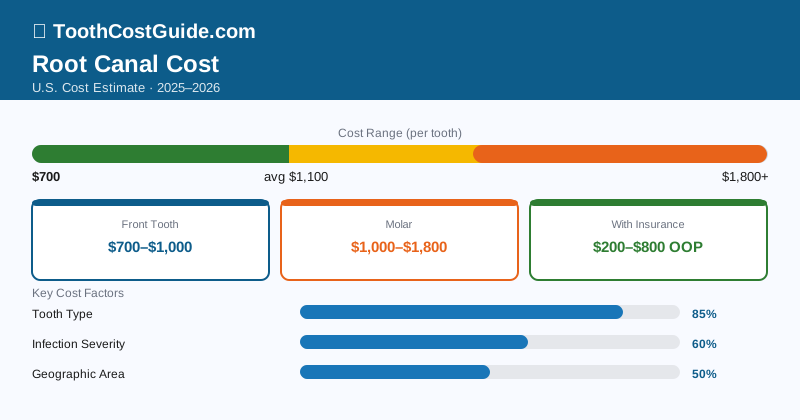
Root canals have a reputation problem they don’t deserve. The American Association of Endodontists surveys patients who’ve had one, and consistently, more people describe the procedure as painless than say it hurt — because the root canal removes the infection that’s causing pain, rather than creating it. What root canals do have is a cost problem: $700–$1,800 for the procedure itself, and most treated teeth need a crown afterward, adding another $800–$1,800.
Let’s break down exactly where that number comes from — and where you can cut it.
Estimates based on 2026 national averages adjusted for your state. Actual costs vary by provider, complexity, and plan details. Get a written treatment estimate before proceeding.
Cost by Tooth Type
The number of root canals inside a tooth determines almost everything about cost and complexity. A front tooth has one. A molar can have four.
| Tooth | Canals | Root Canal Cost (No Insurance) |
|---|---|---|
| Front teeth — incisors, canines | 1–2 | $700–$1,000 |
| Premolars (bicuspids) | 1–2 | $800–$1,100 |
| Molars — back teeth | 3–4 | $1,000–$1,800 |
| Retreatment (failed previous RCT) | varies | $900–$1,800 |
| Apicoectomy (root tip surgery) | n/a | $900–$1,800 |
| Post and core buildup after RCT | — | $150–$400 |
| Crown (almost always required on molars) | — | $800–$1,800 |
Why molars cost nearly twice as much as front teeth: Each canal requires individual cleaning, shaping, and filling. A lower first molar with four canals takes 60–90 minutes of meticulous work under a dental microscope. An upper incisor with one canal takes 30–45 minutes. More canals, more time, higher fee — straightforward.
General Dentist vs. Endodontist: Which Should You See?
This decision affects both cost and outcome.
General dentists can perform root canals on many teeth — particularly straightforward single-rooted front teeth and uncomplicated premolars. They typically charge 20–40% less than an endodontist for the same tooth. If your dentist does root canals regularly and is confident handling your specific case, there’s nothing wrong with proceeding.
Endodontists are specialists who do root canals exclusively. They typically use CBCT 3D imaging to map root canal anatomy before starting, operate under dental microscopes with 12–25x magnification, and see complex cases that general dentists refer out. For calcified canals, curved roots, previously treated teeth, or multi-rooted molars, the specialist’s precision is worth the premium.
A reasonable guideline: routine front tooth or premolar RCT → your general dentist is fine. Molar RCT, retreatment, or any case your dentist hesitates about → endodontist. The extra $200–$400 is cheap insurance for a procedure where a missed canal means the tooth fails.
If a root canal fails — due to a missed canal, persistent bacteria, or new decay — the tooth requires retreatment: the endodontist removes all the existing filling material and redoes the procedure. Retreatment costs $900–$1,800 and isn’t always successful. Getting it right the first time is worth the specialist fee on complex cases.
The Real Total Cost: Root Canal + Crown
The root canal fee is almost never your final bill for the tooth. Here’s a realistic complete picture for a molar:
| Component | Typical Cost |
|---|---|
| Endodontist fee (molar, 3–4 canals) | $1,200–$1,800 |
| Post (if needed) | $100–$300 |
| Core buildup | $150–$300 |
| Zirconia crown | $1,000–$1,800 |
| Total | $2,450–$4,200 |
With decent dental insurance covering 50–80% of each component, your out-of-pocket portion might land at $900–$1,800 — but that assumes you haven’t already burned through your annual maximum. Many patients discover mid-treatment that their $1,500 annual cap is nearly exhausted.
Before starting, ask your dentist or endodontist: “Can you give me the complete treatment plan cost — including the post, buildup, and crown — not just today’s procedure?”
With Dental Insurance
Root canals fall into either “basic” or “major” coverage depending on your plan — this matters because basic services are typically covered at 80%, major at 50%.
Typical scenario: $1,400 molar root canal (endodontist), plan covers “basic” at 80% after $50 deductible.
- Deductible: $50
- Insurance pays 80% of remaining $1,350 = $1,080
- Patient pays: $50 + $270 = $320
That’s a good outcome — but it assumes the plan classifies RCT as “basic” (some plans put it under “major” at 50%). Always check your Summary of Benefits or call your insurance before treatment.
Important: submit a predetermination request before treatment. Your dentist sends x-rays and treatment codes to your insurer, who responds with a written estimate of exactly what they’ll cover. Takes 5–10 business days, prevents billing surprises, and is completely free to request.
Ways to Save
Dental school endodontic clinics — Graduate endodontic programs at dental schools perform root canals at 40–65% off private practice rates, supervised by faculty. A molar root canal that costs $1,400 at a private endodontist might run $500–$700 at a dental school. The tradeoff: multiple longer appointments, a waiting list, and a less convenient experience. Search “[your city] dental school endodontics” to find programs.
General dentist for appropriate cases — If your case is straightforward, your general dentist’s lower fee is real savings with no meaningful quality compromise.
Timing across insurance years — Root canal in December, crown in January means two calendar years of insurance coverage. If your annual max is $1,500, this effectively doubles what insurance pays for the combination.
FSA/HSA funds — Root canals and crowns are fully qualified medical expenses. Using pre-tax dollars provides a 22–37% effective discount based on your marginal tax rate.
Don’t skip the crown — This sounds counterintuitive, but patients who complete the root canal and then skip the crown to save money often lose the tooth anyway. A root-canal-treated tooth without a crown is brittle and at high risk of fracture, which usually means extraction. The crown is the investment that makes the root canal worthwhile.
The Extraction Alternative
People sometimes ask: should I just pull it?
A simple extraction costs $150–$400. But that’s not the end of the story — it’s the beginning of a different, usually more expensive one. The gap left by a missing back tooth causes neighboring teeth to drift and opposing teeth to super-erupt over months and years. Replacing the tooth with an implant runs $3,000–$6,000. A bridge replacing one tooth often runs $2,500–$5,000.
The math usually favors saving the tooth, even at $2,500–$3,600 for root canal plus crown. The exception: if the tooth is already cracked below the gumline or structurally non-restorable, extraction becomes the only option. A good dentist will tell you honestly which situation you’re in.
“Is this tooth worth saving?” It’s a legitimate question. Ask your dentist or endodontist directly: given the current condition of this tooth, what are the realistic odds it lasts another 10+ years with a root canal and crown? If the answer is uncertain, that changes the cost-benefit calculation.
Bottom Line
A root canal costs $700–$1,800 for the procedure itself — with the total tooth-saving bill reaching $2,000–$3,600 when you add a crown and any necessary buildup. With insurance, expect to pay $700–$1,500 total depending on your plan’s coverage limits and annual maximum.
Despite the sticker shock, root canals are almost always cheaper than the long-term consequences of extraction and replacement. The procedure itself is no worse than a long filling appointment — modern anesthesia handles the pain the infected tooth was already causing.
Get a written, itemized treatment plan before starting, and request a predetermination from your insurer. Ask explicitly for the complete cost — root canal, post, buildup, and crown — so you’re not surprised by each piece as it arrives. And if your general dentist seems hesitant about a complex molar case, ask for a referral to an endodontist before starting.
Frequently Asked Questions
A root canal costs $700–$900 for front teeth, $800–$1,000 for bicuspids, and $1,000–$1,500 for molars, per the ADA. These are procedure-only fees — a crown afterward typically adds $1,000–$1,800. Total treatment runs $1,700–$3,300 in most US markets.
Most PPO dental plans cover root canals at 50–80% after the deductible, up to the annual maximum (typically $1,000–$2,000). HMO plans may cover them with a fixed copay. Always confirm your plan's annual maximum before proceeding — a full root canal + crown can exceed most plans' yearly cap.
Modern root canals with local anesthesia are about as uncomfortable as getting a filling. The tooth is numbed before any drilling begins. Post-procedure soreness for 2–3 days is common and manageable with OTC ibuprofen. The pain of an untreated infected pulp is significantly worse.