Marcus had his upper molar treated four years ago. The root canal went smoothly, the crown went on three weeks later, and he forgot about that tooth entirely — which is exactly what’s supposed to happen. Then, six months ago, a dull throb returned. Pressure when chewing. Then a persistent ache. His dentist ordered a new X-ray and delivered the news: the root canal had failed. There was a shadow at the root tip — a periapical lesion forming where bacteria had recolonized the canal system.
His options were retreatment, an apicoectomy, or extraction. And he needed to decide fast, because infections around root tips don’t stand still.
If you’re in a similar situation, here’s what you need to know about cost, candidacy, and whether retreatment is actually worth it.
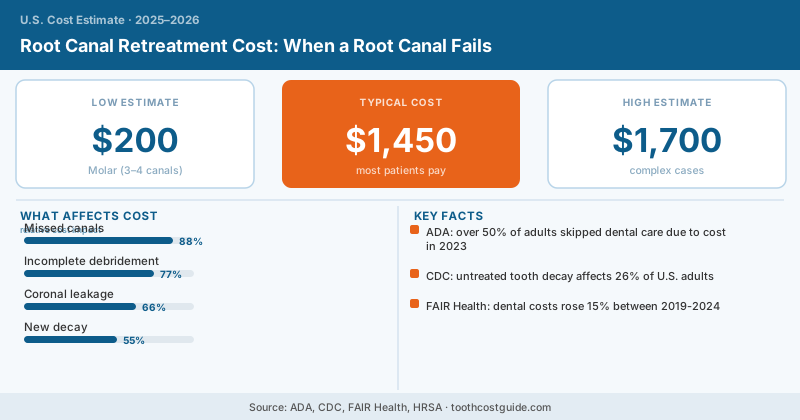
Root Canal Retreatment Cost by Tooth Type
| Tooth Type | Retreatment Cost (No Insurance) |
|---|---|
| Anterior (front teeth, 1–2 canals) | $900–$1,200 |
| Premolar (1–2 canals) | $1,000–$1,400 |
| Molar (3–4 canals) | $1,200–$1,700 |
| Endodontist premium over general dentist | +$200–$400 |
Molars cost more because they have more canals — and retreating a molar means navigating around old gutta-percha filling material in each of those canals. Front teeth are simpler. Expect the high end of any range if you’re seeing a specialist in a major metro area.
Why Root Canals Fail
A root canal isn’t supposed to fail. The goal is to completely clean, shape, and seal the canal system so bacteria can’t survive inside it. But “completely” is difficult in a three-dimensional anatomical structure you can’t see directly. Here’s what actually goes wrong:
Missed canals. Molars frequently have accessory canals, lateral branches, or unusual anatomy that didn’t show up clearly on the original X-ray. A canal that was overlooked stays infected — and eventually that infection spreads to the periapical tissue. Studies cited in JADA systematic reviews of endodontic failures consistently identify missed canals as a leading cause of retreatment need.
Incomplete debridement. Even identified canals can have areas that weren’t fully cleaned during the original procedure — especially in curved or narrow canals where instruments can’t reach every surface.
Coronal leakage. If the final crown or restoration was delayed, cracked, or leaked over time, oral bacteria can reinfect the canal system from the top down. This is one of the most common causes of late failure — the root canal itself was fine, but the seal above it wasn’t.
New decay. Recurrent decay underneath or around the crown can create a new pathway for bacteria to the roots.
Vertical root fracture. A crack extending along the length of the root creates a bacterial highway that can’t be cleaned or sealed. This is usually a death sentence for the tooth — retreatment won’t help, and most cases end in extraction.
Retreatment vs. Apicoectomy vs. Extraction
These three paths have different indications, costs, and success rates. Here’s the honest comparison:
Retreatment (orthograde) means going back through the crown of the tooth — removing old filling material, re-cleaning and re-shaping the canals, then refilling and resealing. It’s the preferred first option when the failure is coronal leakage or a missed canal, because it addresses the root cause.
Apicoectomy is a surgical approach from the outside — the periodontist or endodontist makes an incision in the gum, removes the tip of the root, cleans out the infection, and seals the root end with a small filling. It’s indicated when retreatment through the crown isn’t feasible (e.g., the canal is blocked by a post, or calcification prevents access) or when a persistent infection at the root tip hasn’t resolved despite retreatment.
Extraction and implant is sometimes the smartest option — not a last resort. According to the American Association of Endodontists, implant survival rates consistently exceed 95% at 10 years. For a tooth with a vertical fracture or severe supporting bone loss, skipping the retreatment gamble and going straight to implant often makes more financial and clinical sense.
Request a cone-beam CT (CBCT) scan before committing to retreatment. Standard X-rays show the tooth in two dimensions — CBCT shows it in three, revealing missed canals, root fractures, and the exact extent of periapical infection. Many endodontists offer CBCT for $150–$300 and it dramatically improves prognosis accuracy. Don’t commit to retreatment based on a 2D film alone.
What Retreatment Actually Involves
It’s more complex than the original root canal, and the appointment is usually longer.
First, the dentist or endodontist removes the existing crown or accesses the tooth through it (if the crown can be preserved). Then they remove the old gutta-percha filling material using a combination of solvents, heat, and specialized rotary instruments designed to unwind or dissolve the original fill. Depending on the filling technique used originally, this can take 30–60 minutes before the actual re-treatment even begins.
Once the canals are cleared, the tooth is re-examined — ideally with magnification (microscopes or loupes) and CBCT guidance — to identify any missed anatomy. Canals are re-cleaned, reshaped, and irrigated with antimicrobial solutions. Then they’re resealed, usually with a fresh placement of gutta-percha and sealer.
Total appointment time: 90–180 minutes. Most patients need local anesthesia only. Post-op soreness is common for 2–5 days; prescription anti-inflammatories or antibiotics may be prescribed if infection is present.
After retreatment, a new crown is typically required — budget another $1,000–$1,800. Always factor this into the total cost calculation when comparing retreatment vs. extraction.
General Dentist vs. Endodontist for Retreatment
Not all general dentists should be performing retreatment, and most will tell you so honestly. Endodontists — dentists who completed an additional 2–3 years of postgraduate training specifically in root canal treatment — have surgical microscopes, CBCT imaging, and the rotary instrumentation specifically designed for retreatment cases.
The AAE reports that endodontists perform an average of 25 root canal procedures per week, compared to approximately 2 per week for general dentists. For a retreatment case — which is harder than the original — that experience gap matters. Expect to pay $200–$400 more to see an endodontist. It’s usually worth it.
Insurance Coverage for Retreatment
Most dental insurance plans classify retreatment the same way as the original root canal: major restorative service, covered at 50% after the annual deductible. But watch for these common coverage traps:
Same-tooth frequency limitations. Many plans won’t cover retreatment on the same tooth if the original root canal was covered within the past 2–5 years (the specific window varies by plan). This means even if the retreatment is medically necessary, you might be paying 100% out of pocket.
Missing tooth clause. Doesn’t apply here (the tooth is still present), but worth knowing if you’re evaluating extraction + implant.
Waiting periods. If you’re newly enrolled in a plan, most impose a 6–12 month waiting period before major services are covered.
Call your insurer before your appointment. Ask specifically about retreatment coverage, your remaining annual maximum, and any same-tooth limitations.
Don’t delay retreatment hoping the infection will resolve on its own. Periapical infections can spread to adjacent teeth, the jaw bone, and — in rare but serious cases — beyond. An untreated abscess from a failed root canal has caused hospitalizations and, in extreme cases, life-threatening complications. If your dentist recommends retreatment, act on it within weeks, not months.
Frequently Asked Questions
Yes — but the success rate is lower than for the original procedure. The American Association of Endodontists reports retreatment success rates of 75–85%, compared to 90–95% for initial root canals. The gap exists because retreatment involves working around existing filling material, and the reasons for failure — missed canals, calcification, fractures — aren't always fully correctable. An endodontist can review your X-rays and give you a realistic prognosis before you commit.
Extraction makes more sense when the tooth has a vertical root fracture (these almost never heal), when bone loss around the root is severe and irreversible, or when the cost of retreatment plus a new crown would exceed the cost of extraction and implant replacement. Extraction followed by an implant ($3,000–$5,000 total) has a 95%+ long-term success rate — sometimes that's the cleaner path forward.
Most dental insurance plans cover retreatment at the same rate as the original root canal — typically 50% after the deductible, classified as a major service. However, many plans include a frequency limitation: if the original root canal was covered within the last 2–5 years, they may deny retreatment on the same tooth. Check your plan's 'same tooth clause' before your appointment.