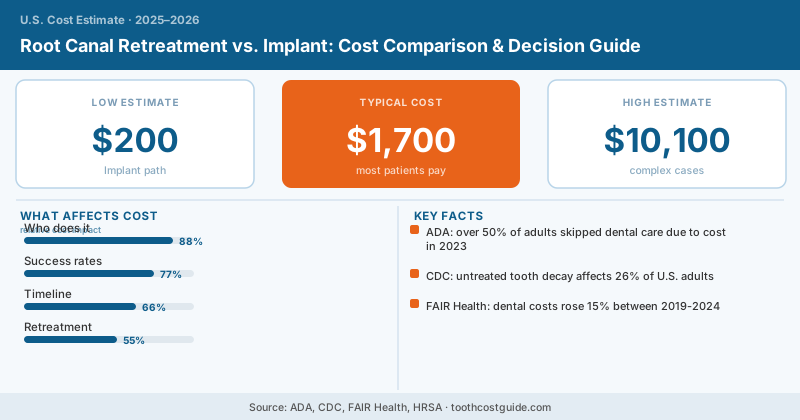
Your root canal from five years ago is failing. The pain is back, the X-ray shows a dark shadow at the root tip, and your dentist is presenting you with two options: redo the root canal, or pull the tooth and replace it with an implant. The cost difference is significant. So is the right answer — and it’s not the same for everyone.
Here’s how to think through both options with real numbers.
Cost Comparison: Side by Side
| Treatment Path | Component | Typical Cost |
|---|---|---|
| Retreatment path | Root canal retreatment (endodontist) | $900–$1,800 |
| Retreatment path | New crown (if needed) | $1,200–$3,500 |
| Retreatment path | Total | $2,100–$5,300 |
| Implant path | Extraction | $200–$600 |
| Implant path | Bone graft (often needed) | $400–$3,000 |
| Implant path | Implant post | $1,500–$3,500 |
| Implant path | Abutment + crown | $1,000–$3,000 |
| Implant path | Total | $3,100–$10,100 |
In most cases, retreatment costs $1,500–$4,000 less than implant replacement upfront. But upfront cost isn’t the whole story.
What Is Root Canal Retreatment?
When an original root canal fails — meaning bacteria recolonize the canal, a missed canal was never treated, or the seal breaks down — retreatment involves reopening the tooth, removing the old filling material, cleaning the canals again (more thoroughly this time), and resealing everything.
Who does it: Ideally an endodontist (root canal specialist). They use operating microscopes and ultrasonic instruments to find and clean canals that general dentists may miss.
Success rates: The AAE (American Association of Endodontists) reports that retreatment succeeds in roughly 75–85% of cases. A tooth that survives retreatment can last another 5–20 years.
Timeline: One or two appointments, each 60–90 minutes. The existing crown usually needs to be removed and replaced afterward, adding cost.
Retreatment is the better financial and biological choice when: the tooth has solid bone support, the crown is intact and relatively new, the patient can’t afford the implant path right now, or the tooth is a strategic anchor for a bridge or partial denture. Keeping a natural tooth — even a retreated one — is almost always preferable to an artificial replacement from a biomechanical standpoint.
What the Implant Path Involves
Extraction removes the failed tooth. If bone loss has occurred around the root (common with long-term endodontic failure), a bone graft is needed before an implant can be placed — adding 3–6 months of healing and $400–$3,000 in cost.
The implant post is placed surgically and requires 3–6 months to osseointegrate (fuse with bone). Then the abutment and final crown are attached. Total timeline: 9–18 months from extraction to final restoration.
Success rates: Dental implants have long-term success rates of 95%+ over 10 years when placed in healthy bone by an experienced surgeon. They don’t get cavities and don’t need root canals.
But: Implants cost more, take longer, involve surgery, and require adequate bone volume. They’re a permanent prosthetic, not a biological tooth.
The Hidden Variable: What Does “Failure” Actually Mean?
The decision hinges on why the root canal failed. If:
- Missed canal: Retreatment by an endodontist with a microscope is highly likely to succeed
- Cracked root: Retreatment won’t work — extraction and implant is the correct path
- Reinfection from a broken seal: Retreatment success depends on how much bone loss occurred
- Vertical root fracture: Can’t be retreated; extraction is necessary
Your endodontist should tell you the likely cause based on clinical exam, X-rays, and CBCT imaging. If the tooth has a crack extending down the root, retreatment is money wasted.
When to Choose Retreatment
- The tooth structure is intact and there’s no crack
- The existing crown is relatively new and worth preserving
- Budget is a real constraint (retreatment is $1,500–$5,000 less)
- The patient has conditions that increase implant risk (uncontrolled diabetes, blood thinners, previous radiation to jaw)
- Retreatment prognosis is good based on endodontist’s assessment
When to Choose Extraction and Implant
- The root is cracked or the tooth is non-restorable
- Retreatment has already been done once and failed again
- Severe bone loss around the root makes long-term prognosis poor
- The patient is a good implant candidate and has the budget
- The existing crown is old and will need replacement anyway
Don’t let cost alone drive the decision toward retreatment when the tooth has a poor prognosis. Spending $2,000–$3,000 on a retreatment that fails in 2 years, then paying $5,000 for an implant anyway, costs more total than choosing the implant from the start. Get a frank prognosis from an endodontist before deciding — many offer free or low-cost consultations.
Insurance Coverage Differences
Retreatment: Most dental plans that cover root canals will cover retreatment at 50–80% after deductible — though some plans limit retreatment on the same tooth. Check your plan’s “frequency limitations” clause.
Implants: Coverage is improving but still inconsistent. Some plans cover the crown portion; fewer cover the implant post itself. Annual maximums ($1,000–$2,000) often limit how much insurance helps with an implant.
Net cost difference with insurance: Retreatment’s cost advantage over implant narrows somewhat when insurance covers more of the retreatment. But retreatment almost always remains the cheaper out-of-pocket option.
Getting the Best Outcome Either Way
For retreatment: Use an endodontist, not a general dentist. The success rate difference is significant. Endodontists see retreatment cases every day; general dentists rarely do.
For implants: Use a periodontist or oral surgeon with documented implant volume. Request their long-term implant survival data if you’re paying out of pocket.
For both: Get the endodontist’s honest prognosis for the tooth before committing. An endodontist who tells you “this tooth has a poor long-term outlook even with retreatment” is giving you valuable information, even though it costs them the case.
There’s no universal right answer. But with clear information on tooth prognosis, total costs, and your own risk tolerance, the decision becomes much easier to make.
Frequently Asked Questions
Root canal retreatment typically costs $900–$1,800, while a complete dental implant (including crown) ranges from $3,500–$6,000. The implant cost is significantly higher because it involves tooth extraction, implant placement surgery, osseointegration (3–6 months of healing), and a custom crown, whereas retreatment works on your existing tooth structure.
Most dental insurance plans cover root canal retreatment at 50–80% after your deductible, making your out-of-pocket cost $180–$900. Dental implants are rarely covered by standard plans and are often classified as cosmetic or major restorative work, leaving patients responsible for $2,500–$6,000 out-of-pocket; however, some plans cover 50% of the crown portion only.
Root canal retreatment has minimal recovery—you can eat soft foods within a few hours and return to normal eating within 1 week after the crown is placed (usually completed within 2–4 weeks). A dental implant requires 3–6 months of bone healing before the crown is attached, so you cannot use the tooth functionally for half a year, making retreatment the faster option if your existing tooth can be saved.