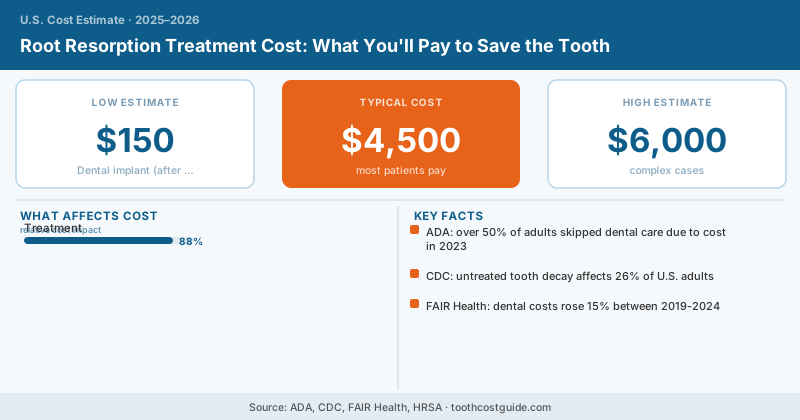
Most patients have never heard of root resorption — until an X-ray shows it. Then you’re sitting in the chair while your dentist explains that your tooth’s root is, essentially, dissolving. It sounds alarming. The treatment costs, and whether the tooth can be saved at all, depend entirely on the type and how far it’s progressed.
Here’s what root resorption treatment actually costs and what your options are.
Root Resorption Treatment Costs
| Treatment | Cost Range |
|---|---|
| Root canal therapy (internal resorption) | $700–$1,800 |
| Surgical repair (external cervical resorption) | $1,200–$3,500 |
| Tooth extraction (severe cases) | $150–$650 |
| Dental implant (after extraction) | $3,000–$6,000 |
| CBCT 3D scan for diagnosis | $150–$650 |
| Specialist consultation (endodontist) | $150–$350 |
Types of Root Resorption (Costs Vary By Type)
Root resorption isn’t one thing — it’s several distinct processes that happen for different reasons and require different treatments.
Internal Root Resorption
Internal resorption starts from inside the tooth. Pulp cells that become activated after trauma or chronic inflammation begin resorbing the inner dentin walls. On X-ray, it appears as a balloon-like widening of the root canal space.
Treatment: Root canal therapy to remove the pulp tissue and stop the resorption process. Cost: $700–$1,800 depending on which tooth and whether you see a general dentist or endodontist (specialist). If the resorption hasn’t perforated the root wall, the prognosis is good.
External Root Resorption (Apical)
External apical resorption — shortening of the root tip — happens most commonly as a side effect of orthodontic treatment. The American Journal of Orthodontics and Dentofacial Orthopedics has documented that significant apical resorption (more than 4mm) occurs in roughly 1–5% of orthodontic patients.
Mild apical resorption is usually monitored rather than treated. The teeth remain functional with shorter roots. Severe cases that compromise stability may eventually require extraction.
Treatment: Monitoring (no additional cost), or extraction plus replacement if severe ($150–$6,000+).
External Cervical Resorption (ECR)
This is the aggressive type. ECR invades the root from the outside near the gumline and can excavate large sections of the root. It’s often caused by a history of dental trauma, bleaching, or orthodontic treatment.
ECR is classified by severity (Heithersay Class 1–4). Early-stage (Class 1–2) can often be treated surgically: a periodontist or oral surgeon lifts the gum tissue, removes the resorbing tissue, and fills the defect with a biocompatible material like MTA or composite.
Treatment: Surgical repair: $1,200–$3,500, depending on defect size and whether a specialist is involved. Advanced Class 3–4 cases typically require extraction.
Standard X-rays often underestimate the extent of root resorption. A cone-beam CT (CBCT) scan ($150–$650) shows the three-dimensional extent of the defect and is often essential for treatment planning, especially for ECR. Many endodontists and oral surgeons require it before surgery. Ask whether the consultation fee includes the scan or whether it’s billed separately.
When the Tooth Can’t Be Saved
Severe root resorption — particularly ECR Class 3 or 4, or internal resorption with root perforation that’s gone untreated — often means extraction is the most practical path. The research on outcomes for advanced ECR is sobering: a study published in the International Endodontic Journal found that Class 4 ECR cases had a significantly lower treatment success rate than earlier stages.
After extraction, your replacement options are:
- Dental implant: $3,000–$6,000 per tooth. Best long-term replacement when adequate bone remains.
- Dental bridge: $2,400–$6,000 for a three-unit bridge.
- Removable partial denture: $1,000–$2,500. Less expensive, but removable.
Specialist vs. General Dentist
Internal resorption cases are often handled by general dentists performing root canals. External cervical resorption cases almost always require an endodontist (root canal specialist) or periodontist for the surgical component.
Endodontist consultation fees: $150–$350 for the first visit, often applicable toward treatment if you proceed. Specialist root canal therapy: $1,200–$2,000, about 25–40% more than a general dentist’s price.
Insurance Coverage
Root canal therapy is typically covered by dental insurance at 50–80% after deductible. Surgical repair for ECR is more variable — it may be covered as a surgical procedure or partially denied. The CBCT scan is often not covered or covered only partially.
Root resorption that’s actively progressing is a time-sensitive problem. The longer external cervical resorption goes untreated, the more root structure is destroyed — and the difference between a Class 2 (treatable) and Class 4 (extract) case is often just a matter of months. If your dentist spots resorption on an X-ray, don’t delay the specialist referral.
What to Ask Your Dentist
- What type of resorption is this, and what class or severity?
- Is the tooth saveable, and what’s the realistic long-term prognosis?
- Do I need a CBCT scan before treatment planning?
- Should I see an endodontist or periodontist for this?
- If we treat it now, what does success look like in 5 years?
Getting clear answers to these questions before committing to expensive treatment — or writing off a saveable tooth — is worth the extra consultation cost.
Frequently Asked Questions
Root resorption treatment typically ranges from $300 to $3,500+, depending on the type and severity of the condition. Conservative treatments like fluoride applications or monitoring may cost $300–$800, while root canal therapy to save the tooth runs $1,200–$2,500, and extraction followed by replacement (implant or bridge) can exceed $3,500.
Most dental insurance plans cover endodontic treatment (root canals) at 50–80% after your deductible, though root resorption is sometimes classified as a pre-existing condition or excluded if it stems from orthodontics. Tooth extraction is typically covered at 80%, but replacement options like implants are often considered cosmetic and covered at 0–50% or not at all.
Early-stage external root resorption may be managed with fluoride gel or close monitoring without invasive treatment, delaying costs for 6–12+ months. However, once internal resorption is detected, a root canal is usually necessary within weeks to stop the process, as waiting increases the risk that the tooth cannot be saved and extraction becomes the only option.