Most people have never heard of a salivary gland stone until they get one. Then they definitely know — because a salivary stone (technically called a sialolith) can cause pain so sharp it stops you mid-meal. The good news: they’re highly treatable. The cost, though, can range from a couple hundred dollars to well over $3,000 depending on size, location, and how you treat it.
Here’s what you’re looking at.
What Is a Salivary Gland Stone?
Your mouth has three pairs of major salivary glands: the parotid (in your cheeks), submandibular (under your jaw), and sublingual (under your tongue). These glands produce saliva that flows through ducts into your mouth.
Sometimes minerals — mainly calcium — accumulate in those ducts and form stones. The submandibular glands are involved in about 80–90% of cases, according to research published in the Journal of the American Dental Association. Parotid stones account for most of the rest.
When a stone partially or fully blocks the duct, saliva backs up. You get:
- Pain and swelling in the affected gland — especially when eating
- A hard lump you can sometimes feel under your jaw or cheek
- Dry mouth on one side
- Difficulty swallowing in severe cases
Untreated blockages can lead to bacterial infection of the gland (sialadenitis) — which escalates treatment complexity and cost significantly.
How Much Does Salivary Gland Stone Treatment Cost?
| Treatment Method | Low | Typical | High |
|---|---|---|---|
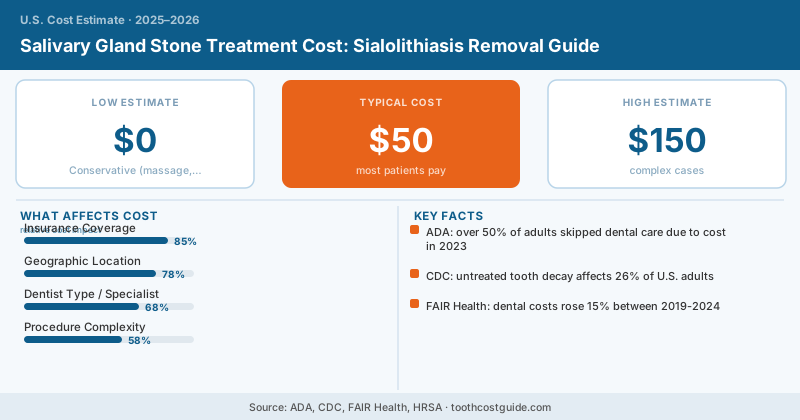
| Conservative (massage, hydration, sialogogues) | $0 | $50 | $150 |
| In-office manual expression/probing | $150 | $300 | $600 |
| Sialendoscopy (minimally invasive endoscopy) | $1,500 | $2,500 | $4,000 |
| Extracorporeal shock wave lithotripsy (ESWL) | $800 | $1,800 | $3,500 |
| Surgical duct incision (intraoral) | $500 | $1,200 | $2,500 |
| Salivary gland removal (sialadenectomy) | $3,000 | $6,000 | $12,000 |
The cost ladder corresponds to stone size and accessibility. A tiny stone near the duct opening often dislodges with massage and stimulated saliva flow — cost: nearly zero. A large stone deep in the gland may require endoscopy or surgery.
Treatment Options Explained
Conservative Management (First Line)
Before any procedure, doctors try to coax the stone out naturally. You’ll be told to:
- Massage the gland toward the duct opening
- Drink plenty of water and stay hydrated
- Suck on sour candy or lemon drops (stimulates saliva production, which helps flush the duct)
- Apply warm compresses
This works for small stones — those under 2–3mm — and costs virtually nothing beyond the office visit to confirm the diagnosis.
In-Office Manual Expression or Probing
For stones near the duct opening, an oral surgeon or ENT can often manipulate the duct with a blunt probe and physically express the stone. This is done under local anesthesia. It’s quick — often 15–30 minutes — and relatively inexpensive.
Sialendoscopy
This is the gold standard for moderate-sized stones (3–7mm) that can’t be expressed manually. A tiny rigid or semi-rigid endoscope is inserted into the salivary duct under local anesthesia or sedation. The surgeon can visualize the stone directly and either extract it with a basket retrieval device or fragment it with a laser through the scope.
Sialendoscopy is minimally invasive — no external incision, no facial scar, minimal recovery. It’s now widely available at academic medical centers and ENT practices with head and neck surgery training.
Sialendoscopy preserves the gland and costs significantly less than removing it. A 2023 systematic review in the International Journal of Oral and Maxillofacial Surgery found that sialendoscopy successfully removed over 85% of stones with low complication rates. If your surgeon goes straight to recommending gland removal, ask whether sialendoscopy has been tried or considered first.
Extracorporeal Shock Wave Lithotripsy (ESWL)
ESWL uses focused sound waves — the same technology used to break up kidney stones — to fragment salivary stones so they can pass on their own. It’s non-invasive and requires no incision or sedation. The limitation: it’s only available at specialized centers, isn’t offered everywhere, and works best on parotid gland stones. Insurance coverage is inconsistent.
Surgical Duct Incision (Intraoral Approach)
For stones in the submandibular duct near the mouth floor, a surgeon can make a small incision inside your mouth — no external scar — and extract the stone directly. This is a step up in invasiveness from probing, but still less extensive than full gland removal.
Salivary Gland Removal (Sialadenectomy)
This is the last resort — for large stones deep within the gland that can’t be reached endoscopically, or for recurrent infections that have damaged the gland. Submandibular gland removal is an outpatient procedure but does carry risks including temporary numbness and rare nerve injury. Costs easily reach $5,000–$12,000 when facility and anesthesia fees are added.
Does Insurance Cover It?
Usually yes — because salivary gland stones are a medical condition, not a dental cosmetic issue. Most coverage runs through your medical insurance rather than dental.
- Medical insurance (including Medicaid) typically covers diagnosis, conservative treatment, sialendoscopy, and surgery as medically necessary.
- Dental insurance rarely covers salivary gland procedures unless the oral surgeon submits under specific dental codes.
- ESWL coverage varies; some plans classify it as experimental.
Always verify with your insurer whether you need a referral to an ENT or oral surgeon, and whether the facility is in-network.
If you have fever, rapidly increasing swelling, or red streaking around the jaw, go to an emergency room — not a dental office. An infected salivary gland can progress to a serious deep-neck infection. Don’t wait for a scheduled appointment.
Who Treats Salivary Gland Stones?
Your primary care doctor or dentist may diagnose it first, but treatment is typically done by:
- Oral and maxillofacial surgeons (OMS) — handle both in-office expression and surgical options
- ENT (otolaryngology) specialists — especially those trained in sialendoscopy
- General dentists — can sometimes manage small, accessible stones but usually refer out
Ultrasound or CT imaging is often needed to confirm the stone’s size and location. Imaging typically costs $200–$800 additional, though it’s usually covered by medical insurance.
Questions to Ask Before Treatment
- What size is the stone and where exactly is it located?
- Have conservative options been tried first?
- Is sialendoscopy available and appropriate for my case?
- Will this go through my medical or dental insurance?
- What’s the risk that the stone recurs?
Recurrence is possible — roughly 10–15% of patients develop new stones — so ask about long-term hydration habits and whether any underlying metabolic factors (like elevated calcium) contributed.
Bottom Line
Salivary gland stone treatment ranges from free (home massage and hydration) to $4,000+ for sialendoscopy or $12,000 for gland removal in complex cases. Most people land somewhere in the $300–$2,500 range, and medical insurance usually picks up most of the cost. The key is catching the stone before it causes a full-blown infection — so don’t ignore a swollen, painful jaw that flares up when you eat.
Frequently Asked Questions
The cost ranges from $300–$4,000+ depending on the treatment method and stone severity. Conservative treatments like anti-inflammatory medication and hydration run $300–$500, while in-office stone extraction costs $800–$1,500, and surgical removal under anesthesia can reach $2,000–$4,000 or more including facility and anesthesia fees.
Most major health insurance plans cover medically necessary salivary gland stone removal as it addresses a painful condition, though your out-of-pocket cost typically ranges from $200–$1,000 depending on your deductible and coinsurance. However, insurance may not cover conservative at-home treatments like ice packs or over-the-counter pain relief, which you would pay entirely out-of-pocket.
Non-surgical treatment allows you to resume normal activities within 1–2 days, while in-office extraction typically has minimal downtime with most patients returning to regular eating within 24–48 hours. Surgical removal requires 1–2 weeks of recovery time with dietary restrictions, though full healing takes 4–6 weeks.