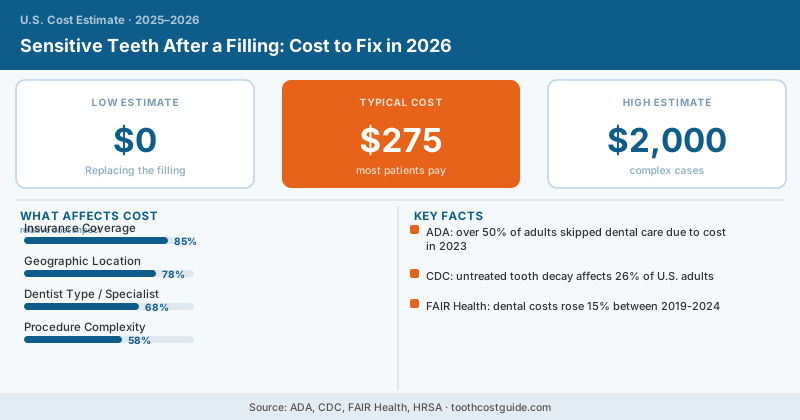
You got a cavity filled last week, and now that tooth zings every time you bite or sip something cold. Did the dentist mess up? Should you go back? And — the question on everyone’s mind — will fixing it cost you again? Good news: most post-filling sensitivity costs nothing and fades on its own. Here’s how to tell when it doesn’t.
What Resolving It Costs
| Situation / Fix | Typical Cost (No Insurance) |
|---|---|
| Normal mild sensitivity (waits it out) | $0 |
| Desensitizing toothpaste | $6–$15 |
| Bite adjustment (high filling) | $50–$200 |
| Replacing the filling | $150–$400 |
| Root canal (irreversible pulp damage) | $700–$2,000 |
| Crown after root canal | $1,000–$2,000 |
Why It Happens (and Why It’s Usually Fine)
Drilling out decay and placing a filling irritates the tooth. The pulp — the living nerve inside — gets inflamed by the procedure and reacts to temperature and pressure for a while afterward. This is normal and expected, especially with deeper fillings. The American Dental Association notes that mild sensitivity after a restoration is common and typically temporary.
For most people, it calms down within a few days to a few weeks as the tooth settles. The fix during that window is patience plus, if needed, a desensitizing toothpaste — total cost, maybe $10.
Normal post-filling sensitivity steadily improves over two to four weeks. If it’s fading — even slowly — you’re almost certainly fine and shouldn’t pay for anything. If it’s holding steady or getting worse after a month, or if it’s sharp and lingering, that’s your signal to call the dentist. Going back for a check is usually free if it’s within the original visit’s follow-up window — ask.
When It’s Not Normal (and Costs Money)
A few situations need a fix:
- High filling (bad bite): If the filling sits a hair too tall, you hit it first every time you bite, and that constant overload makes the tooth sore. The fix is quick and cheap — a bite adjustment ($50–$200) where the dentist shaves the filling down to meet correctly. This is a common, easily fixed cause, and many dentists do it free as a follow-up.
- The wrong cause was treated: Occasionally a sensitive tooth has another issue — like an exposed root or a crack nearby — and the filling didn’t address it.
- Failed or leaking filling: If the filling didn’t seal well, replacing it ($150–$400) solves it.
- Irreversible pulp damage: Rarely, the decay was deep enough that the nerve can’t recover. Then a root canal is needed, usually followed by a crown. This is the expensive outcome — but it’s uncommon, and it reflects how deep the original decay was, not a botched filling.
Sharp vs. Dull: A Quick Guide
- Brief zing to cold that fades fast: Normal, reversible. Wait it out.
- Pain when biting down: Likely a high filling — easy bite adjustment.
- Lingering throb after cold, or spontaneous pain: The nerve may be in trouble — root canal territory. Get it checked.
Insurance and Saving Money
A bite adjustment within the follow-up window is frequently no-charge — always ask before assuming you’ll pay. Replacing a recently placed filling may also be done at reduced or no cost depending on the office’s policy. A root canal and crown run through your insurance like any major work, typically at the 50% tier. Our how dental insurance works guide covers the details. Uninsured? A dental savings plan discounts the bigger procedures if you need them.
Severe, throbbing pain after a filling — especially if it wakes you up, lingers long after the trigger, or comes with swelling — can mean the nerve is dying or infected. That’s not normal post-filling sensitivity. Call your dentist promptly; see our dental emergency cost guide if it’s after hours.
Bottom Line
Sensitive teeth after a filling cost most people exactly nothing — it fades in a few weeks. A high bite is the usual fixable culprit and often free to adjust. Only the rare case that needs a root canal gets expensive, and that’s about how deep the cavity was, not the filling itself.
Frequently Asked Questions
Costs range from $50 to $2,000 depending on the cause. A simple bite adjustment typically runs $50–$200, a filling replacement costs $150–$500, and a root canal (the most expensive option) ranges from $800–$2,000 without insurance.
Most insurance plans cover bite adjustments and filling replacements as part of restorative care, usually at 80% after your deductible. Root canals are typically covered at 50%, leaving you with significant out-of-pocket costs; check your plan's endodontic coverage limits, which often cap at $1,000–$1,500 annually.
Wait 2–4 weeks, as mild sensitivity usually fades on its own during this period. If sharp pain or sensitivity to biting persists beyond 4 weeks, or if it's getting worse instead of better, contact your dentist immediately to rule out bite problems or an improperly sealed filling.