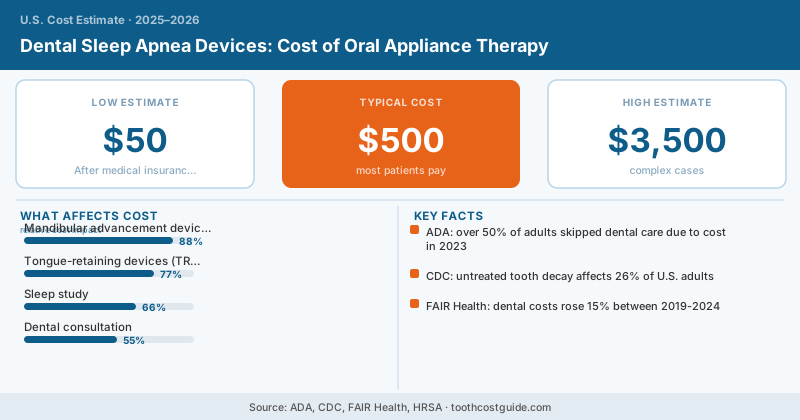
The $3,500 quote your dentist handed you for a sleep apnea device probably caught you off guard. You were expecting a dental bill. What you’re actually looking at is a medical device — and that changes everything about how it gets paid for.
Oral appliance therapy (OAT) for obstructive sleep apnea (OSA) costs $1,800–$3,500 out of pocket. But most patients with a qualifying diagnosis pay far less. The American Academy of Sleep Medicine (AASM) issued guidelines in 2015 recommending oral appliances as a first-line treatment for mild-to-moderate OSA and as an alternative for patients who can’t tolerate CPAP — and most major medical insurers follow those guidelines.
| Service / Device | Typical Cost |
|---|---|
| Custom mandibular advancement device (MAD) | $1,500–$2,500 |
| Initial dental consultation + impressions | $150–$300 |
| Follow-up titration visits (2–4 sessions) | $50–$150 each |
| Total out-of-pocket (no insurance) | $1,800–$3,500 |
| After medical insurance (typical) | $200–$800 |
| Home sleep study (if not yet diagnosed) | $150–$300 |
| In-lab polysomnography | $1,000–$3,500 |
| CPAP device (for comparison) | $500–$1,000 |
MADs vs. Tongue-Retaining Devices
There are two main categories of oral appliance for sleep apnea, and they work differently.
Mandibular advancement devices (MADs) are by far the most common. They look similar to a sports mouthguard — but with upper and lower trays connected by hardware that advances your lower jaw forward. That forward position tightens the airway and prevents collapse. Custom MADs are fabricated from dental impressions and adjusted over several follow-up visits. Common brands include SomnoDent (from SomnoMed), the Herbst Appliance, and the EMA (Elastic Mandibular Advancement). These run $1,500–$2,500 for the device itself.
Tongue-retaining devices (TRDs) hold the tongue forward using gentle suction, without moving the jaw. Less common, but an option for patients with TMJ issues who can’t tolerate jaw advancement. Similar price range.
Over-the-counter boil-and-bite devices exist for under $100. They’re not custom-fit, not adjustable, and the AASM doesn’t recommend them for treating diagnosed OSA. If you have a formal diagnosis, a custom device is what you need.
The Full Cost Breakdown
Your total cost for oral appliance therapy covers more than just the device:
Sleep study. You need a formal OSA diagnosis before insurance will cover anything. If you haven’t had one, a home sleep test runs $150–$300; an in-lab polysomnography (PSG) costs $1,000–$3,500. Many insurance plans require the home test first.
Dental consultation. A dentist trained in dental sleep medicine will evaluate your jaw mechanics, bite, and existing dental work to confirm you’re a candidate. Expect $150–$300 for this visit, often credited toward the device cost.
Device fabrication. Your dentist takes impressions or a digital scan, sends them to a dental sleep lab, and receives the custom appliance in about 2–3 weeks.
Titration appointments. The device gets adjusted incrementally — usually 2–4 visits — to find the optimal jaw position. These visits cost $50–$150 each and are critical for both efficacy and comfort.
How Insurance Works — and Why This Is a Medical Bill, Not a Dental Bill
Here’s the key thing most patients miss: oral appliances for sleep apnea are billed under medical insurance as durable medical equipment (DME), not under dental insurance. Your dental plan won’t cover it. Your medical plan likely will.
Medicare Part B covers oral appliances for OSA when a sleep physician documents that CPAP is medically necessary but the patient can’t tolerate it. Coverage is 80% after deductible, with the remaining 20% paid by supplemental coverage or out of pocket.
Commercial plans (employer-sponsored, ACA marketplace) generally follow similar coverage logic — diagnosis required, CPAP intolerance documented. Out-of-pocket after coverage typically falls in the $200–$800 range depending on your deductible and whether the dentist is in-network for DME providers.
To get oral appliance therapy covered by medical insurance, you typically need: (1) a formal OSA diagnosis from a sleep study, (2) a prescription from a physician or sleep specialist, (3) documented CPAP intolerance (a sleep study showing failure to adapt, or a physician’s note), and (4) a dentist who is enrolled as a DME supplier with your insurer. Ask the dental office upfront if they handle medical billing — not all do.
Oral Appliance vs. CPAP: The Cost Comparison
A CPAP machine costs $500–$1,000. Ongoing supplies — mask, tubing, filters, water reservoir — add $150–$300 per year. Over five years, total CPAP cost is roughly $1,000–$2,500. An oral appliance costs more upfront but has lower ongoing costs (occasional adjustments, replacement every 3–5 years at $500–$1,500).
The bigger difference isn’t cost — it’s adherence. A 2019 study in the Journal of the American Dental Association found that patients with mild-to-moderate OSA were significantly more likely to consistently use oral appliances than CPAP. An effective device you actually use beats a more effective device sitting on your nightstand.
For severe OSA (AHI above 30), CPAP remains the gold-standard recommendation. For mild-to-moderate cases, or for confirmed CPAP intolerance, oral appliance therapy is a clinically validated, insurance-covered alternative.
Oral appliances should only be used for diagnosed obstructive sleep apnea under the care of a sleep physician and a dentist trained in dental sleep medicine. Do not use over-the-counter devices as a substitute for a professional evaluation. Untreated sleep apnea carries serious cardiovascular risks. Cost estimates reflect U.S. averages for 2025 and vary by provider and region.
Frequently Asked Questions
A custom oral appliance from a dentist typically costs $1,800–$3,500 total, including consultation, device fabrication, and follow-up titration visits. The device itself runs $1,500–$2,500; the rest covers clinical fees.
Yes — most major medical insurers, including Medicare Part B, cover oral appliance therapy when you have a formal OSA diagnosis and documented CPAP intolerance. The device is billed as durable medical equipment (DME), not dental. Out-of-pocket after insurance is typically $200–$800 depending on your plan.
A CPAP uses positive airway pressure through a mask to keep your airway open during sleep. An oral appliance repositions your jaw or tongue mechanically, without a mask or machine. CPAP is more effective for severe OSA; oral appliances work well for mild-to-moderate cases and are strongly preferred by patients who can't tolerate CPAP.