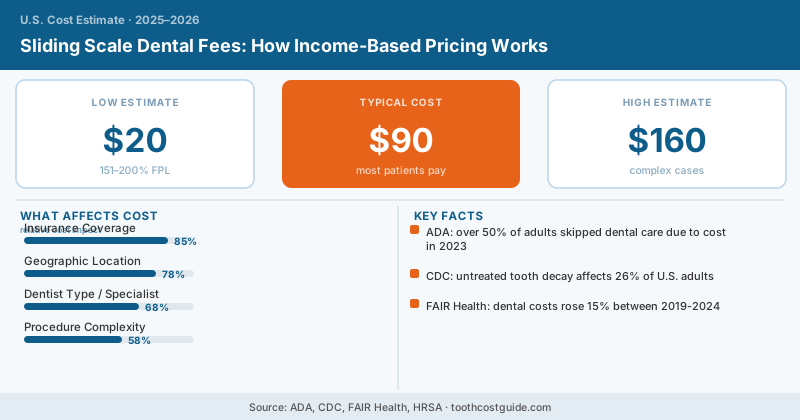
What if your dental bill went down because your income did? That’s exactly how sliding-scale fees work, and it’s one of the most underused ways to get affordable care in America. A cleaning that costs $180 at a private office might cost you $25 at a sliding-scale clinic if your household income is low enough.
Let’s break down what “sliding scale” really means, who qualifies, and what you’ll actually pay.
How sliding-scale pricing works
A sliding fee schedule ties what you pay to your household income and family size, usually measured against the Federal Poverty Level (FPL). The lower your income relative to the FPL, the bigger your discount. The federal poverty line for a family of four was $32,150 in 2025, and most sliding-scale clinics offer discounts up to 200% of that figure.
You’ll typically bring proof of income, pay stubs, a tax return, or a benefits letter, and the clinic slots you into a discount tier.
| Household Income vs. Poverty Level | Typical Discount | Cleaning Cost |
|---|---|---|
| At or below 100% FPL | 80–90% off (nominal fee) | $20–$40 |
| 101–150% FPL | 60–75% off | $40–$70 |
| 151–200% FPL | 40–55% off | $70–$110 |
| Above 200% FPL | Standard reduced rate | $100–$160 |
Even at the top tier, you’re usually still paying less than a private practice charges, because these clinics are nonprofit or federally funded.
Where to find sliding-scale dental care
The biggest network is the Federally Qualified Health Center (FQHC) system, funded by HRSA. There are over 1,400 FQHC organizations operating thousands of sites nationwide, and HRSA reported that community health centers served more than 30 million patients in 2023. Many include full dental departments.
Beyond FQHCs, look at:
- Dental school clinics — supervised student care at deep discounts
- Nonprofit community dental clinics — often faith-based or charity-run
- County and city health departments — some run their own sliding-scale dental units
Use the HRSA “Find a Health Center” tool at findahealthcenter.hrsa.gov and filter for dental services. Call ahead and ask two questions: “Do you offer a sliding fee scale?” and “What income documents do I bring?” Most clinics can quote your tier before you ever sit in the chair.
What sliding scale does and doesn’t cover
Sliding-scale clinics shine for routine and basic care, cleanings, exams, X-rays, fillings, and extractions. Complex work like implants or cosmetic dentistry is often limited or unavailable, since these clinics prioritize medically necessary care.
For bigger procedures, you may need to combine resources. A clinic might do your cleaning on a sliding scale, then refer you to a dental school clinic for a root canal at student rates.
When sliding scale isn’t an option
Maybe your income is too high to qualify, or there’s no clinic nearby. You’ve still got cheaper paths than full price. A dental discount plan gives you 10–60% off at regular dentists with no income test, and our guide on dental savings without insurance covers membership plans and cash strategies.
Don’t assume you don’t qualify. Many people who think they earn “too much” still fall under 200% of the poverty level, especially with a few dependents. The only way to know is to bring your income documents and ask. There’s no penalty for applying and being told you’re at the standard rate.
Combine it with other programs
Sliding-scale fees stack nicely with other aid. If you’re on Medicaid, the clinic bills Medicaid first and applies the sliding scale only to what’s left. If you’re uninsured, the sliding scale is your full pricing. And for anything the clinic can’t handle, free dental care programs and charity events can fill the gap.
The bottom line: sliding-scale dental care is real, widespread, and dramatically cheaper than most people expect. If your income is modest, walking into an FQHC with your pay stubs could turn a $1,000 year of dental work into a couple hundred dollars. That’s worth a phone call.
Frequently Asked Questions
At sliding-scale clinics, a dental cleaning typically costs $20–$60 per visit, compared to $120–$180 at private practices. Your exact fee depends on your household income and the clinic's fee schedule, with lower-income patients paying the minimum rates.
Most dental insurance plans do cover sliding-scale clinics since they are licensed dental facilities, though you may still owe a copay or coinsurance. However, if you have no insurance and qualify based on income, the sliding-scale fee becomes your only cost—eliminating the need for insurance altogether.
Income limits vary by clinic and location, but most sliding-scale programs serve patients earning 100–300% of the federal poverty level (roughly $15,000–$65,000 annually for an individual). You'll typically need to provide recent tax returns or pay stubs when you apply, and approval happens within 1–2 visits.