Can you get a Hollywood smile without touching your teeth? Snap-On Smile says yes. Here’s what the reality looks like.
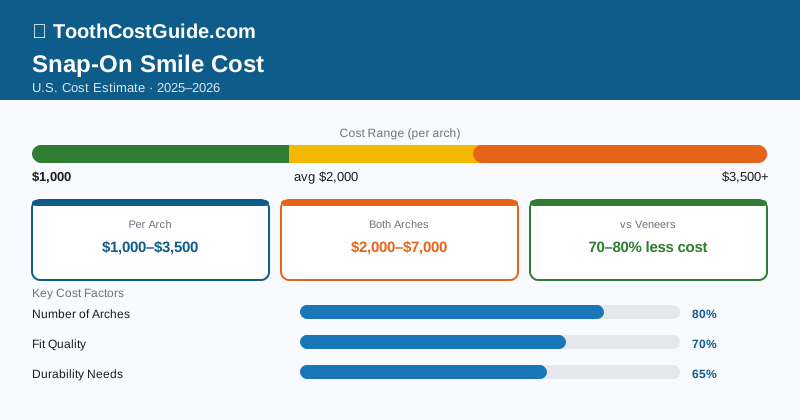
The product is real, it’s professionally made, and it delivers a genuine cosmetic improvement for many patients. It’s also removable, can’t be worn at every meal, lasts 3–5 years before needing replacement, and costs $1,000–$3,500 per arch from a licensed dentist. Whether it’s right for you depends on what you’re trying to solve and what compromises you’re willing to accept.
What Snap-On Smile Actually Is
Snap-On Smile is a patented dental appliance made by Den-Mat — a thin resin arch that snaps onto your upper or lower teeth without any drilling, bonding, or permanent alteration to your existing teeth. It’s custom-fabricated at a dental laboratory from impressions your dentist takes; you choose a shade and tooth shape from Den-Mat’s catalog. The result clips onto your teeth using your natural undercuts for retention, no adhesive required.
It’s not a toy or a costume piece. It’s a professionally made dental appliance dispensed exclusively through licensed dentists — which is what separates it from the $100 mail-order alternatives that use the same concept but inferior materials and no proper bite registration.
Cost Breakdown
| Option | Cost Range | Notes |
|---|---|---|
| Snap-On Smile — upper arch | $1,000–$3,500 | Most common; upper arch only |
| Snap-On Smile — both arches | $2,000–$5,000 | Upper and lower |
| Replacement appliance | $800–$2,000 | When worn out or damaged |
| Online/mail-order press-on veneers | $100–$500 | No dentist fit; lower durability |
| Porcelain veneers (for comparison) | $1,000–$2,500 per tooth | Permanent; better aesthetics |
| Composite bonding (for comparison) | $300–$800 per tooth | Permanent; no lab needed |
What’s behind the price variation: Den-Mat charges every dentist the same lab fee for fabrication — roughly $400–$700. The rest of the price ($300–$2,800) is the dentist’s professional fee for two appointments: taking impressions and fitting the appliance. A cosmetic dentist in Manhattan charges more for those two appointments than a general dentist in a mid-sized market. The product is identical; the fee structure isn’t.
That means it’s worth calling several offices in your area and asking specifically what they charge for Snap-On Smile, upper arch only. You may find $400–$800 in variation without any difference in the final product.
Who It’s Actually For
Snap-On Smile is appropriate for a specific group of patients — not everyone. Here’s where it genuinely makes sense:
Cost-prohibitive permanent treatment. If you need 8 porcelain veneers at $1,500 each to achieve the smile you want, that’s $12,000. If $1,500–$2,500 for an arch that lasts 3–5 years is what fits your current budget, Snap-On Smile can bridge the gap while you save for permanent treatment.
Temporary solution before implants or other restoration. If you’re missing teeth or waiting for implants to heal, a Snap-On Smile can provide a full, complete-looking smile during the transitional period. It’s a better-looking, better-functioning temporary than most conventional options.
Theater, film, photography, or performance work. When the goal is appearance in specific controlled situations rather than all-day, every-day wear, Snap-On Smile is well-suited. Many performers and actors use it precisely because it’s removable and situation-specific.
Patients who genuinely prefer reversibility. Some people simply don’t want to permanently alter their teeth. If you value the option to return to your natural teeth at any time, a removable appliance is the only option that preserves that.
Snap-On Smile cannot fix: missing teeth in a functional sense (it covers the gap cosmetically but provides no chewing support in that area), structural tooth problems that need crowns, active gum disease or significant bone loss, or bite issues — in fact, active bite problems may make it impossible to wear comfortably. It also shouldn’t be placed over teeth with significant decay. A complete dental examination before getting Snap-On Smile isn’t just recommended — it’s required for any responsible dentist to agree to make it for you.
How It Compares to the Alternatives
Vs. press-on veneers (online, $100–$500): Mail-order products use thinner, less durable resin and — critically — are made without proper bite registration. Wearing a device that doesn’t correctly account for your bite mechanics can cause jaw pain, tooth wear, and problems that cost more to fix than you saved. Snap-On Smile is a different category of product, not just a more expensive version of the same thing.
Vs. porcelain veneers ($1,000–$2,500 per tooth): Porcelain veneers are permanently bonded to your teeth, last 10–20 years, look more natural up close, and have no eating restrictions. They’re also irreversible — your natural enamel is permanently modified during preparation. The comparison isn’t just price; it’s also permanence, quality, and lifestyle fit. Snap-On Smile doesn’t match porcelain veneers aesthetically, but it also doesn’t require touching your natural teeth.
Vs. composite bonding ($300–$800 per tooth): Composite bonding addresses specific teeth rather than covering everything. For a patient with 2–3 teeth that need improvement, targeted bonding at $600–$2,400 total may deliver a more natural-looking permanent result at similar cost to Snap-On Smile. Ask your dentist to quote both options before deciding.
Lifespan and the 10-Year Math
With careful use, Snap-On Smile lasts 3–5 years. That means you’ll likely need 2–3 replacements over 10 years, at $800–$2,000 each. Ten-year total cost: $2,600–$7,500 for continued Snap-On Smile coverage.
Compare that to 8 porcelain veneers at $1,500 each: $12,000 upfront, lasting 10–20 years with no replacements and no eating restrictions. Over 15 years, the per-year cost converges — and the porcelain case provides a better-looking, more functional result throughout.
This isn’t an argument against Snap-On Smile. It’s context: the decision shouldn’t be made purely on sticker price. If the budget is the constraint, Snap-On Smile is a valid option. But if you’re comparing them at similar total cost over a 10-year window, permanent treatment looks increasingly competitive.
Insurance and HSA/FSA
Snap-On Smile is a cosmetic dental appliance. No dental insurance plan covers it — no exceptions, no workarounds. It’s excluded under cosmetic treatment provisions.
HSA/FSA reimbursement is a gray area. The IRS does not reimburse cosmetic dental expenses through pre-tax accounts. If your dentist documents a functional component — say, the appliance provides occlusal coverage during a treatment gap — some HSA administrators may approve the expense. Not guaranteed; check with your plan administrator before assuming it qualifies.
Avoid the online alternatives claiming to replicate Snap-On Smile for $100–$500. These products are made without professional bite registration, use lower-quality resin, and can cause real harm if they interfere with your natural bite. The professional dental fee you pay for authentic Snap-On Smile isn’t just a markup — it pays for impressions that capture your bite correctly, a fitting appointment to verify the appliance seats without creating pressure points, and a provider to call if something goes wrong. The difference is significant.
Frequently Asked Questions
Snap-On Smile is made from Den-Mat's proprietary hi-tech resin — more durable than the resin used in cheap mail-order alternatives, but not as hard or stain-resistant as porcelain. With proper care (removing it before eating hard or chewy foods, cleaning it with a soft toothbrush, storing it in the provided case), most patients get 3–5 years of use before noticeable wear, chipping, or discoloration. Some patients report getting closer to 6–7 years with careful use; others experience chipping within 1–2 years if they wear it more aggressively. A replacement runs $800–$2,000 from the same dentist. Over 10 years, replacement costs can approach or exceed the cost of permanent treatment.
You can eat soft foods with Snap-On Smile in place — things like pasta, fish, soft sandwiches, or yogurt. Hard, crunchy, chewy, or sticky foods are off the menu while wearing it. That means no apples, carrots, nuts, bagels, steak, gummy candy, or anything that requires significant bite force or prolonged chewing. Most people remove it before meals and put it back in afterward for social situations. This limitation is one of the most commonly cited downsides by actual users — if you want to wear your cosmetic improvement all day without dietary restrictions, Snap-On Smile isn't the right choice.
It depends on the shade and design you choose and your existing tooth anatomy. Snap-On Smile can look very natural in photographs and at conversational distance — the resin mimics the surface texture of enamel reasonably well, and it's available in natural-looking shades, not just ultra-bright white. Up close, an observant person may notice it looks slightly different from natural teeth — the edges sit over your existing teeth, which adds a small amount of bulk to the front surfaces. Speech may have a slight adjustment period (a mild lisp for a few weeks). Overall, for photos and typical social situations, most patients find it convincingly natural. For intimate or close-up situations, results vary.