If you’re on Medicaid in California, you can get a crown covered. If you’re on Medicaid in Texas, you probably can’t — adult dental benefits in Texas Medicaid are limited to emergency extractions only.
That difference is not a rumor. It’s the reality of how adult dental care works in the United States. Federal law requires states to provide dental benefits for children under Medicaid, but adult dental coverage is entirely optional. As of 2024, roughly half of states offer comprehensive adult dental coverage; the other half offer emergency-only or no coverage at all.
Here’s how to navigate the system regardless of which state you’re in.
The Federal Baseline: What’s Required vs. Optional
Under federal Medicaid law, dental coverage for children (under age 21) is mandatory and must include preventive, restorative, emergency, and orthodontic services where medically necessary. The Children’s Health Insurance Program (CHIP) also covers dental for enrollees under 19.
Adult dental coverage is optional. States can choose to cover it comprehensively, partially, or not at all. They can also add and remove adult dental benefits when budgets change — it’s happened in multiple states in both directions during economic cycles.
State-by-State Overview
Comprehensive adult coverage (preventive + restorative + major services): California (Denti-Cal), New York, Washington, Massachusetts, Oregon, Minnesota, Vermont, Connecticut, and several others offer adult benefits that include cleanings, fillings, extractions, crowns, partial dentures, and sometimes root canals.
Limited adult coverage (emergency only or basic only): Texas (emergency extractions only for most adults), Florida (emergency services only), Georgia, Alabama, and several others provide minimal or no routine dental coverage for adults.
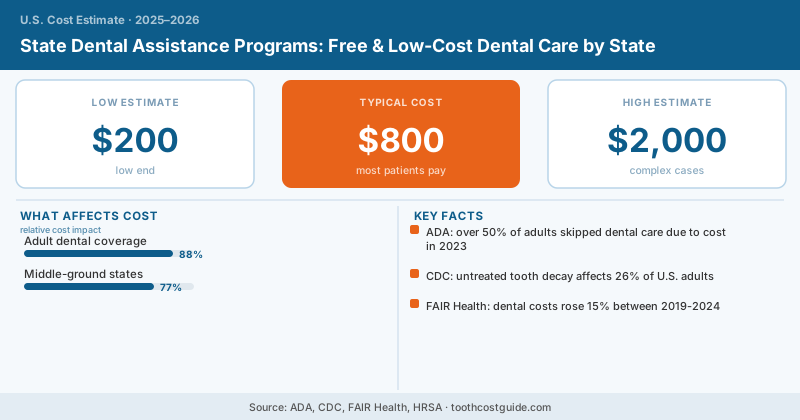
Middle-ground states: Many states cover preventive and basic restorative services (cleanings, exams, basic fillings) but exclude major services like crowns, bridges, and dentures.
Medicaid dental benefits change with state budgets. The most current information is always at your state’s Medicaid agency website (search “[your state] Medicaid dental benefits”) or by calling your state’s Medicaid member services line. The NASHP (National Academy for State Health Policy) also maintains an annual state dental benefits tracker at nashp.org.
CHIP: Comprehensive Dental for Kids Under 19
Even in states with minimal adult Medicaid dental benefits, children enrolled in CHIP or Medicaid receive comprehensive dental coverage. The ADA notes that untreated dental decay is the most common chronic disease in children — 45% of children aged 2–19 have had cavities in their primary or permanent teeth according to CDC data.
CHIP enrollment income thresholds vary by state but generally cover families earning up to 200–300% of the federal poverty level (FPL). In many states it’s higher. Children whose families earn too much for Medicaid but struggle to afford private dental insurance are often eligible for CHIP dental.
To apply: healthcare.gov/medicaid-chip/children-s-health-insurance-program/ or your state’s CHIP agency.
Federally Qualified Health Centers: The Safety Net for Everyone
Regardless of your state’s Medicaid policy, Federally Qualified Health Centers (FQHCs) provide dental care on a sliding scale based on your income. They serve patients of all income levels and insurance statuses — including uninsured patients paying cash on a sliding fee.
FQHCs receive federal funding specifically to provide care in underserved communities and are required to offer services regardless of ability to pay. Sliding scale fees are based on household income relative to the federal poverty level. For a family of four earning $35,000, a cleaning might cost $30–$50. For someone earning $15,000, it might be $15–$25.
Find your nearest FQHC at findahealthcenter.hrsa.gov. See our full FQHC dental guide for more detail on what they offer and how to get an appointment.
State Dental Society Mission Events
Most state dental associations organize free dental care events — sometimes called “Give Kids a Smile” (for children) or adult missions. These range from single-day events at convention centers to multi-day clinics that serve hundreds of patients.
At these events, volunteer dentists provide free cleanings, fillings, extractions, and sometimes more complex services to uninsured and low-income patients. Services are genuinely free — no income documentation required at most events.
How to find them:
- Search “[your state] dental association mission” or “[your state] dental society free clinic”
- The ADA’s “Give Kids a Smile” program runs events nationally each February — search ada.org for your state’s participating locations
- America’s ToothFairy and Donated Dental Services also organize events and maintain provider networks
Free dental events often have long lines and limited appointment slots — some patients wait 4–6 hours. Arrive early. Services may be limited (extractions and basic restorative only; no root canals or complex prosthetics). But for patients who need an urgent extraction or have multiple untreated cavities, these events can provide significant relief at no cost.
Dental Schools: Supervised Care at 30–50% Savings
Every state has at least one dental school, and all 67 accredited U.S. dental schools offer patient care clinics where dental students perform procedures under faculty supervision. The cost is typically 30–50% below private practice rates.
Dental school clinics are not charity care — you pay for services, just at reduced rates. They’re appropriate for patients who have some ability to pay but can’t afford private practice prices. Learn more in our dental school clinics guide.
Income Thresholds to Know
Most assistance programs and sliding-scale services use the Federal Poverty Level (FPL) as their benchmark. For 2025–2026:
- 100% FPL: approximately $15,060/year for an individual; $31,200 for a family of four
- 200% FPL: approximately $30,120 individual; $62,400 family of four
- 400% FPL (ACA subsidy cliff): approximately $60,240 individual; $124,800 family of four
Medicaid income eligibility generally falls at 138% FPL in expansion states. FQHCs serve anyone but offer the deepest discounts (close to $0) at incomes below 100% FPL.
Your State-by-State Action Plan
Check your Medicaid eligibility: Apply at healthcare.gov or your state Medicaid agency. Even if you’ve been denied before, eligibility thresholds change and re-applications are free.
Find your nearest FQHC: findahealthcenter.hrsa.gov — this should be your first call if you’re uninsured or on a tight budget.
Look up dental school clinics: ada.org/education/dental-schools maintains a complete list. Call and ask about their sliding scale or low-income programs specifically.
Search for local dental mission events: Your state dental society’s website will list upcoming events.
Consider a dental discount plan if you have modest income but not enough for insurance premiums: annual fees of $100–$200 provide 20–50% reductions at participating dentists.
Emergency dental care (severe pain, swelling, tooth infection) is typically available at hospital emergency departments regardless of insurance status, though ERs can only manage pain and antibiotics — they can’t perform the dental work itself. For true dental emergencies without a dentist, an FQHC or dental school emergency triage slot is usually faster and more clinically appropriate than an ER.
Frequently Asked Questions
A dental crown typically costs $800–$1,500 per tooth without insurance, depending on the material (porcelain, ceramic, or metal) and your dentist's location. In states with generous Medicaid coverage like California, eligible adults may have this cost fully covered, while in states like Texas with minimal adult dental benefits, you would pay the full amount out-of-pocket.
Federal law only requires Medicaid to cover dental benefits for children; adult dental coverage is entirely optional and varies dramatically by state. California and New York offer comprehensive adult dental coverage including crowns and major procedures, while Texas limits adult Medicaid dental to emergency extractions only, leaving most treatment uncovered.
You can contact your state health department or visit your state Medicaid website to locate federally qualified health centers (FQHCs) and dental schools that offer sliding-scale fees based on income, typically ranging from free to $150–$300 per visit. Many states also have dental assistance programs specifically for low-income uninsured adults that you can access through 211.org or your local health department.