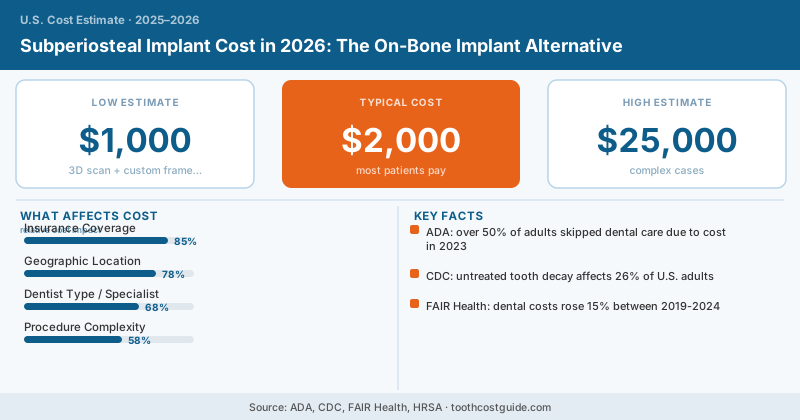
Q: I was told I don’t have enough bone for normal implants — what’s a subperiosteal implant and what does it cost?
A: A subperiosteal implant is a custom metal framework that rests on top of your jawbone, under the gum, rather than being screwed into the bone like a standard implant. It costs anywhere from $5,000 to $25,000 or more depending on whether it’s a single area or a full arch. And for most patients, it’s no longer the first choice.
Let’s walk through it as a Q&A, because the questions people ask about this implant are exactly the ones that determine whether it’s right for you.
Q: What does it actually cost?
| Scope | Typical Cost |
|---|---|
| Partial subperiosteal framework | $5,000–$12,000 |
| Full-arch subperiosteal implant | $12,000–$25,000+ |
| 3D scan + custom framework design | $1,000–$3,000 |
| General anesthesia / surgical fees | $1,000–$3,000 |
That’s in the range of — or above — a conventional full-arch case. You’re paying for a fully custom-fabricated metal framework built to your exact jaw shape from a 3D scan.
Q: How is it different from a regular implant?
A standard (endosteal) dental implant is a titanium post placed inside the jawbone, which then fuses to it. A subperiosteal implant skips the bone-fusion step entirely: it’s a saddle-shaped frame that sits on the bone surface beneath the gum, with posts protruding through the gum to hold teeth. It relies on the framework’s fit and the gum closing over it, not osseointegration.
Subperiosteal implants were designed for patients with severe jawbone loss who can’t get standard implants and want to avoid extensive grafting. But modern alternatives — bone grafting, sinus lifts, and zygomatic implants — have made the classic subperiosteal implant a niche, last-resort option. Most surgeons reach for it rarely.
Q: Who’s actually a candidate?
The classic candidate has severe bone resorption — usually in the lower jaw — and either can’t undergo extensive grafting or wants to avoid it. The American Academy of Implant Dentistry recognizes the technique, but notes that advances in grafting and angled implants have narrowed when it’s the best call.
If you have any usable bone, a surgeon will usually first explore:
- A bone graft to rebuild ridge volume
- Angled or short implants that work around limited bone
- Zygomatic anchorage for severe upper-jaw loss
Q: Why don’t more dentists offer it?
Two reasons. First, it’s technically demanding and few surgeons are trained in modern (3D-printed) subperiosteal frameworks. Second, the long-term data favors osseointegrated implants, which have survival rates above 95% at 10 years in large studies — a track record the subperiosteal design doesn’t match as cleanly.
Be cautious if a single clinic pushes a subperiosteal implant without first ruling out grafting or angled implants. Because it’s a rare procedure, you’ll want a surgeon who does these regularly and a clear explanation of why standard options won’t work for your anatomy. Always get a second opinion on a five-figure surgery this specialized.
Q: Will insurance help?
Rarely in full. Dental plans cap implant benefits around $1,000–$1,500, which barely touches a five-figure framework. When bone loss results from trauma, cancer surgery, or a congenital condition, medical insurance sometimes contributes — so document the cause. For the balance, most patients use CareCredit for dental or in-house financing.
Q: Is there a simpler, cheaper route?
Often, yes. If your goal is replacing a full arch, a full mouth reconstruction plan using conventional or angled implants — possibly with grafting — is the path most surgeons recommend first. It usually has more predictable long-term outcomes.
Bottom Line
A subperiosteal implant costs $5,000–$25,000+ and exists for a narrow group: patients with severe bone loss who can’t or won’t undergo grafting. It’s a legitimate but rarely-first-choice option, largely displaced by modern grafting, angled, and zygomatic techniques. If it’s on the table, confirm with a second opinion that the standard routes genuinely won’t work for your jaw.
Frequently Asked Questions
A subperiosteal implant typically costs between $5,000 and $25,000 or more, depending on whether you need a single-tooth implant or a full-arch restoration. The final price varies based on the complexity of the custom metal framework, imaging requirements, and your geographic location. Additional costs for the crown or denture base attached to the implant are usually separate.
Most dental insurance plans do not cover subperiosteal implants because they are considered a specialty procedure and often classified as elective or experimental. You can expect to pay 100% out-of-pocket in most cases, though some plans may cover a portion of the abutment or crown restoration if you meet specific criteria. Always verify coverage with your insurance provider before proceeding.
Subperiosteal implants are primarily for patients with severe bone loss in the jaw who cannot support traditional implants and want to avoid bone grafting surgery. They require healthy gums and adequate bone width (though not depth) to support the custom framework. Most modern patients opt for bone grafting followed by standard implants instead, making subperiosteal implants a less common choice today.