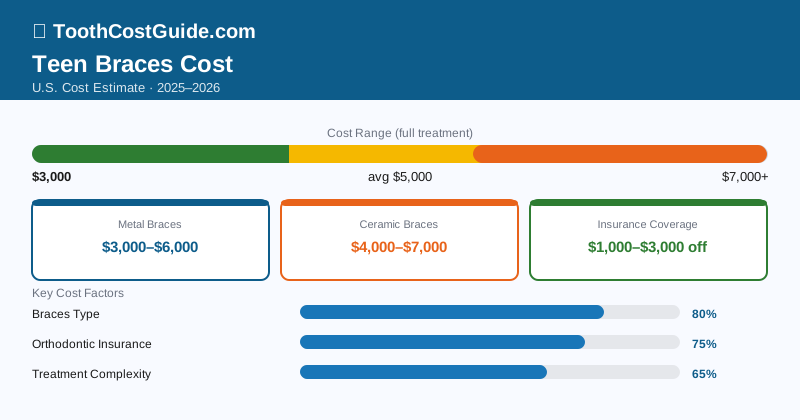
Good news first: teen orthodontic treatment is the best-insured orthodontic scenario in the US. Nearly every dental plan that includes orthodontic benefits covers patients under 18. That doesn’t mean the bill disappears — but insurance typically cuts it by $1,000–$2,000, and orthodontists structure payment plans specifically for families stretched across monthly installments.
Teen braces cost $3,000–$7,000 for a full course of treatment, with most families landing between $4,000–$6,000 before insurance. After insurance, real-world out-of-pocket costs commonly run $2,000–$4,000. The type of braces, the complexity of the case, and the local market all move that number.
| Teen Orthodontic Treatment | Cost Without Insurance |
|---|---|
| Metal braces (teen) | $3,000–$5,500 |
| Ceramic (tooth-colored) braces | $4,000–$7,000 |
| Invisalign Teen | $3,000–$8,000 |
| Self-ligating metal braces (Damon) | $3,500–$7,000 |
| Lingual braces (rarely for teens) | $8,000–$13,000 |
| Limited/Phase 2 braces after Phase 1 | $2,500–$5,000 |
What Moves the Price
Complexity. Mild crowding in a teenager with good jaw development might wrap up in 12–18 months for $3,000–$4,500. A case with significant overbite, crowding, and spacing requiring 24–30 months can reach $6,000–$7,000. Orthodontists don’t charge by the bracket — they price based on the total clinical work involved.
Appliance choice. Metal braces remain the most popular teen option because they’re the most affordable and most effective for complex cases. Many teens personalize them with colored elastics within the first few appointments. Ceramic or Invisalign Teen add $500–$2,000 to the cost, reflecting an aesthetic preference that families often weigh seriously.
Phase 1 history. If a teen received early orthodontic treatment (Phase 1, ages 7–10), the comprehensive Phase 2 treatment is often shorter and less expensive. Many orthodontists discount Phase 2 by $500–$1,000 for their own Phase 1 patients.
Retention planning. Confirm whether retainers are included in the quoted fee. Most practices include one set of removable retainers; bonded permanent retainers ($200–$550 per arch) are often charged separately.
Location. Fees in major metro areas average 20–35% higher than in smaller markets. The same case that costs $5,000 in a large city might run $3,500–$4,000 in a suburban or rural practice.
Timing Matters More Than Parents Realize
The ideal age for comprehensive braces in most teens is 11–14, when the majority of permanent teeth have erupted but jaw growth is still active. Active growth is an orthodontic asset — moving teeth while the jaw is still developing is faster, less resistant, and often produces better long-term stability.
Key milestones from the American Association of Orthodontists:
- Age 7: First orthodontic evaluation recommended
- Ages 7–10: Phase 1 (early interceptive) treatment if needed
- Ages 11–14: Optimal window for comprehensive treatment
- Ages 16–18: Late comprehensive treatment, slightly longer than ideal
Starting comprehensive braces between 11–14 typically means shorter treatment times and lower total fees than waiting until 17 or 18.
Starting comprehensive braces between ages 11–14 typically results in shorter treatment times, better outcomes, and lower total cost than waiting until the late teens. The optimal window is when most permanent teeth are in but some jaw growth remains to work with.
Metal Braces vs. Invisalign Teen
Invisalign Teen is Align Technology’s product built specifically for teenagers. It includes up to 6 free replacement aligners (for when they get lost at lunch), blue compliance indicators that fade with wear so parents and orthodontists can verify actual wear time, and accommodations for teeth still coming in.
| Feature | Metal Braces | Invisalign Teen |
|---|---|---|
| Average cost | $3,000–$5,500 | $3,000–$8,000 |
| Compliance required | Built-in (fixed) | 22 hrs/day (removable) |
| Visible? | Yes (silver) | Barely |
| Effectiveness | Gold standard | Comparable for most cases |
| Dietary restrictions | Yes (hard/sticky foods) | None |
| Sports/activities | Requires mouthguard | Removed for sports |
| Suitable for complex cases | Yes | Moderate |
For teens who play contact sports or instruments, removability is a real advantage. For teens who struggle with follow-through — and most parents know if their teenager falls into this category — fixed braces guarantee treatment progress regardless of compliance.
Insurance Coverage for Teen Braces
Standard insurance terms:
- Lifetime orthodontic maximum: $1,000–$3,000 per patient
- Coverage: 50% of treatment cost up to the lifetime maximum
- Age limit: Usually 18–19 (dependents through 26 on family plans may qualify, depending on the specific dental plan)
- Waiting period: Some plans require 12 months of coverage before orthodontic benefits kick in
Example calculation (metal braces, $4,500):
- Insurance lifetime maximum: $1,500
- Insurance pays: $1,500 (50% up to the maximum)
- Family pays: $3,000
If your teen had Phase 1 orthodontic treatment at age 9, some of the lifetime maximum may already be used. Check the remaining balance before starting Phase 2 — the total maximum doesn’t increase just because treatment spans two phases.
The lifetime orthodontic maximum does NOT reset annually. Once used, it’s gone — even if you change insurance plans. Keep records of all orthodontic insurance claims so you know the remaining balance before starting treatment with any provider.
Financing for Families
In-house payment plans: Standard across orthodontic practices. Total treatment cost is divided over the treatment period (typically 18–30 months) at 0% interest. Monthly payments for a $5,000 case over 24 months come out to roughly $208/month — a manageable line item for most families.
CareCredit: 0% APR promotional periods of 12–24 months for qualified applicants. Useful for families who want longer terms than the orthodontist’s in-house plan offers, but pay the balance before the promotional period ends.
Medicaid and CHIP: Children and teens who qualify may have orthodontic coverage when treatment is “medically necessary.” Qualifications vary by state and typically require severe malocclusion causing functional impairment — not just cosmetic alignment concerns. Contact your state Medicaid office for specific eligibility criteria.
FSA: Orthodontic expenses are eligible, including monthly installment payments. Directing pre-tax FSA dollars toward braces payments saves 22–37% on every dollar spent.
How Families Pay Less
Get two or three consultations. The AAO reports fees vary 15–40% for equivalent cases within the same market. Most initial consultations are free and include X-rays and a case assessment.
Dental school orthodontic programs. Treatment by supervised orthodontic residents at dental schools costs 30–50% less than private practice. Wait times to start may be longer, but the clinical supervision is robust. Find programs at aaoinfo.org.
Choose metal over ceramic or Invisalign. Metal braces run 20–30% less than ceramic or Invisalign Teen for equivalent cases. Most teens are initially resistant, then completely indifferent by month three once they realize nobody cares as much as they feared.
Ask about sibling discounts. Many practices offer 10–15% discounts for siblings of existing patients. It’s rarely advertised — ask the front desk directly.
The Bottom Line
Teen braces cost $3,000–$7,000 before insurance, with most families paying $2,000–$4,000 after their lifetime benefit is applied. Metal braces remain the most cost-effective option. In-house payment plans make monthly costs manageable. Starting treatment in the 11–14 window, using available insurance benefits, and comparing 2–3 orthodontists are the most reliable strategies for keeping total cost under control.
Teen orthodontic treatment is the most insurance-supported orthodontic scenario in the US. Maximize insurance benefits, start at the optimal 11–14 age window, and use in-house payment plans to spread costs. Dental school programs are the deepest discount available for families who need to reduce cost significantly.
Frequently Asked Questions
Teen braces typically cost $3,000–$7,000 for a full treatment course, depending on the complexity of the case, whether you choose traditional metal braces or ceramic options, and your geographic location. After insurance coverage reduces the cost by $1,000–$2,000, most families pay $1,500–$5,000 out-of-pocket, often spread across monthly payment plans.
Yes, nearly every US dental plan that includes orthodontic benefits covers patients under 18, making teen orthodontics the best-insured orthodontic scenario. Most plans cover 50% of orthodontic costs after you meet your deductible, with lifetime orthodontic maximums typically ranging from $1,000–$2,500 per patient.
Traditional braces treatment for teenagers usually takes 18–24 months, though some cases may be completed in as little as 12 months or take up to 30 months depending on the severity of misalignment. Orthodontists recommend starting treatment between ages 9–14 when the jaw is still developing and teeth move more easily.