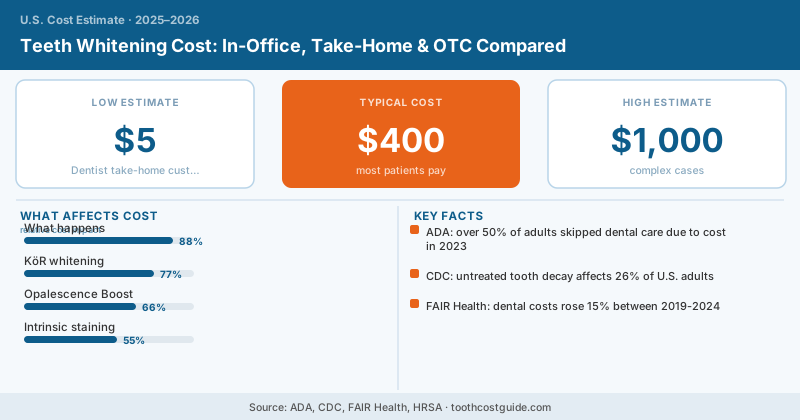
Teeth whitening is the most requested cosmetic dental procedure by patients under 50, according to the ADA — and the US whitening market now exceeds $3.7 billion annually. With options ranging from $25 drugstore strips to $1,000 in-office laser treatments, the price range is wider than almost any other dental procedure. What’s actually different between them, and which one delivers results worth paying for?
The answer turns almost entirely on one variable: peroxide concentration.
What Whitening Actually Costs
| Option | Cost | Peroxide Concentration | Results Timeline |
|---|---|---|---|
| OTC whitening toothpaste | $5–$20 | Abrasive only (no peroxide) | Surface stain removal only |
| OTC whitening strips (Crest, Oral-B) | $25–$80 | 10–14% hydrogen peroxide | 2–5 shades over 2–4 weeks |
| OTC whitening trays | $30–$75 | 10% carbamide peroxide | 2–4 shades over 2–4 weeks |
| Dentist take-home custom trays | $200–$600 | 10–22% carbamide peroxide | 4–8 shades over 1–2 weeks |
| In-office whitening (Zoom, Boost) | $300–$700 | 25–40% hydrogen peroxide | 5–8 shades in 1–2 hours |
| In-office KöR whitening (premium) | $600–$1,000 | Refrigerated 34% HP + custom trays | 8–16 shades over 3–4 weeks |
How Whitening Works
Peroxide bleaches teeth through oxidation. When hydrogen peroxide (HP) or carbamide peroxide (CP, which breaks down into HP) contacts enamel, the oxygen molecules penetrate the porous enamel structure and oxidize the chromogen molecules — the organic compounds responsible for tooth discoloration. The reaction disrupts the chromogen’s chemical bonds, reducing the concentration of colored compounds in the enamel and making the tooth appear lighter.
Higher concentrations work faster but increase the risk of sensitivity. Carbamide peroxide releases its hydrogen peroxide more slowly than HP, which is why take-home trays using 10–22% CP produce gradual results over 1–2 weeks rather than the rapid change you see in an in-office session using 35–40% HP.
The ADA’s guidance on tooth whitening products confirms that both approaches are safe and effective when used as directed — the question is speed versus cost.
In-Office Whitening: Fast Results, Real Price
In-office professional whitening at a dental office runs $300–$1,000 per session. The variation comes from the system used (Zoom, KöR, Opalescence Boost, Pola Office) and your local dental market.
What happens: Your dentist applies a protective barrier to your gums, then applies a 25–40% hydrogen peroxide gel to the enamel surfaces. A special light or laser may be used with some systems to activate the peroxide. The gel sits for 15–20 minutes, is removed, and often reapplied 1–3 times in the same appointment. Total chair time: 60–90 minutes.
Zoom: Among the most widely known in-office systems. Uses a 25% HP gel activated by a blue LED light. Results of 4–8 shades are typical. Cost: $400–$800 at most practices.
KöR whitening: A premium system ($600–$1,000) that stands out because the product is refrigerated from manufacture to delivery — preventing breakdown of the peroxide before use. KöR uses a combination of in-office treatment and custom take-home trays, typically over 3–4 weeks. It’s the system most often used for difficult cases including tetracycline staining, which standard systems can’t touch. Not inexpensive, but it’s a different category of result.
Opalescence Boost: A chemical activation system — no light needed. 40% HP applied chairside. Comparable results to Zoom at slightly lower average cost.
Whitening lights (LED, halogen, plasma arc) are a major marketing feature of in-office systems. A JADA review of clinical evidence found that light activation produces little to no additional whitening effect compared to the gel alone — the primary driver of results is the peroxide concentration and contact time. You’re not paying extra for the light; you’re paying for the expertise and the high-concentration product. Don’t choose a system based on the light.
Take-Home Custom Trays: The Best Long-Term Value
Dentist-dispensed take-home trays cost $200–$600 and involve two visits: one to take impressions for custom-fitted trays, and one to deliver the trays with professional-grade whitening gel.
The gel is 10–22% carbamide peroxide (some dentists offer 35–44% CP for accelerated at-home use). You wear the trays 30–60 minutes per day (or overnight with lower concentrations) for 1–2 weeks.
Why custom trays are often the best value:
- The trays fit precisely, keeping the gel in contact with enamel and off gum tissue
- You can reuse the trays for touch-up treatments for years — just buy additional gel syringes ($30–$60 each)
- Results (4–8 shades) are comparable to most in-office systems, just slower
- The ADA’s whitening guidance notes that patients who use custom tray systems for maintenance maintain results longer than those who rely solely on one-time in-office treatments
OTC Strips: Effective for Mild Staining
Crest Whitestrips Professional Effects and Oral-B 3D Whitestrips are the category leaders. At $30–$80 per box, they’re the most accessible option — and they actually work, within limits.
The strips use 10–14% hydrogen peroxide in a thin adhesive film applied to your teeth. Used as directed (30 minutes daily for 20 days), clinical testing shows 2–5 shades of improvement for patients with mild-to-moderate extrinsic staining.
The limitations: the strips don’t conform precisely to teeth, leaving gaps at the edges and between teeth where whitening doesn’t occur. Results are noticeably less uniform than tray-based methods. They won’t fix anything beyond surface and near-surface staining. And if your teeth are already significantly stained, you’ll spend $240 on three boxes and still fall short of what a single professional session would achieve.
For maintenance between professional treatments? Strips are a solid choice. As your first whitening option for significant discoloration? Probably not.
What Whitening Can’t Fix
Before spending money on any whitening product, know what you’re dealing with.
Intrinsic staining. Staining inside the tooth structure — from tetracycline antibiotics taken during childhood, fluorosis, or internal bleeding after trauma — doesn’t respond to surface peroxide bleaching. Standard whitening won’t help. KöR whitening is the only system with meaningful evidence for tetracycline cases, and it requires a dedicated protocol and multiple sessions.
Crowns, veneers, and composites. Restorations don’t bleach. If you have a crown or veneer on a front tooth and whiten the surrounding natural teeth, the crown will look darker by comparison. This is a real clinical consideration. If you’re planning whitening and restorations, your dentist should whiten first, then match the restoration to the new lighter shade.
Gum recession exposing root surfaces. Root surfaces are dentin, not enamel. Dentin whitens poorly with standard peroxide products and is far more sensitive. If you have recession, ask your dentist before attempting whitening.
Dental cost estimates in this guide reflect U.S. national averages for 2025–2026. Teeth whitening is almost never covered by dental insurance — it’s a cosmetic procedure under virtually all plan definitions. Sensitivity is common in the first 24–48 hours after whitening; potassium nitrate toothpaste used before and during treatment reduces it significantly. If you have crowns or veneers on visible teeth, consult your dentist before whitening — mismatched shades after treatment can require expensive re-restoration.
Frequently Asked Questions
It depends on what's staining your teeth and how dark they are to start. Vital teeth with surface staining from coffee, tea, or wine typically improve 5–8 shades with professional whitening — sometimes more. The ADA notes that most patients see meaningful improvement after one in-office session, though touch-ups extend results. Intrinsic staining (tetracycline antibiotics, fluorosis, trauma-related discoloration) responds poorly to any peroxide-based whitening, regardless of concentration or how long you use it. If you've had crowns, veneers, or composite bonding on visible teeth, those restorations won't change color — only your natural enamel bleaches.
For most people with mild-to-moderate staining, Crest Whitestrips Professional Effects deliver genuine results — typically 2–5 shades of improvement with consistent use over 20 days. Professional whitening achieves faster and often more dramatic results (5–8 shades in a single appointment) because the peroxide concentration is 3–4 times higher. A JADA clinical review found that in-office whitening achieved significantly greater shade improvement in a single session compared to OTC strips, but that OTC strips used consistently over 4 weeks produced comparable long-term results in some cases. If you're whitening for a specific event two weeks out, OTC won't get you there fast enough.
When used as directed, ADA-accepted peroxide whitening products don't damage enamel. The temporary sensitivity most people experience comes from peroxide passing through enamel and stimulating pulp nerves — not from structural enamel damage. That sensitivity resolves within 24–48 hours. Where damage can occur is with overuse: using high-concentration products more frequently than recommended, leaving trays on longer than directed, or doing multiple in-office sessions back-to-back without adequate recovery time. Stick to the protocol and ask your dentist about sensitivity-reducing additives like potassium nitrate or fluoride if you're prone to post-whitening discomfort.