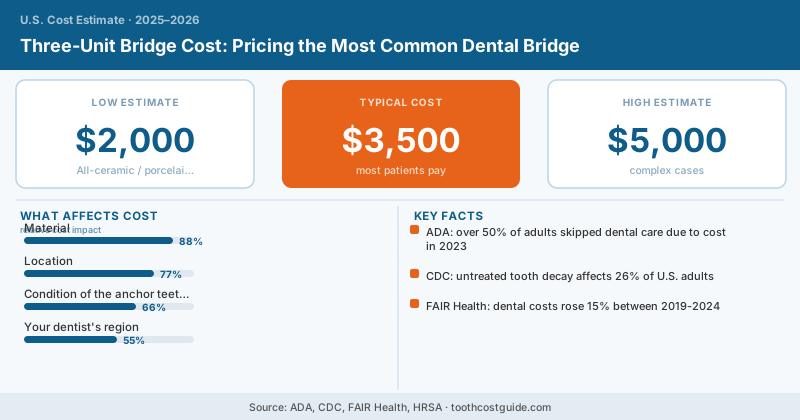
One missing tooth. Three crowns on the bill. That math catches a lot of people off guard — and it’s exactly how a three-unit bridge works. To fill a single gap, the dentist crowns the two teeth on either side and hangs a fake tooth between them. Three units, one solid piece. It’s the most common bridge in dentistry, and here’s what it really costs.
Three-Unit Bridge Costs at a Glance
| Material | Cost (No Insurance) | With 50% Insurance |
|---|---|---|
| Porcelain-fused-to-metal (PFM) | $2,000–$4,000 | $1,000–$2,000 |
| All-zirconia | $2,500–$5,000 | $1,250–$2,500 |
| All-ceramic / porcelain | $2,500–$4,500 | $1,250–$2,250 |
| Gold / high-noble alloy | $2,500–$5,000 | $1,250–$2,500 |
Most patients pay $2,500–$3,500 without insurance. Why so much for one missing tooth? You’re paying for three crowns, not one — the two anchor crowns plus the fake tooth (called a pontic) suspended between them.
How the Three Units Break Down
Picture the gap with a healthy tooth on each side. A three-unit bridge does this:
- Unit 1 — A crown over the tooth on the left of the gap (the abutment)
- Unit 2 — The pontic, a fake tooth filling the gap, fused to the crowns
- Unit 3 — A crown over the tooth on the right of the gap (the other abutment)
All three are cemented as one connected piece. The two anchor teeth carry the chewing load for the missing one. That’s why the price roughly equals three crowns — because mechanically, that’s what it is.
A three-unit bridge requires grinding down two healthy neighboring teeth to anchor it, which is the biggest downside. A single dental implant replaces just the missing tooth and leaves the neighbors untouched — but it costs more up front ($3,000–$6,000) and takes months. If the teeth beside the gap already need crowns anyway, a bridge can be the smarter, faster choice. If they’re perfectly healthy, an implant may be worth protecting them. See our dental bridge vs implant comparison.
What Drives the Price Up or Down
Material. PFM is the budget standard; zirconia and gold cost more but last longer and look or wear better. For a visible front bridge, you’ll want a tooth-colored material.
Location. Front bridges demand more aesthetic work and shade matching, which adds cost. Back bridges can use simpler materials.
Condition of the anchor teeth. If an abutment tooth needs a root canal or a core buildup first, that’s an added charge before the bridge work even starts.
Your dentist’s region. Big-city fees run well above rural ones for identical work.
How Insurance Treats Bridges
Most dental PPO plans cover bridges at 50% of the allowable fee after the deductible — the same major-service tier as crowns. That can cut a $3,000 bridge to around $1,500 out of pocket. But two things bite:
- Annual maximums. Many plans cap benefits at $1,000–$2,000 per year, and a bridge can blow right past that. The overflow is on you.
- Missing-tooth clauses. Some plans won’t cover replacing a tooth that was already missing before your coverage started.
A free predetermination spells out exactly what your plan pays. See how dental insurance works and dental insurance cost per month to plan around the cap.
Ways to Pay Less
Split across two plan years if the timing works — start prep in December, finish in January to tap two annual maximums.
Dental school clinics do bridges under supervision at 40–60% below private fees.
Compare against a partial denture. A removable partial denture can replace the same tooth for far less up front, though it’s less stable. And a dental savings plan or CareCredit financing helps uninsured patients.
Confirm whether the anchor teeth need any prep work — root canals, buildups, or treating decay — before the bridge fee is quoted. These add-ons can raise the total by $1,000 or more. Always get a written, itemized treatment plan listing all three units plus any prep, and submit it for predetermination.
Bottom Line
A three-unit bridge costs $2,000–$5,000, with most patients paying $2,500–$3,500 before insurance and roughly half that with a typical PPO. You’re paying for three crowns — two anchors and a pontic — to replace one missing tooth. It’s faster and cheaper up front than an implant but requires reshaping two healthy teeth. Compare it honestly against a dental implant and a partial before deciding, get a predetermination, and budget for any anchor-tooth prep.
Frequently Asked Questions
A three-unit bridge typically costs $2,000–$5,000 without insurance, depending on the material used. Porcelain bridges fall on the higher end of this range, while composite or metal options may be less expensive. The final price also varies by region and your dentist's experience level.
Most dental insurance plans cover 50% of bridge costs after you meet your deductible, leaving you responsible for $1,000–$2,500 out-of-pocket. However, many plans exclude or limit coverage for bridges, so check your policy first—some only cover up to $1,000–$1,500 annually for major procedures.
A three-unit bridge typically requires two appointments over 1–2 weeks: the first visit involves preparing the anchor teeth and taking impressions, and the second involves placing the finished bridge. There is no recovery period—you can eat and function normally immediately, though your dentist may recommend waiting 24 hours before eating hard foods.