Between 4% and 10% of newborns are born with tongue-tie — that’s the estimate from the American Academy of Pediatric Dentistry. For many families, that diagnosis lands in the middle of an already-stressful postpartum period, and the questions come fast: Who does this procedure? Does insurance cover it? How much does it cost? Does my baby actually need it?
Here’s a clear-eyed breakdown of what tongue-tie release costs, who performs it, and when it’s worth doing.
Tongue-Tie Release Costs by Procedure Type
| Procedure | Typical Cost | Best For |
|---|---|---|
| Infant laser frenotomy | $300–$800 | Newborns with breastfeeding difficulty |
| Child/adult conventional frenectomy | $600–$1,500 | Scissors or scalpel, local anesthesia |
| Adult laser frenectomy | $800–$2,000 | Precise release, faster soft-tissue healing |
| Myofunctional therapy (per session) | $100–$150 | Post-procedure rehab for older children/adults |
Cost depends on your geographic area, whether you’re going to a pediatric dentist vs. an ENT vs. a general dentist with laser training, and — most significantly — which procedure type your provider recommends.
The Three Procedure Types
Frenotomy (infant, scissors or laser): The standard first-line approach for newborns. The frenulum — the small band of tissue tethering the underside of the tongue to the floor of the mouth — is clipped or lasered. In newborns, this takes under a minute with minimal anesthesia. Many infants nurse almost immediately afterward, often with noticeable improvement in latch and suction.
Conventional frenectomy (scissors or scalpel): Used for older children and adults with thicker frenula that require more tissue removal. Performed under local anesthesia. Sutures are placed and typically dissolve within 1–2 weeks. Recovery is longer than a laser procedure — soreness for several days, soft foods recommended.
Laser frenectomy: Uses a soft-tissue diode or CO2 laser to remove the frenulum. Advantages include minimal bleeding, reduced infection risk, and faster soft-tissue healing compared to scissors in most patients. The higher cost reflects the equipment investment and specialized training required. Preferred by many pediatric dentists and adult patients who want the most comfortable post-procedure experience.
Who Performs Tongue-Tie Release
Newborn frenotomies are typically performed by pediatricians, ENTs, lactation-credentialed physicians, or pediatric dentists. Laser procedures are offered by pediatric dentists and general dentists with soft-tissue laser certification. Conventional frenectomies for adults are often done by oral surgeons or ENTs.
Provider choice matters beyond credentials. For infants, a provider who coordinates same-day lactation support after the procedure dramatically improves breastfeeding outcomes. A release with no post-procedure guidance produces weaker results. Ask specifically: “Do you work with a lactation consultant?” That follow-up isn’t a nice-to-have.
Ask your provider: “What’s your post-procedure protocol?” For infants, you want lactation support within hours of the release. For older children, ask whether they recommend speech therapy follow-up. For adults, confirm whether myofunctional therapy is part of the plan — without it, adult tongue-tie releases often produce limited functional improvement.
Does Insurance Cover Tongue-Tie Release?
Coverage varies — but it’s available more often than patients expect when the case is documented as medically necessary.
For infants with documented breastfeeding difficulty: Most insurers cover frenotomy when it’s coded appropriately and supported by clinical documentation from a pediatrician or lactation consultant. The ICD-10 diagnosis code Q38.1 (ankyloglossia) plus clinical notes documenting poor latch, low weight gain, or maternal pain typically support coverage. Submit through medical insurance, not dental — infant frenotomies almost always run through medical benefits.
For children with speech issues: Coverage is generally available when a speech-language pathologist has documented articulation errors attributable to tongue restriction. The assessment from the SLP is the critical piece of documentation.
For adults: Most variable. Some plans cover tongue-tie release under medical benefits; others treat adult cases as elective. Prior authorization is often required. Budget for potential out-of-pocket costs of $400–$900 if coverage is denied.
Key tip: Submit to both medical and dental insurance. Many patients assume tongue-tie release is a dental claim — but for infants and functional cases, medical coverage is often the better pathway.
The Myofunctional Therapy Cost
For adults and older children, tongue-tie release alone frequently produces disappointing results. The tongue has spent years compensating for restricted movement — releasing the frenulum doesn’t automatically undo those neuromuscular patterns. Myofunctional therapy (oral motor therapy with a certified orofacial myologist) retrains tongue posture and function after the release.
Expect $100–$150 per session for myofunctional therapy, with a typical course of 8–16 sessions. That adds $800–$2,400 to the total treatment cost for adults — a significant line item to plan for before committing to the procedure.
Adult tongue-tie release without myofunctional therapy often produces limited improvement. The procedure opens the physical range of motion; therapy is what trains the tongue to actually use it. If your provider doesn’t discuss post-release therapy as part of the plan, ask why — or find a provider who integrates it.
Realistic Total Cost by Patient Type
For a newborn with breastfeeding difficulty: $300–$800 for the frenotomy, likely covered by medical insurance with proper documentation. Lactation consultation fees ($100–$200) may apply separately.
For a school-age child with speech issues: $600–$1,500 for the release, plus potential speech therapy. Insurance often covers both when documentation is in order.
For an adult seeking improved tongue function: $800–$2,000 for laser or conventional frenectomy, plus $1,000–$2,000 in myofunctional therapy. Out-of-pocket exposure is real here — budget accordingly.
Bottom Line
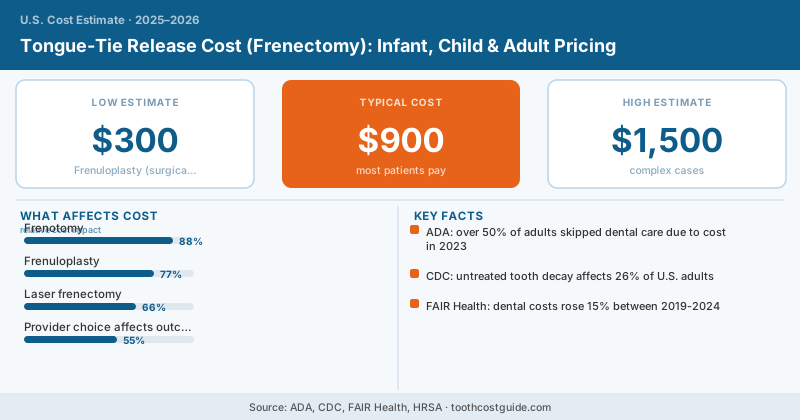
Tongue-tie release costs $300–$800 for infant frenotomy and $800–$2,000 for adult laser procedures. Insurance often covers it when functional necessity is documented — especially for infants and children. Adults face the highest total costs when myofunctional therapy is included, but the combined approach produces the best outcomes. Act quickly for infants: the breastfeeding relationship has a narrow window, and the AAPD’s clinical guidance supports early intervention for affected newborns with documented feeding impairment.
Frequently Asked Questions
Tongue-tie release for infants typically costs $300–$800 without insurance, depending on the provider and procedure type. Many pediatric dentists and oral surgeons offer this procedure, and costs may be lower in certain regions or at community health centers.
Most insurance plans cover tongue-tie release when deemed medically necessary, particularly when it interferes with breastfeeding or feeding. However, out-of-pocket costs typically range from $0–$500 depending on your deductible, copay, and whether the provider is in-network; always verify coverage with your plan before the procedure.
Tongue-tie release is often performed in the first few weeks of life if it's causing feeding problems, though some cases resolve without intervention. Not all tongue-ties require treatment—your pediatrician or lactation consultant can assess whether your baby has functional limitations that warrant the 10–15 minute procedure.