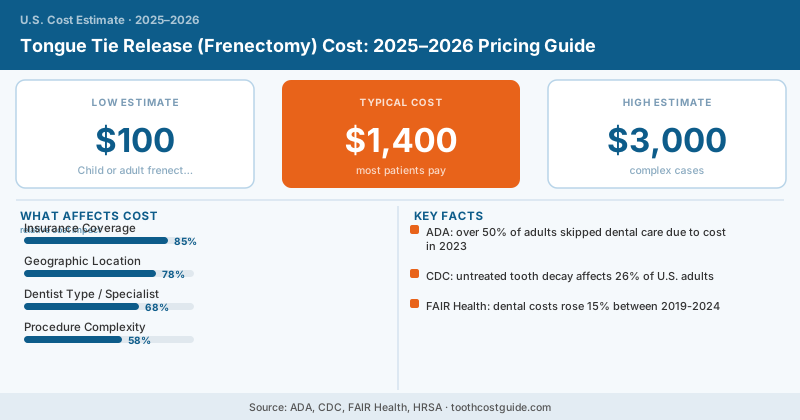
Most people assume tongue ties are only a newborn issue — something that gets snipped in the hospital and that’s that. They’re wrong. The American Academy of Otolaryngology estimates that lingual frenulum restrictions affect 4–10% of the population, and plenty of adults are walking around with an undiagnosed tie that’s causing speech issues, jaw tension, or even sleep apnea. Whether it’s for your infant or yourself, here’s what the procedure actually costs.
What Is a Frenectomy?
A frenectomy (also called a frenotomy or frenulectomy) releases the frenum — the small band of tissue connecting the tongue to the floor of the mouth. If that band is too tight or thick, it restricts tongue movement. There are two basic approaches:
- Conventional (scissors or scalpel) — quick, low-tech, often done in a pediatric dental or ENT office
- Laser frenectomy — uses a diode or CO₂ laser; less bleeding, faster healing, preferred for infants
For adults and older children, a more involved procedure called a lingual frenuloplasty may be needed when simple snipping isn’t enough.
| Procedure | Average Cost |
|---|---|
| Infant frenotomy (scissors/scalpel) | $300–$800 |
| Infant laser frenectomy | $500–$1,500 |
| Child or adult frenectomy | $800–$2,000 |
| Lingual frenuloplasty (adult, surgical) | $1,500–$3,000 |
| Myofunctional therapy (post-procedure) | $100–$200/session |
Who Does the Procedure?
This is where costs diverge sharply. Pediatric dentists, oral surgeons, ENTs, and lactation dentists all perform tongue tie releases — and they charge very differently.
A pediatric ENT doing a quick infant frenotomy in their office might charge $300–$500. A laser-focused pediatric dentist who includes pre- and post-procedure consultations could charge $1,200–$1,500 for the same age patient. For adults needing full frenuloplasty, an oral surgeon will typically be on the higher end.
Does Insurance Cover It?
Yes — sometimes. Medical insurance tends to cover tongue tie release better than dental insurance does, especially when there’s documentation of a functional problem:
- Feeding difficulties in infants — usually covered under medical with a pediatrician or lactation consultant’s referral
- Speech impairment — often covered with a speech-language pathologist’s documentation
- Elective (no documented function issue) — usually not covered
Dental insurance may classify a frenectomy under oral surgery and cover 50–80% after deductible, up to your annual maximum. But many dental plans specifically exclude frenectomies or limit them to age 18 and under. Always pre-authorize.
For infants especially, submit the claim to your medical insurer first. If they deny it, try dental. Some families get reimbursement from one or the other — rarely neither, if there’s documented feeding or speech impact.
The Myofunctional Therapy Factor
Many tongue tie specialists now recommend myofunctional therapy (essentially physical therapy for the tongue) before and after a frenectomy for older children and adults. It’s not optional if you want lasting results — releasing a tight frenum without retraining muscle patterns can lead to re-tethering or persistent dysfunction.
Myofunctional therapy runs $100–$200 per session, with typical treatment courses lasting 8–16 sessions. That adds $800–$3,200 to your total cost picture. Some speech therapists can provide myofunctional therapy, which may be partially covered by medical insurance.
Be skeptical of providers who push laser frenectomy for every infant without thorough assessment. The CDC notes that tongue tie diagnoses have increased dramatically in recent years, and not all cases require intervention. Get a second opinion if your infant is feeding and gaining weight normally.
Real Out-of-Pocket Costs
For an infant with breastfeeding difficulties:
- With medical insurance covering 80%: $60–$300 out-of-pocket
- Without insurance: $500–$1,500
For an adult with functional impairment:
- With dental insurance (50% coverage): $750–$1,500 out-of-pocket
- Without insurance: $1,500–$3,000+ (including myofunctional therapy)
The variation is real. Your best move is to call your medical insurer first, get a referral from your pediatrician or primary care physician, and document the functional problem clearly before the procedure.
Frequently Asked Questions
A lingual frenectomy typically costs between $300 and $3,000, depending on the release method, provider type, and patient age. Laser or surgical procedures tend to fall on the higher end ($1,500–$3,000), while simple scissor-based releases for newborns may cost $300–$800. Costs also vary significantly by region and whether the procedure is performed by a pediatrician, dentist, or ENT specialist.
Coverage varies widely by insurance plan and whether the procedure is deemed medically necessary versus elective. Many plans cover frenectomy for newborns with documented feeding difficulties, with out-of-pocket costs typically $0–$500 after deductible and copay. Adult frenectomies are more often classified as elective or cosmetic, resulting in little to no coverage; check your plan or call your insurer with your diagnosis code to confirm.
Recovery is typically very quick: most patients experience minimal discomfort and can return to normal eating within 24–48 hours. Newborns often resume nursing immediately after the procedure, while older children and adults may need 3–7 days of dietary adjustments (soft foods) to allow the wound to heal fully. Complete tissue healing usually occurs within 2–4 weeks with no permanent scarring.