An antibiotic prescription alone doesn’t cure a tooth abscess. It controls the bacterial load — reduces the swelling, knocks back the fever, makes the next few days tolerable. But antibiotics don’t reach the source of the infection, which is either a dead tooth pulp or a deep periodontal pocket. When the course ends, the bacteria are still there. The abscess comes back. This cycle repeats until someone removes or treats the infected source.
That’s the fundamental thing to understand before we talk money: treating an abscess always requires definitive dental work. The antibiotics are part of the plan, not the whole plan.
What a Tooth Abscess Is
An abscess is a pocket of pus formed by bacterial infection. Three types show up in dental contexts:
- Periapical abscess — the most common type. Bacteria infect the pulp (the nerve and blood vessel tissue inside the tooth), usually through deep decay or a cracked tooth. Infection spreads to the root tip and into surrounding bone.
- Periodontal abscess — originates in the gum and bone around the tooth rather than inside it. Common in patients with advanced gum disease.
- Gingival abscess — a superficial infection of the gum tissue itself, typically from a foreign body lodged in the gums.
All three hurt. All three require treatment. And all three can spread if ignored.
Why Ignoring It Is Genuinely Dangerous
The CDC’s 2020 Emergency Department data found that dental conditions — many of them abscess-related — account for approximately 2.1 million ER visits annually in the United States. The ADA has noted that many of these visits are for conditions that could have been treated at a dental office at a fraction of the cost.
More critically: dental infections don’t stay contained. A periapical abscess can track along the jaw, enter the neck space, and threaten the airway in a condition called Ludwig’s angina — a rapid-onset, potentially fatal cellulitis of the floor of the mouth. It’s rare, but it happens. The path from “tooth hurts” to “airway compromised” can unfold in 24–72 hours in severe cases.
The Treatment Path and What It Costs
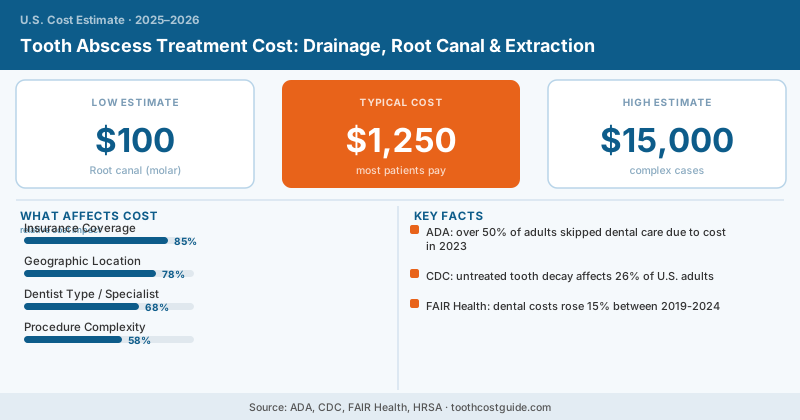
| Treatment | Estimated Cost | When It’s Used |
|---|---|---|
| Emergency dental visit | $100–$250 | Initial exam, X-rays, antibiotics, referral |
| Incision & drainage (I&D) | $150–$400 | Significant swelling requiring immediate drainage |
| Root canal (anterior tooth) | $700–$1,000 | Save the tooth; periapical abscess |
| Root canal (molar) | $1,000–$1,500 | Save the tooth; more complex anatomy |
| Extraction | $150–$350 (simple) / $300–$600 (surgical) | Remove the tooth instead of saving it |
| Hospital admission (severe cases) | $5,000–$15,000+ | Spreading infection, airway involvement |
The typical sequence: Emergency visit first — your dentist examines, takes an X-ray, prescribes antibiotics, and decides whether to drain immediately or wait for the infection to localize. If there’s significant swelling, incision and drainage happens that day. Then, once the acute infection is controlled (usually 5–7 days of antibiotics), you return for definitive treatment: either a root canal to save the tooth or an extraction to remove it.
Root canal vs. extraction: When the tooth is restorable, a root canal followed by a crown ($1,000–$1,800) preserves the tooth and prevents bone loss. Extraction is faster and cheaper upfront but creates a gap that eventually requires an implant ($3,500–$6,000) or bridge ($3,000–$5,000) if you want to replace it. For many patients, the root canal is cheaper long-term — but if the tooth is badly fractured or the bone loss too advanced, extraction is the only viable option.
Call your dentist today — or go to the ER immediately — if you experience any of these:
- Fever above 101°F
- Swelling extending to your jaw, neck, or floor of the mouth
- Difficulty swallowing or opening your mouth
- Difficulty breathing
- Feeling suddenly much more unwell than the day before
These are signs of spreading infection. Do not wait for a morning dental appointment if you’re experiencing any of them.
If You Don’t Have Dental Insurance
Uninsured patients have real options beyond postponing treatment:
Federally Qualified Health Centers (FQHCs) offer dental care on a sliding fee scale based on income. Find one at findahealthcenter.hrsa.gov. Emergency dental visits run $50–$150 at most FQHCs.
Dental school emergency clinics treat abscesses under faculty supervision. Costs are 40–70% lower than private practice. Treatment is slower but clinically sound.
Negotiating directly at private practices: many offices will discount emergency fees for patients in genuine financial hardship. Ask before assuming the sticker price is fixed.
What you shouldn’t do is substitute ER visits for dental care. ERs can prescribe pain medication and antibiotics — they can’t perform root canals or extractions. You’ll pay $500–$2,000 for an ER visit and still need all the dental treatment.
Insurance Coverage
Dental abscesses are covered as emergency treatment under virtually every dental plan. Emergency exam, X-rays, drainage, root canal, and extraction all have corresponding ADA procedure codes that standard plans reimburse. If you have coverage, use it — and call your insurer the same day to confirm in-network emergency providers if your regular dentist isn’t available.
Spreading dental infections can close the airway within hours. Difficulty swallowing, neck swelling, trismus (inability to open your mouth fully), or a high fever alongside dental pain are not symptoms to monitor at home overnight. Call 911 or go to the emergency room immediately. This is one of the few true dental emergencies where the ER is the right first call, not the dentist.
Bottom Line
A tooth abscess costs $500–$2,000 to treat definitively — more if the infection has spread or hospitalization is required. The cost is significant. The cost of not treating it is incalculable. Get seen today if you think you have an abscess. The antibiotics your physician or urgent care prescribes are buying time, not providing a cure.
Frequently Asked Questions
Expect $150–$400 for drainage, plus $700–$1,500 for a root canal or $150–$600 for an extraction. Total costs typically run $500–$2,000 depending on which treatment path is appropriate.
No. Antibiotics control the infection temporarily but can't eliminate the source — the infected pulp or periodontal pocket. Without definitive dental treatment, the abscess returns every time antibiotics finish.
Go to the ER immediately if you have difficulty swallowing, difficulty breathing, neck swelling, high fever (above 101°F), or inability to open your mouth fully. These signs suggest the infection has spread beyond the tooth and can become life-threatening.