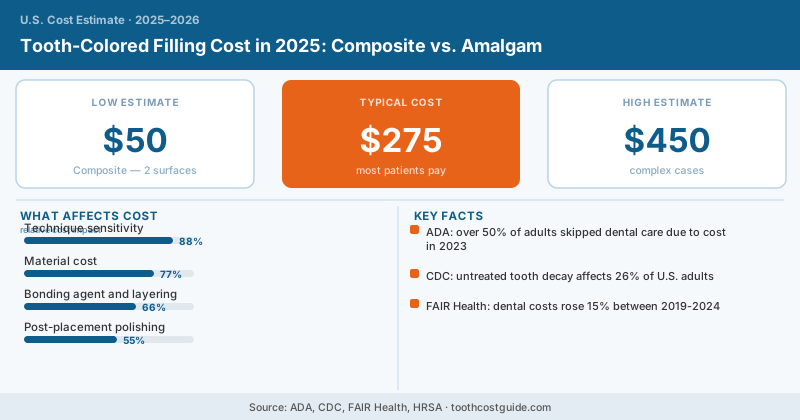
In 2010, amalgam (silver) fillings were still the default in many dental offices. By 2025, composite (tooth-colored) fillings have largely taken over — and not just for cosmetic reasons. Modern composite resins have closed much of the durability gap that once made amalgam the obvious choice for back teeth. The trade-off is cost: you’re paying $75–$200 more per tooth for a filling that matches your enamel.
Here’s when that price difference is worth it, and when it isn’t.
Cost by Filling Type and Surfaces
| Filling Type | Cost Per Tooth |
|---|---|
| Amalgam — 1 surface | $75–$150 |
| Amalgam — 2–3 surfaces | $100–$250 |
| Composite — 1 surface | $150–$250 |
| Composite — 2 surfaces | $200–$350 |
| Composite — 3+ surfaces (large) | $250–$450 |
| Composite — front tooth (Class III/IV) | $150–$300 |
| Interim therapeutic restoration (glass ionomer) | $50–$150 |
Why Composite Costs More
The price gap isn’t arbitrary. Composite fillings cost more for legitimate technical reasons:
Technique sensitivity: Composite must be placed in a completely dry field. Any contamination with saliva during placement compromises the bond. Dentists use cotton rolls, retraction cord, or rubber dams, and must work quickly and carefully. It takes longer than amalgam placement.
Material cost: Composite resin materials cost more than amalgam alloy.
Bonding agent and layering: Composite is placed in 2mm layers, each cured with a light before the next is placed. A multi-surface composite filling might involve 4–6 separate layers. Amalgam is packed in and shaped in one step.
Post-placement polishing: Composite requires polishing to achieve proper surface texture. Amalgam polishes naturally.
A composite filling appointment typically runs 20–30 minutes longer than an equivalent amalgam — that additional chair time is reflected in the fee.
Durability: The Honest Comparison
For years, amalgam was considered the durability winner. That’s less true today. A 2020 systematic review in the Journal of Dental Research found that modern composites perform comparably to amalgam in posterior (back tooth) restorations over 5-year follow-up periods, with some studies showing similar performance at 10 years.
That said, large, multi-surface composite fillings on high-stress chewing surfaces still see more failure over 10+ years compared to amalgam in the same location. For a small one-surface cavity on a first molar, a composite filling is a reasonable long-term choice. For a massive three-surface replacement filling on a heavily loaded second molar with existing fracture lines, some dentists still consider amalgam or a ceramic inlay/onlay a more conservative choice for longevity.
The honest truth: most patients’ composite fillings last 7–12 years before needing replacement. Well-placed amalgam fillings can last 15–20 years. Your dentist should be able to tell you honestly where your specific tooth falls on that spectrum.
Composite is the clear choice for front teeth — no one disputes this. Amalgam on an incisor or canine is visible every time you smile. For front teeth, composite’s aesthetics are the deciding factor, and its durability under lower bite forces is perfectly adequate. The amalgam-vs-composite debate really only applies to premolars and molars, where chewing forces are high and aesthetics matter less.
Does Insurance Cover Tooth-Colored Fillings?
The ADA reports that dental insurance coverage for composite fillings has evolved significantly — most plans now cover them on anterior (front) teeth without question. Posterior composite fillings are the sticking point.
Many dental plans cover posterior composites at the composite fee, others cover them only at the amalgam rate (requiring you to pay the difference), and some older plans still exclude posterior composites entirely.
Common coverage scenarios for a 2-surface molar composite:
- Composite fee: $300
- Plan covers composite on posterior teeth at 80%: you pay $60
- Plan covers at amalgam rate only (plan allowance $175 at 80% = $140): you pay $160 + the $125 difference
- Plan excludes posterior composite: you pay $300 in full (or $112.50 after amalgam coverage)
Call your insurer before your appointment and ask: “Does my plan cover composite fillings on back teeth, or only at the amalgam benefit level?” This single question prevents billing surprises.
Replacing Old Amalgam Fillings: Is It Worth the Cost?
“Should I have my silver fillings replaced?” is one of the most common questions dentists receive. The short answer: not solely for cosmetic or safety reasons. The ADA’s position — supported by the FDA and multiple systematic reviews — is that intact, non-failing amalgam fillings pose no demonstrated health risk and don’t require replacement.
Replacing a functional amalgam filling means removing tooth structure unnecessarily and accepting the risks of any restorative procedure (pulp irritation, post-op sensitivity, potential for fracture during removal). A $200 composite filling replacing a perfectly functional $0 (existing, paid-off) amalgam isn’t a wise use of resources.
When amalgam replacement is appropriate:
- The filling is failing — margins breaking down, secondary decay developing underneath, visible cracks
- The tooth needs a new restoration anyway for structural reasons
- The patient is pregnant (avoidance of new amalgam placement during pregnancy is a reasonable precaution; the FDA updated guidance in 2023 recommending avoidance for certain high-risk groups)
If a dentist recommends replacing all your amalgam fillings at once without specific clinical indications for each tooth, get a second opinion before proceeding. Replacing six functional fillings means six opportunities for post-operative sensitivity, possible pulp irritation on deeply placed fillings, and $1,200–$2,700 in fees. Each tooth needs an individual justification, not a blanket “silver fillings are bad” rationale.
Ways to Save
Dental school clinics charge $75–$200 for composite fillings that would run $150–$450 at a private practice. For multiple cavities, the savings compound quickly. A patient needing four two-surface composites might pay $800–$1,400 at a private practice; $300–$600 at a dental school.
Community health centers (Federally Qualified Health Centers) provide sliding-scale dental care based on income — fillings are among the services most commonly offered. Find locations at findahealthcenter.hrsa.gov.
FSA/HSA funds cover all filling types as qualified dental expenses.
Bottom Line
Tooth-colored composite fillings cost $150–$450, roughly $75–$200 more per tooth than amalgam. For visible teeth, composite is the universal choice. For back teeth, composite is the default in modern dentistry — it looks better, doesn’t contain mercury, and performs well for most patients over 7–12 years. Large fillings under heavy bite forces are the one area where the durability argument for amalgam still has some merit. Talk to your dentist about the specific situation for each tooth rather than making a blanket choice for all restorations.
Frequently Asked Questions
Tooth-colored composite fillings typically cost $150–$450 per tooth in 2025, depending on the filling size, tooth location, and your dentist's experience level. This is significantly higher than silver amalgam fillings, which cost $75–$250 per tooth, making composites $75–$200 more expensive on average.
Most dental insurance plans cover composite fillings at the same rate as amalgam fillings (usually 80%), but you'll pay the difference out-of-pocket for the premium material. For example, if insurance covers $100 of an amalgam filling, you'll cover the remaining $250–$350 cost of a $350 composite filling yourself.
A composite filling typically takes 20–30 minutes per tooth and hardens immediately under the dentist's UV light, so you can eat right away—though waiting 30 minutes is recommended to avoid sensitivity. Unlike amalgam, composite fillings don't require a waiting period and cause minimal tooth sensitivity after placement.