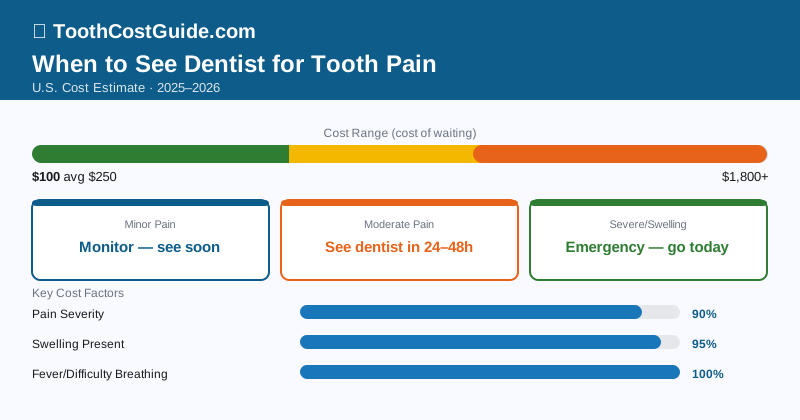
Two people call their dentist on Monday morning. One says, “I’ve had some sensitivity to cold for a few days.” The other says, “I’ve had throbbing pain all weekend and my cheek is swollen.” Both are describing tooth pain. But the similarity ends there — one is a routine appointment, the other is a same-day emergency with a cost range starting at $800.
Tooth pain exists on a spectrum from “schedule sometime this month” to “call 911 right now.” Getting the urgency level right isn’t just about your health — it directly determines what you’ll pay, where you go, and how quickly you need to act.
| Symptom Level | Urgency | Likely Treatment | Cost Range |
|---|---|---|---|
| Brief cold sensitivity, no pain at rest | Low — schedule within 2 weeks | Filling or desensitizing treatment | $100–$300 |
| Dull ache, localized, no swelling | Moderate — see dentist within 3 days | Filling or crown | $200–$1,800 |
| Sharp pain when biting | Moderate — see dentist within 2–3 days | Crown or root canal | $700–$3,300 |
| Spontaneous throbbing pain | High — see dentist same day | Root canal or extraction | $800–$3,300 |
| Pain with visible swelling, no fever | High — same day | Root canal + drainage | $800–$2,000 |
| Pain + swelling + fever | Emergency — today | Root canal or extraction + antibiotics | $800–$2,500 |
| Swelling in neck/trouble swallowing | Medical emergency — ER now | Hospital treatment | $5,000–$50,000 |
Level 1: Watch and Wait — Schedule Within Two Weeks
What it feels like: A brief flash of sensitivity when something cold hits a specific tooth, gone in under 10 seconds. No lingering pain. Nothing when the tooth is at rest. No swelling anywhere.
What it usually means: Early dentin sensitivity (enamel worn thin exposing underlying tooth layer), a small cavity just entering dentin, gum recession exposing root surfaces, or temporary sensitivity from a recent dental procedure. None of these require immediate intervention.
What to do: Book a routine dental appointment within 1–2 weeks. Use a desensitizing toothpaste in the meantime — Sensodyne and similar products take about two weeks to show full effect. Ibuprofen if the sensitivity is bothersome.
Cost if treated at this stage: $0–$300 — exam and X-rays, possibly a small filling or fluoride treatment.
Level 2: Urgent but Not Emergency — See a Dentist Within Three Days
What it feels like: A persistent dull ache in a specific tooth. Maybe some increased pain when chewing or biting. Lingering sensitivity after eating something hot or cold — it doesn’t go away in a few seconds, it takes a minute or two. No visible swelling. No fever. Ibuprofen takes the edge off.
What it usually means: Decay has reached the dentin layer beneath enamel, the nerve is irritated by a crack or failing filling, or an old restoration has developed a gap allowing bacteria in. The pulp is stressed but likely not yet irreversibly damaged.
What to do: Call the dentist first thing next morning. Describe the symptom clearly: “I have a persistent dull ache in a specific tooth that gets worse with biting.” Most offices can fit this in within 1–3 days. Take ibuprofen 400–600 mg every 6 hours for management.
Cost if treated at this stage: $150–$1,800 (filling, crown, or bonding). Still in the “before this became a root canal” range.
Level 3: Same-Day Dental Care Needed
What it feels like: Moderate to severe throbbing pain that doesn’t need a trigger — it’s there when you wake up, it wakes you at night. You can point to the tooth. There may be mild visible swelling (puffiness along the gum). No significant fever, or a low-grade one under 101°F.
What it usually means: Pulpitis (inflamed or dying pulp tissue) or an early periapical abscess — an infection forming at the root tip. The infection is still contained to the tooth and its immediate surroundings.
What to do: Call the dentist when the office opens and say: “I have severe tooth pain that woke me up last night and I may have an abscess.” Those words get you a same-day slot at most practices. While waiting, take ibuprofen and acetaminophen together — they work on different pain pathways and the combination is more effective than either alone.
Cost at this stage: $800–$2,500 — emergency exam plus root canal or extraction and antibiotics. This is where the dull ache from Level 2 lands if you wait too long.
Level 4: Dental Emergency — Go Today, Consider the ER
What it feels like: Significant swelling of the cheek or jaw that you can see in the mirror. Fever above 101°F. A bad taste in your mouth (pus drainage). You’re having trouble fully opening your jaw.
What it usually means: A dental abscess has spread beyond the tooth into surrounding soft tissue. This is a rapidly progressing infection that doesn’t respect the weekend schedule.
What to do: Call your dentist and describe your symptoms explicitly — “I have facial swelling and a fever.” Request to be seen within hours. If your dentist cannot see you that day, go to an urgent care center for immediate antibiotics and a dentist referral, or go directly to the ER. If swelling is growing visibly over the course of an hour, don’t wait for any appointment — go to the ER.
Cost at this stage: $1,500–$5,000 — ER visit or urgent care plus antibiotics, then dental follow-up for root canal or extraction.
Level 5: Medical Emergency — Call 911 or Go to the ER Right Now
What it feels like: Swelling extending below the jaw, in the neck, or toward the floor of the mouth. Difficulty swallowing. Difficulty breathing or a feeling that your airway is narrowing. Swelling around or below one eye. Your voice sounds different — muffled or as if you have something in your mouth when you don’t. Fever over 103°F. The swelling is visibly larger every time you check.
What it means: Ludwig’s angina, a submandibular space infection, or another deep neck space infection. These are life-threatening emergencies that can close off the airway within hours.
What to do: Call 911 or drive to the nearest emergency room immediately. Do not wait for a dentist appointment. Do not drive yourself if breathing is in any way compromised. This is no longer a dental problem — it’s an airway emergency.
Cost: $10,000–$100,000+ (hospital care, possible ICU, surgical drainage, sometimes airway management). Most health insurance plans have out-of-pocket maximums that cap your exposure, but this is a serious financial event on top of a serious health event.
Insurance Cost Impact at Each Level
With dental insurance:
- Level 1 (exam + small filling): $20–$80 out of pocket
- Level 2 (crown or root canal): $400–$1,000 out of pocket
- Level 3 (root canal + antibiotics): $500–$1,200 out of pocket
- Level 4 (ER + dental): $500–$2,500 out of pocket
- Level 5 (hospitalization): $2,000–$10,000+ (health plan out-of-pocket maximum limits total exposure)
Without insurance:
- Level 1: $100–$250
- Level 2: $200–$1,800
- Level 3: $800–$2,500
- Dental schools and FQHCs (Federally Qualified Health Centers) reduce all costs by 40–70% for uninsured patients at any level
Managing Pain While You Wait
For mild to moderate pain:
- Ibuprofen 400–600 mg every 6 hours reduces both pain and inflammation — it’s the most effective OTC choice for dental pain specifically
- Alternating ibuprofen with acetaminophen 500–1,000 mg increases total pain relief without exceeding safe doses of either
- Cold compress applied to the outside of the cheek for 15-minute intervals
- Avoid temperature extremes in food and drink
- OTC dental cement (Dentemp) for a lost filling or loose crown
For severe pain:
- Maximize the ibuprofen-acetaminophen combination — for adults without contraindications, this pairing is nearly as effective as many prescription pain medications for dental pain
- Apply clove oil (eugenol) with a cotton swab directly to the painful area — temporary but rapid topical nerve relief
- Do not apply heat to the outside of the face — heat accelerates bacterial spread in an infected area
- Do not place aspirin directly on gum tissue — it causes chemical burns
The Financial Argument for Acting at Level 2
CDC oral health data and ADA Health Policy Institute surveys both consistently show that delayed dental care costs significantly more on average than timely care. The mechanism is simple: a dull ache at Level 2 treated promptly is a $150–$300 filling in most cases. That same tooth treated six weeks later, after pain has become constant and unbearable, is now a root canal plus crown at $1,500–$3,600. The six-week delay didn’t save any money — it multiplied the cost by a factor of ten.
Getting to an FQHC or dental school for uninsured patients at Level 2 costs $80–$400. Waiting until Level 3 at those same facilities costs $400–$1,200. The incentives point the same direction at every income level.
Tooth pain that spreads to the ear, jaw, or neck — combined with swelling, fever, or difficulty swallowing — is a warning sign of serious infection. Do not use pain medication to mask these symptoms and delay care. Dental infections that spread to the airway can become fatal within 24–48 hours without surgical intervention.
The Bottom Line
Tooth pain urgency ranges from “schedule in two weeks” to “call 911 right now” — and costs range from $100 to six figures at the extremes. The five levels above give you a practical framework for honest self-assessment. When you’re uncertain, call your dentist’s office and describe what you’re experiencing — most practices can triage over the phone and tell you how soon you need to be seen. Never rationalize fever plus facial swelling as something that can wait until Monday. It can’t.
Frequently Asked Questions
Emergency dental visits for tooth pain typically range from $800 to $1,500 depending on the underlying cause and required treatment. This initial visit usually includes an exam and X-rays; if a root canal or extraction is needed, costs can climb to $2,000–$3,500. A routine same-day appointment without emergency fees runs $150–$300.
Most dental insurance plans cover emergency care at 50–80% after you meet your deductible, though coverage varies by plan. However, many plans exclude or limit coverage for root canals and extractions, leaving you responsible for 20–50% of the bill even with insurance. It's essential to review your specific plan documents or call your insurer before treatment to confirm coverage limits.
If you have severe throbbing pain, facial swelling, fever, or difficulty swallowing, seek emergency care the same day or visit an urgent care facility—delaying can lead to serious infections. For mild to moderate sensitivity or aching that started recently, schedule a regular appointment within 1–3 days to avoid worsening. Pain lasting more than a few days always warrants professional evaluation, even if it seems minor.