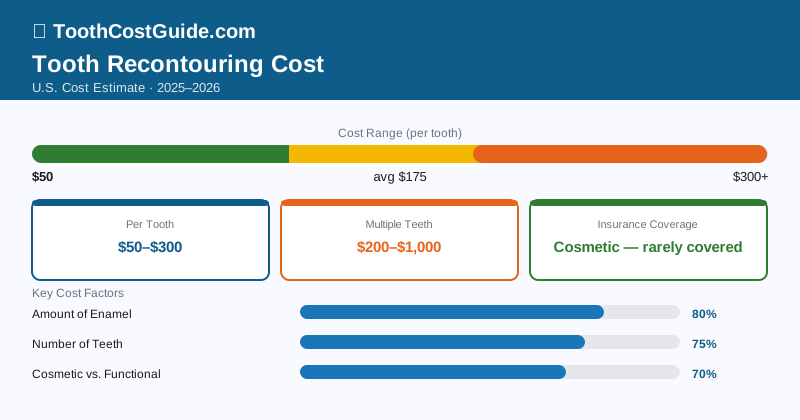
One slightly pointed canine. Two front teeth that aren’t quite the same length. A small chip from biting into something harder than expected. These are the kinds of things that catch your eye in photos and bug you quietly for years. And yet, fixing them often takes less than half an hour and costs $50–$200. It’s called tooth recontouring, and it’s one of the most underrated procedures in cosmetic dentistry.
Tooth Recontouring Costs by Scenario
| Procedure Scenario | Cost |
|---|---|
| Single tooth recontouring (minor chip or edge) | $50–$150 |
| Single tooth recontouring (more substantial reshaping) | $150–$300 |
| Multiple teeth (smile enhancement, 4–6 teeth) | $300–$1,200 |
| Recontouring combined with dental bonding | $200–$500 per tooth |
| Full smile recontouring (8–10 front teeth) | $600–$2,000 |
| Recontouring after braces (bite refinement) | $100–$400 |
| Enameloplasty for bite/occlusal adjustment | $50–$200 per tooth |
What This Procedure Actually Involves
Tooth recontouring — also called dental contouring, odontoplasty, or enameloplasty — uses dental burs and polishing instruments to remove small amounts of enamel, reshaping the tooth’s visible contour. No needles required in most cases. No lab fees, no waiting period, no recovery time. The result is immediate.
The procedure is inherently limited by enamel thickness. Most recontouring involves removing less than 1mm of enamel. Too much removal reaches the dentin layer and causes sensitivity. A skilled dentist knows exactly where that boundary is and works within it.
What Drives the Price Up or Down
How much needs to change. Smoothing a small chip takes 5–10 minutes and costs $50–$100. Reshaping a noticeably long, pointed, or asymmetrical front tooth — requiring careful proportioning to maintain natural curvature — takes 15–30 minutes and runs $150–$300.
How many teeth are involved. Recontouring is usually billed per tooth. One tooth costs $50–$300. Six to eight front teeth treated for a smile enhancement total $300–$2,000. Some dentists offer a per-visit flat rate when making multiple small adjustments at once, which can work out better than per-tooth pricing for patients needing several minor tweaks.
Whether bonding gets added in. Recontouring removes tooth structure. When a tooth has a deep notch, a significant asymmetry, or is too short rather than too long, composite bonding — adding resin material to build up the tooth — is needed alongside or instead of the removal. Combined recontouring and bonding runs $200–$500 per tooth. More than contouring alone, but far less than a veneer.
Who you see. General dentists and cosmetic-focused dentists both do this work. Practices marketing themselves as “cosmetic specialists” (there’s no ADA-recognized cosmetic specialty) often charge $200–$300 per tooth even for minor work. A general dentist with solid aesthetic skills charges $50–$150 for the same result. Look at before-and-after photos from actual recontouring cases, not practice branding.
Tooth recontouring is one of the most cost-effective smile improvements available. Minor chips, uneven edges, and slightly pointed canines can often be transformed in one appointment for under $200 total. For patients considering veneers ($900–$2,500 per tooth), recontouring is worth exploring first — it can achieve excellent results when the underlying tooth shape is good and only subtle adjustment is needed.
A Case-by-Case Breakdown
Minor chip or rough edge. The most common application. A small chip creating a sharp or uneven edge gets smoothed and polished in under 10 minutes. This kind of work can sometimes be added to the end of a routine cleaning appointment at minimal additional charge — $50–$100, sometimes nothing.
One incisor longer than the other. One central incisor that’s visibly longer than its twin can be shortened through careful recontouring. The challenge is maintaining the natural incisal edge curvature while achieving symmetry. A 15–20 minute procedure at $100–$250.
Pointed canines. Some people have naturally sharp canine tips that look aggressive or just “off.” Rounding those tips to a softer profile is one of the most popular and simplest applications of recontouring — $75–$200 per canine, 10 minutes each. Patients are often genuinely surprised at the improvement.
Smile makeover recontouring. When a dentist uses photos, smile analysis, and planning to recontour 6–10 front teeth for an overall improvement in smile proportions, this is more skill-intensive than single-tooth work. Some teeth might need shortening; others might need edge reshaping; some might need bonding added. Total cost: $600–$2,000. Compare that to the veneer alternative for those same 10 teeth: $9,000–$25,000.
Occlusal bite adjustment. After a new filling, crown, or orthodontic treatment, specific spots on back teeth sometimes need to be reduced for the bite to seat correctly. This is a functional application of the same technique, often included in the fee for the original work that altered the bite. When billed separately: $50–$200 per tooth.
Insurance: A Realistic Assessment
Tooth recontouring is predominantly cosmetic, and dental insurance excludes cosmetic procedures. That’s the baseline.
When coverage might apply:
If recontouring is performed for a functional reason — smoothing a rough tooth edge that’s been lacerating the tongue, adjusting a bite high spot after a filling, addressing a structurally compromised chip — your dentist can code and document the work in functional terms. Some of that may be covered.
For trauma-related chips:
If the chip happened from a documented accident, some dental policies have trauma-related provisions that treat the repair differently from cosmetic exclusions. Document the accident (date, what happened) and ask your dentist to include a narrative with the claim.
Combined functional and cosmetic work:
If a chipped tooth needs both a small restoration (covered at 70–80%) and some cosmetic recontouring (not covered), the covered portion gets paid and the cosmetic portion is patient-pay. Ask your dentist how they’ll code the claim.
Without insurance:
At $50–$300 per tooth, recontouring is one of the few cosmetic dental procedures that’s genuinely affordable without insurance. It’s a fraction of bonding ($200–$600) or veneers ($900–$2,500) for the right cases.
If your tooth was chipped by an accident or trauma, some dental policies have provisions for trauma-related repairs that may include recontouring or bonding. Document the cause (accident date, circumstances) and ask your dentist to include a narrative with the claim. Accident-related coverage operates differently from standard cosmetic exclusions.
When Recontouring Is and Isn’t the Right Call
Recontouring works well for:
- Minor chips that created a rough or sharp edge
- Slight length discrepancy between two adjacent teeth
- Pointed canine tips you’d prefer to be softer
- Small irregularities in the incisal edges of front teeth
- Occlusal high spots after dental work
Recontouring won’t work for:
- Teeth that are too short (you’d need bonding or veneers to add material)
- Significant discoloration (whitening or veneers address this, not enamel removal)
- Structurally compromised teeth with cracks or decay (those need restorative work first)
- Alignment problems (orthodontics, not contouring)
The clearest signal that recontouring is appropriate: the tooth’s underlying shape is good and only a small amount of material is in the wrong place. If you need to add material or address something structural, the procedure expands to include bonding, and pricing reflects that.
Ways to Pay Less
Ask about including it in a cleaning appointment. For a minor chip or rough edge, the actual work takes only a few minutes. Your dentist may be willing to do it at the end of a cleaning appointment for $50–$100 rather than scheduling a separate visit with its own per-visit overhead.
Group multiple teeth in one session. When several front teeth need small adjustments, doing them all in one visit can reduce the per-tooth cost compared to separate appointments.
Dental schools. Dental school cosmetic clinics perform recontouring at 50–70% below private practice rates. For aesthetic recontouring of multiple front teeth, a dental school can save $200–$600 compared to private practice.
Compare general dentists to “cosmetic specialists.” The tools and technique are the same. Look at actual work, not marketing language. A general dentist with a good aesthetic eye can do this work at lower cost.
HSA/FSA for functional cases. Recontouring performed for functional reasons (bite adjustment, repairing a structurally compromised chip) likely qualifies. Keep documentation of the functional purpose.
Financing This Procedure
At $50–$300 per tooth, this isn’t a financing situation for most patients. Even a multi-tooth smile enhancement at $600–$1,200 is manageable as a cash payment. If you’re looking at a $1,500–$2,000 full-smile recontouring case:
Dental membership plans: In-office membership plans ($99–$199/year) typically include a 15–20% discount on all procedures including cosmetic work. That 20% off a $1,000 case saves $200.
Pay upfront for a small cash discount. Cosmetic procedures are often not covered by insurance, which means the practice handles no insurance billing for them. Some dentists offer a 5–10% discount for upfront cash payment on cosmetic work — ask quietly.
Dental cost estimates in this guide reflect U.S. national averages for 2024–2025 and may vary significantly by geographic region, provider type, and individual treatment needs. Enamel removal is irreversible — ensure your dentist evaluates enamel thickness and discusses the procedure’s limitations before beginning. Always request a written treatment plan with itemized costs before agreeing to any dental work.
Frequently Asked Questions
Tooth recontouring typically costs $50–$300 per tooth, with most patients paying $50–$200 for a single tooth. The final price depends on how much reshaping is needed and your location, but the procedure is generally one of the most affordable cosmetic dental options available.
Most dental insurance plans classify tooth recontouring as a cosmetic procedure and do not cover it, leaving you responsible for the full $50–$300 cost per tooth. However, if recontouring is medically necessary to fix a broken tooth or improve bite function, some insurers may cover a portion; contact your plan directly to confirm your coverage.
Tooth recontouring typically takes 30 minutes or less per tooth, making it one of the quickest cosmetic dental treatments. You can usually return to normal activities immediately, and there is no recovery time or post-procedure downtime required.