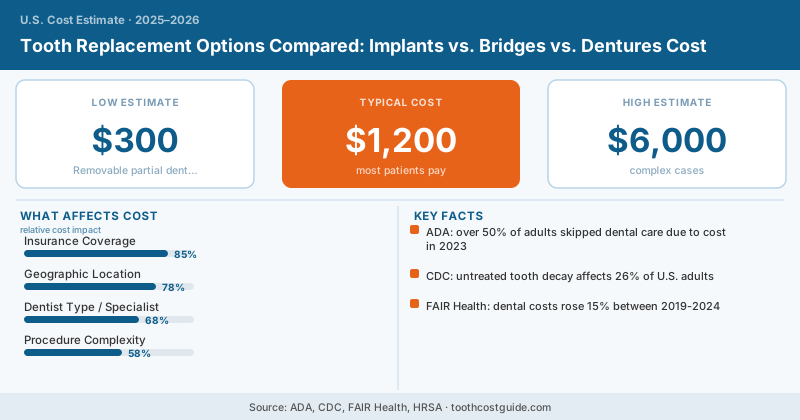
What does it actually cost to fill a gap where a tooth used to be? The honest answer: anywhere from $300 to $6,000, and the number depends entirely on which of four very different options you choose.
Every one of them solves the immediate problem — an empty space that affects chewing, speech, and how your smile looks. But they age differently, they cost differently over a 20-year span, and they treat your other teeth differently. Here’s the real comparison.
| Option | Upfront Cost | Typical Lifespan |
|---|---|---|
| Dental implant (single tooth) | $3,000–$6,000 | 20+ years / lifetime |
| Fixed bridge (3-unit) | $2,000–$5,000 | 10–15 years |
| Removable partial denture | $600–$1,800 | 5–8 years |
| Flipper (temporary partial) | $300–$800 | 1–3 years |
Dental Implants: Highest Upfront, Best Long-Term Value
An implant replaces the missing tooth root with a titanium post, topped with a crown. It’s the only option that doesn’t touch your neighboring teeth at all. The American Academy of Implant Dentistry estimates more than 3 million Americans currently have implants, with about 500,000 more placed each year — a number that’s grown steadily as costs have become more predictable.
The catch is upfront cost and time: implants require a healing period of 3–6 months between placement and the final crown, plus a healthy amount of bone at the site. If you’ve been missing the tooth for years, bone grafting may add $300–$800 before the implant can even go in.
Fixed Bridges: Faster, But Costs Your Healthy Teeth
A bridge fills the gap using the two neighboring teeth as anchors, which means those teeth get ground down to accept crowns — even if they were perfectly healthy before. That’s the biggest trade-off: you’re sacrificing structure on two good teeth to replace one bad one.
Bridges are faster than implants (2–3 weeks from prep to placement, no healing period needed) and cost roughly the same range. But because the anchor teeth are now committed to supporting the bridge, if either one fails down the road, you lose more than just the original gap.
Removable Partial Dentures: Budget-Friendly, More Maintenance
A partial denture clips onto your remaining teeth and comes out for cleaning every night. It’s a fraction of the cost of implants or bridges, but it comes with daily trade-offs: it can shift while eating, needs periodic relines as your gums change shape, and most wearers say it takes a few weeks to get used to speaking normally with it in.
Single missing tooth with healthy bone and good overall health: implant is usually the best long-term value. Multiple missing teeth in a row, or you want to avoid surgery: bridge or partial denture. Temporary solution while healing from an extraction, before an implant: a flipper.
Flippers: A Bridge to the Real Solution
A flipper is a lightweight, removable acrylic tooth on a small plate, usually made same-day or within a few days of an extraction. It’s never meant to be permanent — think of it as a placeholder that keeps your smile intact while you save for or plan the actual long-term fix, whether that’s an implant or a bridge.
The Real Math Over 20 Years
Run the numbers past a single purchase price and the picture shifts. An implant at $4,500 that lasts 20+ years works out to roughly $225/year. A bridge at $3,500 that needs replacing every 12 years costs about $290/year once you factor in the eventual redo. A partial denture at $1,200 replaced every 6 years runs about $200/year but adds ongoing costs for relines and adjustments.
Don’t leave a gap unaddressed while you decide. Neighboring teeth drift into the empty space over months, and the opposing tooth can supra-erupt down or up into the gap. Both problems make future treatment more complicated and expensive — even a temporary flipper prevents this shift while you weigh your options.
The Bottom Line
There’s no single “best” tooth replacement — there’s a best option for your bone health, budget, timeline, and how many teeth need replacing. Implants win on long-term value if your bone and budget support them. Bridges are faster but cost you healthy tooth structure. Partial dentures are the most affordable path for multiple missing teeth. Get quotes for at least two of these options before committing — the price spread within a single city can be significant.
Frequently Asked Questions
A removable partial denture or 'flipper' is the cheapest option at $300–$1,500, though it's meant as a short-term or budget solution. A fixed bridge ($2,000–$5,000) and a dental implant ($3,000–$6,000) cost more upfront but tend to last far longer per dollar spent over a lifetime.
Implants typically cost more upfront than bridges but don't require grinding down neighboring healthy teeth, and they can last 20+ years or a lifetime with proper care, compared to 10–15 years for a bridge. Over a 20-year span, implants are often the better value despite the higher initial cost.
Dental implants can last 20+ years or a lifetime with good oral hygiene. Fixed bridges typically last 10–15 years before needing replacement. Removable partial dentures last 5–8 years on average, and flippers are designed as temporary solutions lasting 1–3 years.