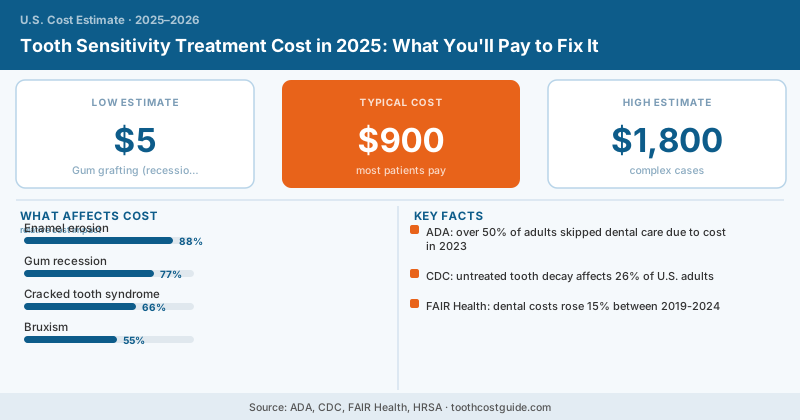
That sharp jolt when ice water hits a tooth? More than 40 million American adults deal with it regularly, according to the Academy of General Dentistry. The frustrating part isn’t the pain itself — it’s that treatment cost ranges wildly based on why it’s happening. Desensitizing toothpaste costs $5 a tube. A crown to protect a cracked tooth costs $1,000–$1,800. The difference is diagnosis.
Here’s what you’ll actually pay at each level of care.
Cost by Treatment Type
| Treatment | Average Cost (No Insurance) |
|---|---|
| Desensitizing toothpaste (OTC) | $5–$15/tube |
| In-office fluoride varnish | $25–$75 |
| Dental bonding (exposed root) | $300–$600 per tooth |
| Gum grafting (recession) | $600–$1,200 per area |
| Root canal (pulp damage) | $700–$1,800 |
| Dental crown (cracked tooth) | $1,000–$1,800 |
| Night guard (bruxism-related) | $300–$800 |
Why Diagnosis Drives Everything
Tooth sensitivity isn’t a diagnosis — it’s a symptom. Six different underlying causes produce identical sharp pain, and each requires a different fix.
Enamel erosion is the most common culprit. Acid from soda, citrus, and reflux wears away enamel over years, exposing the microscopic tubules in the dentin beneath. Cold, heat, and sweet foods travel through those tubules directly to the nerve. Mild erosion responds well to fluoride varnish applied in-office ($25–$75) and prescription-strength fluoride toothpaste. Severe erosion may require dental bonding to cover exposed dentin ($300–$600 per tooth).
Gum recession exposes root surfaces that were never meant to see the outside world. Root dentin is far more porous than enamel. If your sensitivity concentrates along the gumline, recession is likely. Mild recession may respond to desensitizing agents and bonding. Significant recession causing structural concern typically requires a gum graft ($600–$1,200 per area).
Cracked tooth syndrome produces sensitivity to pressure and cold that lingers. It’s frequently misdiagnosed because cracks don’t always show on x-rays. If your pain is sharp with biting and lingers 10–15 seconds after cold exposure, mention this to your dentist explicitly. Treatment depends on crack depth — a crown ($1,000–$1,800) protects the tooth if the crack hasn’t reached the pulp; a root canal is needed if it has.
Bruxism — nighttime grinding — wears enamel from chewing surfaces and can also crack teeth. If your dentist sees flat, worn occlusal surfaces, a night guard ($300–$800 for a custom lab-fabricated one) addresses the cause.
For sensitivity caused by mild enamel erosion or exposed dentin without recession, potassium nitrate desensitizing toothpaste actually works. It takes 4–6 weeks of consistent use to notice a difference. Brush with it last thing before bed, don’t rinse after — let it sit. Products with stannous fluoride (Sensodyne, Colgate Sensitive Pro-Relief) outperform potassium nitrate formulas in several clinical trials. If symptoms improve meaningfully, you’ve identified a low-cost solution. If they don’t improve after 8 weeks, that’s diagnostic information: the cause is structural, not surface-level.
What the Dentist Visit Itself Costs
Before any treatment, you need a diagnosis. A routine exam with x-rays runs $75–$350 depending on provider and location. Some offices waive or reduce the exam fee if you’re a new patient — ask when you call.
The ADA recommends a cold-sensitivity test using a cotton pellet soaked in ethyl chloride or ice applied to each suspect tooth. Your dentist notes how long sensitivity lingers after the cold is removed. Lingering more than 15 seconds suggests pulp involvement (potentially a root canal situation). Immediate sharp pain that stops right when the cold is removed points to dentin hypersensitivity.
Percussion testing (tapping the tooth) and biting tests identify cracked tooth syndrome. This complete diagnostic workup should be part of your standard exam — it shouldn’t cost extra.
With Dental Insurance
Coverage for sensitivity treatments varies widely:
- Fluoride varnish — typically covered at 100% for adults under many plans; some plans exclude adults over 18. Check your benefits.
- Bonding/composite on exposed roots — often covered at 50–80% under basic restorative coverage.
- Gum grafts — generally covered as periodontal treatment at 50% after deductible.
- Root canal — 50–80% coverage depending on whether your plan classifies it as basic or major.
- Crown — typically 50% coverage under major restorative, subject to annual maximum.
- Night guard — covered by some plans, excluded by others. Specifically ask your insurer.
If your dentist recommends a gum graft for sensitivity, ask whether the recommendation is based on structural recession risk (bone loss concern) versus comfort alone. Insurance may require documentation of structural need — not just sensitivity — to cover the procedure. Get the clinical reasoning in writing before submitting a predetermination.
Ways to Save
The highest-leverage move is accurate diagnosis first. Spending $300 on bonding for what turns out to be a cracked tooth is money wasted — the bonding doesn’t fix a crack. A thorough exam with diagnostic testing before any treatment prevents this.
For confirmed dentin hypersensitivity without structural issues:
- Try a full 8-week course of desensitizing toothpaste before proceeding to in-office treatment
- Ask about in-office fluoride varnish or desensitizing agents (oxalic acid, glutaraldehyde) — one application can provide months of relief for $25–$75
For recession-related sensitivity, dental school clinics charge 40–65% less for gum grafting than private practices. The procedure is more complex than a filling, but supervised graduate students perform it competently.
For all sensitivity treatments, using HSA or FSA funds provides an effective 22–37% discount based on your tax bracket. These are fully qualified dental expenses.
Bottom Line
Tooth sensitivity treatment costs anywhere from $5 to $1,800+ — and the only way to know which end of that range applies to you is a proper diagnosis. Start with a comprehensive exam if you haven’t had one recently. Try desensitizing toothpaste for 8 weeks if your dentist confirms surface-level dentin hypersensitivity. For structural causes — cracks, significant recession, pulp involvement — the cost climbs, but so does the necessity.
Untreated sensitivity from a cracked tooth or deep recession tends to worsen, not resolve on its own. Getting ahead of it is almost always cheaper than addressing it later.
Frequently Asked Questions
Desensitizing toothpaste is the most affordable option at $5–$15 per tube and works for mild sensitivity by blocking sensation to the tooth nerve. Professional in-office treatments like fluoride gel or bonding resin cost $100–$300 per tooth, while crowns for severely damaged teeth run $1,000–$1,800 each.
Most dental insurance plans cover professional sensitivity treatments like fluoride applications as preventive care at 100%, but coverage varies by plan. Crowns typically fall under major restorative coverage at 50% coinsurance after your deductible, leaving you responsible for $500–$900 out-of-pocket per crown.
Desensitizing toothpaste takes 2–3 weeks of consistent use to reduce sensitivity, while professional fluoride treatments provide relief within 24 hours and last 3–6 months. You should see a dentist first to identify the cause—sensitivity from gum recession, decay, or cracks requires different treatments ranging from simple topical applications to expensive crowns.