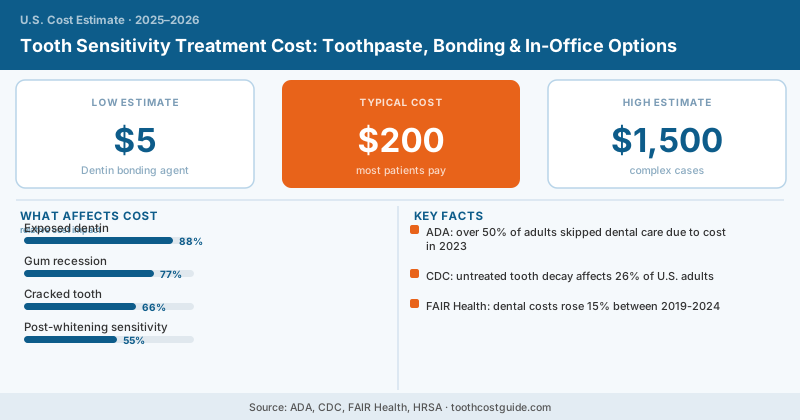
About 40 million American adults deal with tooth sensitivity, according to the American Dental Association. That’s a lot of people wincing at ice cream or holding their breath before a cold sip of water. But here’s the thing most people don’t know: the right treatment depends entirely on why your teeth are sensitive — and the options range from a $6 tube of toothpaste to a $1,500 root canal. Picking the wrong starting point wastes money. Picking the right one can fix the problem in two weeks for almost nothing.
What’s Actually Causing the Pain
Sensitivity isn’t a condition — it’s a symptom. Four different problems produce it, and they need four different solutions.
Exposed dentin. The outer enamel layer is gone or thinned, exposing the dentin underneath. Dentin is full of tiny tubules that connect to the nerve. Cold, heat, sweet foods, or even air pressure moves fluid through those tubules and triggers pain. This is dentin hypersensitivity — the most common cause.
Gum recession. When gums pull away from teeth, the root surface becomes exposed. Root surfaces have no enamel at all. They’re covered only by cementum, which wears down quickly. Recession-driven sensitivity is often worse with cold and brushing.
Cracked tooth. A crack you can’t see on X-ray can cause sharp, momentary pain — usually triggered by specific biting angles or temperature changes. This is different from dentin hypersensitivity and won’t respond to desensitizing products.
Post-whitening sensitivity. Temporary and predictable. Whitening agents briefly increase dentin permeability. It typically resolves within 48–72 hours on its own, or faster with desensitizing toothpaste.
Pulpitis / nerve involvement. This is where the stakes change. If the pain lingers for more than 30 seconds after the stimulus is gone, or comes on spontaneously without any trigger, that’s not surface sensitivity — it’s likely inflammation or infection inside the tooth. That’s a different treatment path entirely, and it’s more expensive.
Identifying the actual cause before you spend anything is the most important step. A dentist can test pulp vitality, probe for recession, and check for cracks in a standard exam. Don’t skip this.
| Treatment | Cost (No Insurance) | How Long It Lasts |
|---|---|---|
| Desensitizing toothpaste (OTC) | $5–$15/month | Ongoing (while using) |
| Prescription fluoride toothpaste | $20–$40/tube | Ongoing (while using) |
| In-office fluoride varnish | $25–$75/visit | 3–6 months |
| Dentin bonding agent | $100–$300/tooth | 2–5 years |
| Gum graft (for recession) | $600–$1,200/tooth | Long-term |
| Root canal (nerve involved) | $700–$1,500 | Permanent resolution |
The Treatment Ladder: Starting Cheap, Moving Up Only When Needed
Step 1: Desensitizing toothpaste — $5–$15/month
Toothpastes with potassium nitrate (like Sensodyne Original) or stannous fluoride (like Sensodyne Pronamel or Colgate Sensitive) are the right first move for straightforward dentin hypersensitivity. Potassium nitrate works by depolarizing nerve fibers. Stannous fluoride physically plugs the dentin tubules. Neither works overnight. You need to use them consistently — twice daily, for at least two weeks — before you can judge whether they’re helping. Many people try for three days, don’t feel much, and give up. That’s the wrong timeframe.
A 2022 systematic review published in the Journal of the American Dental Association found that both potassium nitrate and stannous fluoride formulations showed statistically significant reductions in dentin hypersensitivity with regular use over 4–8 weeks, with stannous fluoride showing a slight edge in tubule occlusion.
Don’t rinse after brushing — spit, and leave the residue on your teeth. That simple change improves the product’s effectiveness.
Step 2: In-office fluoride varnish — $25–$75 per visit
If toothpaste isn’t cutting it after a month, the next step is a dentist-applied fluoride varnish. The concentration is far higher than any OTC product. It’s painted on in a few minutes and sets quickly. Results last three to six months, then you’ll need it again. For mild-to-moderate hypersensitivity without underlying structural issues, this is often the most efficient treatment per dollar spent.
Step 3: Dentin bonding agent — $100–$300 per tooth
For exposed dentin that isn’t resolving with topical approaches, a dentist can seal the exposed tubules directly with a bonding agent or composite resin. It’s more durable than varnish — typically lasting two to five years. It’s the right move when recession has exposed significant root surface and you’ve tried conservative approaches without adequate relief.
Step 4: Gum graft — $600–$1,200 per tooth
If recession is the root cause, covering that exposed root surface with a gum graft is the most effective long-term fix. It’s a surgical procedure. Recovery takes one to two weeks. But it addresses the cause rather than masking the symptom. See our full guide on gum recession treatment cost for a complete breakdown.
Step 5: Root canal — $700–$1,500
When sensitivity has crossed into pulpitis — nerve inflammation or infection — root canal therapy is the only definitive treatment. See our root canal cost guide for specifics. This isn’t a step for regular tooth sensitivity. It’s the path for pain that lingers, pain that wakes you up, or pain that exists without any stimulus.
These signs mean you’re past surface sensitivity and need prompt evaluation:
- Pain lasting more than 30 seconds after cold, heat, or sweet stimulus
- Spontaneous pain with no trigger at all
- Throbbing or deep aching that persists between stimuli
- Swelling near a tooth or in the jaw
- Pain specifically when biting down on a tooth
Any of these points toward pulpitis, a cracked tooth into the pulp, or an abscess — not dentin hypersensitivity. Desensitizing products won’t help and waiting will make treatment more expensive.
What Insurance Actually Covers
- Desensitizing toothpaste: Not covered.
- Fluoride varnish: Some plans cover it for adults at elevated cavity risk; check your benefits. Where covered, it’s typically 80–100% after deductible.
- Dentin bonding: Usually covered at 40–80% under basic or major restorative, depending on classification. Your dentist’s billing code determines how it’s classified.
- Gum graft: Typically covered at 40–60% under major restorative if medically necessary; cosmetic-only cases may be denied.
- Root canal: 40–60% under most plans, subject to your annual maximum.
Pain that lingers more than 30 seconds after a stimulus — or comes on without any trigger — is not tooth sensitivity. It’s a sign of nerve involvement. Don’t treat it with toothpaste. Don’t wait it out. See a dentist promptly; untreated pulpitis can progress to abscess and spread beyond the tooth.
The Bottom Line
Start with a desensitizing toothpaste and commit to two full weeks before judging. If that doesn’t resolve it, in-office fluoride varnish at $25–$75 per visit is the next logical step. Only move to dentin bonding, grafting, or root canal therapy once you know the underlying cause — which requires a clinical exam. Spending $150 on the wrong treatment is how this gets expensive. Spending $6 on the right tube of toothpaste is how it doesn’t.
Frequently Asked Questions
Costs range from $5–$15/month for desensitizing toothpaste to $25–$75 per visit for in-office fluoride varnish, or $100–$300 per tooth for dentin bonding. If recession or nerve involvement is the cause, treatment can run $600–$1,500.
In-office fluoride varnish is sometimes covered for adults at risk for cavities — check your plan. Dentin bonding is typically covered at 40–80% if classified as restorative. Desensitizing toothpaste is not covered.
Sudden sensitivity most often means enamel erosion, gum recession exposing dentin, a new cavity, a crack, or post-whitening reaction. If the pain lingers more than 30 seconds after a stimulus, that's pulpitis — not ordinary sensitivity — and needs prompt evaluation.