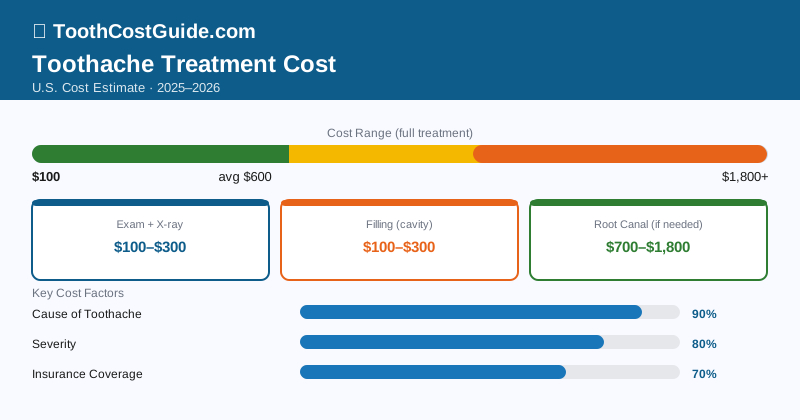
A toothache is a symptom, not a diagnosis. The exact same pain — throbbing molar, waking you at night — can mean a $150 filling or a $2,500 root canal plus crown. You can’t know which until someone takes an X-ray and looks.
What you can know is this: the longer you wait, the more expensive it becomes. A small cavity treated at $150 becomes a $2,000 problem in 12–18 months. Here’s the full cost picture, and how to navigate it.
Cost by Cause
| What’s Causing the Pain | Treatment | Cost (No Insurance) |
|---|---|---|
| Cavity (hasn’t reached the nerve) | Composite filling | $100–$300 |
| Cracked or chipped tooth | Bonding or crown | $200–$1,800 |
| Lost or broken filling | Replacement filling | $100–$300 |
| Infected pulp (pulpitis / abscess) | Root canal + crown | $1,200–$3,300 |
| Impacted wisdom tooth | Extraction | $300–$800 |
| Gum disease causing pain | Deep cleaning (SRP) | $200–$400 per quadrant |
| Sinus pressure (referred pain — no dental cause) | Urgent care or OTC | $0–$200 |
| Exposed root / sensitivity | Desensitizing treatment or crown | $50–$1,500 |
The most important number: the exam + X-rays to find out which scenario you’re in runs $75–$200. This is not optional — you cannot self-diagnose the cause of a toothache. Don’t let a dentist treat without imaging, and don’t skip the diagnosis hoping the pain resolves on its own.
What the Pain Might Be Telling You
Tooth pain has patterns that suggest — though don’t confirm — the likely cause.
Sharp pain when biting down: Often a cracked tooth or a failing old filling. The crack or void allows the tooth to flex under pressure. Cost range: $100–$1,500 depending on severity.
Sensitivity to cold that lingers 10–30 seconds after the stimulus is removed: This pattern (lingering cold sensitivity, not just brief sensitivity) is a strong indicator that the pulp (the nerve inside the tooth) is inflamed or infected — classic pulpitis. Treatment: root canal + crown, $1,700–$3,300 total.
Brief, sharp sensitivity to cold that resolves immediately: Normal or mild sensitivity, not pulpitis. Often responds to desensitizing toothpaste or a fluoride treatment.
Throbbing pain that wakes you up: Pressure from an infected tooth’s pus buildup. Classic abscess presentation. Requires antibiotics (to manage infection) and definitive treatment — root canal or extraction. This doesn’t resolve on its own.
Dull ache, hard to localize, in a back molar area: Could be gum disease, a wisdom tooth issue, or sinus pressure. Exam required to distinguish.
Pain with any swelling or fever: Stop reading this page and call a dentist or go to urgent care. This is an active infection that needs immediate attention.
The Delay Math
Every month a cavity goes untreated, it grows. Here’s what that progression looks like in dollars:
- Enamel cavity, no symptoms: $150 composite filling
- Cavity into dentin: $150–$250 composite
- Cavity near the pulp, mild sensitivity: $200–$300 filling (possibly larger, multiple surfaces)
- Cavity reaches the pulp: Root canal required. $700–$1,500 for the root canal alone
- Abscess developed: Root canal + antibiotics + possible surgical drainage. $1,000–$2,000
- Root canal + crown to protect treated tooth: Total $1,700–$3,300
- Tooth non-restorable, extraction needed: $150–$500 extraction + $3,500–$6,000 implant to replace it later
The $150 problem becomes a $5,000+ problem. Not as a hypothetical — this is a predictable progression that dentists see constantly.
With vs. Without Insurance
Coverage varies by what’s causing the pain:
- Exam + X-rays: 80–100% covered under diagnostic benefits ($0–$40 copay)
- Filling: 70–90% covered under basic restorative ($15–$60 out of pocket)
- Root canal: 50–80% under major or basic coverage ($300–$700 out of pocket)
- Crown after root canal: 50% under major ($400–$800 out of pocket)
- Extraction: 50–80% depending on complexity ($50–$200 out of pocket)
Total realistic cost with insurance for a root canal + crown situation: $700–$1,100 out of pocket, assuming standard PPO with 50% coverage and $1,500 annual maximum not yet fully used. More if the annual max is already partially exhausted.
Without insurance: the same situation runs $1,700–$3,300. A dental school clinic brings this to $800–$1,600. A dental discount plan brings it to $1,200–$2,000.
Managing Pain Before Your Appointment
You need a dental appointment, not a home remedy. But while you wait:
Ibuprofen 400–600mg every 6–8 hours (if you can take NSAIDs) is the most effective OTC option for dental pain — it addresses the inflammation driving much of the discomfort. Acetaminophen works too but doesn’t address inflammation. Alternating ibuprofen and acetaminophen every 3–4 hours is more effective than either alone for moderate-severe pain.
Clove oil (eugenol) applied with a cotton ball directly to the painful tooth area provides brief topical numbing. Available at pharmacies. Helps for 15–30 minutes. Not a treatment — a temporary relief measure.
Cold pack on the cheek for swelling-related pain. 15 minutes on, 15 minutes off.
What doesn’t work: heat, aspirin placed on the tooth (this burns gum tissue), and waiting.
Ibuprofen doesn’t just mask pain — it reduces the prostaglandin-mediated inflammation that amplifies dental pain signals. This is why dental providers often recommend it over acetaminophen for acute dental pain. The effective dental dose is typically 400–600mg (2–3 standard tablets), not the single 200mg tablet commonly self-administered. Always check with your provider if you have kidney issues, GI concerns, or take blood thinners.
Getting Treated Without Good Insurance
Dental school clinics: Root canals at dental school programs cost $300–$700 vs. $700–$1,500 privately. For a filling, $40–$90 vs. $150–$300. The tradeoff is time — longer appointments, more visits. For planned treatment rather than acute emergencies, it’s the most reliable cost reduction available.
Community health centers (FQHCs): Sliding-scale dental fees based on income. Many have same-day or next-day availability. Find one at findahealthcenter.hrsa.gov or call 211.
Dental discount plans: $80–$150/year provides 20–40% off all dental services at participating offices. A discount plan can reduce a $1,500 root canal to $900–$1,100. No waiting period. Worth the annual cost if you’re uninsured and need treatment soon.
Extraction vs. root canal: If the cost of a root canal plus crown ($1,700–$3,300) is genuinely unaffordable and the pain is severe, extraction ($150–$400) addresses the immediate problem. It’s not the preferred solution because the gap requires eventual replacement — but it stops the acute infection. A temporary flipper ($300–$500) fills the cosmetic gap while you save for a longer-term replacement.
The Emergency Signs That Can’t Wait
These symptoms require a same-day call to a dentist or a trip to urgent care or the ER — not a wait-and-see approach:
- Swelling that has spread to your jaw, cheek, or floor of the mouth
- Difficulty swallowing or opening your mouth fully
- Fever above 101°F with dental pain
- Pain that’s so severe it’s not controlled by any OTC medication
A spreading dental infection can reach the airway or enter the bloodstream. People are hospitalized for this. The dental abscess that starts as a toothache can become life-threatening faster than most people realize.
Bottom Line
Toothache treatment costs $100–$300 if caught early, $1,700–$3,300 for a root canal plus crown if the infection has reached the nerve. The exam and X-ray to find out which situation you’re in: $75–$200. With insurance, most toothache situations cost $100–$700 out of pocket. Without insurance, dental schools and community health centers make treatment accessible even without coverage.
Don’t wait on a toothache. What separates a filling from a root canal from a lost tooth is usually just time.
Toothache with swelling, fever, or difficulty swallowing is a medical emergency — go to urgent care or an ER if you can’t reach a dentist immediately. For all other toothaches: see a dentist within 48–72 hours, don’t wait for the pain to go away on its own (infected tooth pain sometimes stops when the nerve dies — the infection is still there and spreading), and get the diagnosis with X-rays before agreeing to any treatment.
Frequently Asked Questions
Toothache treatment costs $100–$500+ depending on the underlying cause. A simple filling typically runs $100–$300, while a root canal costs $700–$1,500, and a root canal plus crown can reach $2,000–$2,500 or more. The exact cost depends on what your dentist finds during examination and X-rays.
Most dental insurance plans cover 80% of basic treatments like fillings after you meet your deductible, leaving you with 20% out-of-pocket. Root canals are typically covered at 50%, meaning you pay significantly more; crowns may have annual maximum limits. Always check your specific plan details, as some endodontic procedures have waiting periods or exclusions.
Delaying treatment can turn a $150 cavity into a $2,000 problem within 12–18 months as decay spreads deeper into the tooth. What starts as a simple filling may escalate to a root canal, crown, or even extraction, each costing substantially more. Getting prompt treatment not only saves money but prevents serious infections and tooth loss.