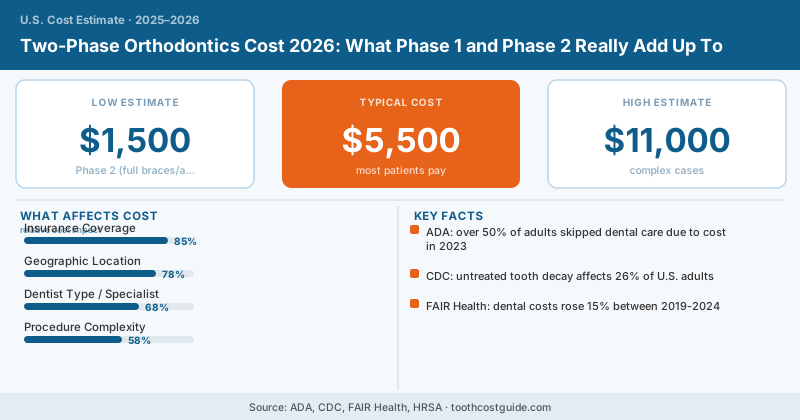
“Your seven-year-old needs braces twice.” That sentence stops parents cold at the orthodontist’s office every day. It sounds like a sales tactic. Sometimes it is. But for the right child, two-phase orthodontics is legitimate care that can prevent a much bigger problem later — and it’ll cost you somewhere around $6,000 to $11,000 across both rounds.
Two-phase treatment splits orthodontics into an early intervention (Phase 1) while a child still has baby teeth, then a second round (Phase 2) once permanent teeth come in. The idea is to guide jaw growth early, then straighten teeth later.
| Phase | Typical Age | Cost | Duration |
|---|---|---|---|
| Phase 1 (early/interceptive) | 7–10 years | $1,500–$4,000 | 9–18 months |
| Resting period | 10–12 years | Monitoring visits | 1–3 years |
| Phase 2 (full braces/aligners) | 11–14 years | $4,000–$7,000 | 12–24 months |
| Combined total | — | $6,000–$11,000 | — |
What Each Phase Does
Phase 1 isn’t about straight teeth — it’s about the foundation. Orthodontists use this window, while the jaw is still growing, to fix things that get harder to correct later: a narrow upper jaw, a severe crossbite, a thumb-sucking habit reshaping the bite, or crowding so bad permanent teeth won’t have room to erupt. A palate expander is a common Phase 1 appliance.
Then comes the waiting. After Phase 1, kids enter a resting period — often a couple of years — while the rest of the permanent teeth arrive. The orthodontist monitors with periodic check-ins. Phase 2 is the full braces or aligner round most people picture, aligning the now-complete set of adult teeth.
Many kids do perfectly well with a single round of braces as teens. Two-phase treatment makes sense when an early skeletal problem would get worse if left alone. The American Association of Orthodontists recommends a first orthodontic check by age 7 precisely to catch these cases — not to start treatment on every child.
Is the Extra Cost Justified?
Here’s the part parents need to hear straight. The American Association of Orthodontists recommends an evaluation by age 7, but an evaluation is not the same as treatment. The AAO is clear that many children who get checked early simply get monitored — not started on appliances. Studies have shown that for many common problems, a single phase of treatment as a teenager produces results just as good as two phases, at lower total cost.
So when does two-phase truly pay off? When there’s a genuine skeletal or functional issue — a developing crossbite, a serious overbite from a protruding jaw, or severe crowding that threatens to trap permanent teeth. In those cases, intervening early can prevent the need for extractions or even surgery down the road. The CDC’s oral-health data backs the broader point: early intervention for genuine problems reduces complications later.
If your child has only mildly crooked teeth, a second opinion is more than fair. You’re well within reason to ask whether waiting for one round of teen braces would work just as well.
What Drives the Price
The two phases together usually cost more than a single comprehensive treatment, but less than double — because Phase 1 is shorter and uses simpler appliances. The retainer at the end of Phase 2 is still required; budget $150–$500 for a retainer to hold the final result.
Geography and complexity drive the rest. A simple expander-only Phase 1 sits at the low end; a Phase 1 involving multiple appliances climbs higher.
Paying Across Years
The silver lining of two-phase treatment is that costs spread out over time, which eases the cash-flow hit. Each phase can be its own payment plan.
Check your orthodontic benefit carefully — it’s usually a lifetime cap of $1,000–$2,500, and it doesn’t reset between phases. Once you’ve used it on Phase 1, Phase 2 may be fully out of pocket. An FSA for dental expenses and a CareCredit dental plan help bridge the gap across multiple years.
Be cautious if an orthodontist recommends Phase 1 treatment for a child with only minor crowding and no skeletal issue. That’s the classic over-treatment scenario. A genuine Phase 1 case has a clear functional reason — get a second opinion if the rationale isn’t obvious.
Bottom Line
Two-phase orthodontics is the right call for children with real early problems, and a costly detour for those who’d do fine with one round later. Get the age-7 evaluation the AAO recommends — but treat “evaluation” and “treatment” as separate decisions, and don’t be afraid to ask why.
Frequently Asked Questions
Two-phase orthodontic treatment typically costs between $6,000 and $11,000 total across both phases combined. Phase 1 (early intervention) usually runs $3,000–$5,000, while Phase 2 (comprehensive treatment) adds another $3,000–$6,000 depending on complexity and your orthodontist's fees.
Most dental insurance plans cover 40–80% of orthodontic costs, with a lifetime maximum benefit of $1,200–$2,000, which typically applies to both phases combined. This means you'll likely pay $4,000–$7,000 out-of-pocket for the full two-phase treatment even with coverage.
Phase 1 typically begins around age 7–10 when a child still has mixed primary and permanent teeth, and lasts 18–24 months to guide jaw growth and create space. Phase 2 begins 1–2 years later after most permanent teeth have erupted and takes another 18–24 months for final alignment.