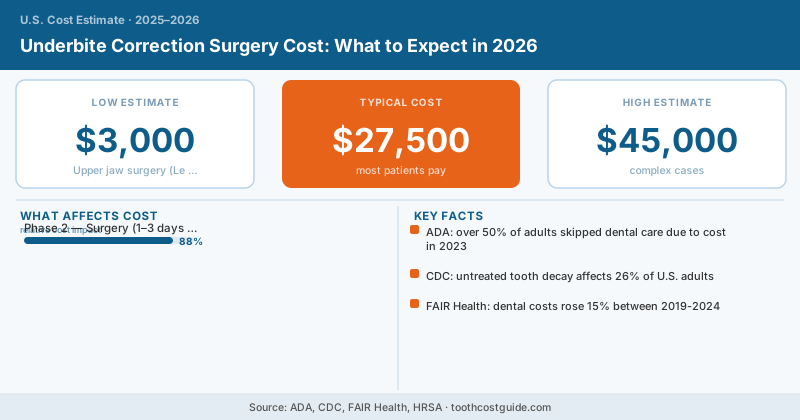
Myth: underbites always need jaw surgery. Wrong. About 60–70% of underbite patients — particularly those caught in childhood or with mild-to-moderate skeletal discrepancy — can be treated successfully with orthodontics alone or orthodontics combined with tooth extraction. Surgery becomes necessary only when the jaw size discrepancy is large enough that tooth movement alone can’t create a stable, functional bite. Knowing which category you’re in determines whether you’re looking at a $4,500 problem or a $35,000 one.
What Causes an Underbite
An underbite — technically called a Class III malocclusion — occurs when the lower jaw protrudes past the upper, causing the lower front teeth to sit in front of the upper front teeth. It can be:
- Dental: Lower teeth angled forward or upper teeth angled backward, but jaw positions are near-normal
- Skeletal: The lower jaw (mandible) is genuinely too large, or the upper jaw (maxilla) is underdeveloped — or both
Skeletal underbites often have a genetic component. The American Association of Orthodontists reports that Class III malocclusion affects roughly 3–5% of the U.S. population, with higher prevalence in Asian-American communities.
Cost by Treatment Approach
| Treatment | Typical Cost | Best For |
|---|---|---|
| Braces or aligners (dental underbite) | $3,000–$7,000 | Mild dental underbite; growing children |
| Palate expander + braces (growing patients) | $4,000–$8,000 | Upper jaw deficiency in early teens |
| Braces + chin reduction (genioplasty) | $8,000–$18,000 | Mild skeletal; chin reduction only |
| Upper jaw surgery (Le Fort I advancement) | $20,000–$35,000 | Maxillary deficiency |
| Lower jaw surgery (BSSO setback) | $18,000–$32,000 | Mandibular excess |
| Double-jaw (bimaxillary) osteotomy | $25,000–$45,000 | Combined upper/lower discrepancy |
Non-Surgical Approaches: When They Work
For children and early teens (before growth is complete), underbites can sometimes be redirected with orthopedic appliances. The reverse-pull facemask — an appliance worn outside the mouth with elastic traction — applies forward force to the upper jaw during growth, encouraging the maxilla to catch up to the mandible. Facemask therapy works only in growing patients, typically ages 7–11 for best results, and costs $1,500–$3,000 as an early interceptive treatment.
For dental underbites in adults, braces or Invisalign can reposition teeth to achieve a functional bite without moving the jaws. Results are limited to the degree the tooth positions (not jaw positions) are causing the problem.
For mild-to-moderate skeletal underbites in adults who can’t or don’t want surgery, orthodontists can sometimes “camouflage” the discrepancy — moving teeth to create acceptable bite function even though the underlying jaw positions remain mismatched. The bite improves; the facial profile doesn’t. Some patients are completely satisfied with this. Others, after seeing what surgical correction would achieve, choose to pursue it. Have an honest conversation with your orthodontist about what camouflage versus surgical correction would look like for your specific case.
Surgical Underbite Correction: The Full Process
When surgery is required, treatment unfolds in three phases:
Phase 1 — Pre-surgical orthodontics (12–18 months): Braces align the teeth in their final positions before the jaw is moved. This is counterintuitive — your bite may look worse during this phase as teeth are “decompensated” to reveal the true skeletal discrepancy. Cost: $3,000–$6,000.
Phase 2 — Surgery (1–3 days inpatient): The oral and maxillofacial surgeon (OMFS) cuts and repositions the jaw bone(s) and secures them with titanium plates and screws. For underbites, this is usually a BSSO (bilateral sagittal split osteotomy) to set back the lower jaw, or a Le Fort I to advance the upper jaw, or both. Surgical + hospital + anesthesia: $15,000–$30,000.
Phase 3 — Post-surgical orthodontics (6–12 months): Fine-tuning the bite after healing. Cost: $2,000–$4,000.
Total: $20,000–$40,000. Medical insurance often covers the surgical and hospital fees when functional necessity is documented — chewing impairment, speech issues, documented TMJ dysfunction, or sleep-disordered breathing.
Medical Insurance: The Critical Variable
Medical insurance can dramatically change your out-of-pocket if you have a documented functional problem. Submit to your medical insurer (not dental) with:
- Cephalometric X-ray showing jaw discrepancy measurements
- Documentation of chewing, speech, or breathing functional impairment
- Letter of medical necessity from your OMFS
Out-of-pocket with medical insurance covering surgery: often $8,000–$16,000 total including orthodontics. Without it: $20,000–$40,000.
A purely cosmetic motivation — wanting a different facial profile without documented functional problems — is generally not covered by medical insurance. Some patients are honest with themselves that their underbite doesn’t cause functional problems but they want surgery for profile improvement. That’s a valid choice; just plan to pay the full bill out of pocket.
Bottom Line
Mild dental underbites and growing children with skeletal underbites have good non-surgical options at $3,000–$8,000. Adults with significant skeletal underbites needing surgery face $20,000–$40,000 total, but medical insurance can cut this substantially when functional necessity is properly documented. Get an orthodontist and OMFS evaluation before assuming surgery is required — and before assuming it’s unaffordable.
Frequently Asked Questions
Surgical correction of an underbite typically ranges from $15,000 to $40,000, depending on complexity, surgeon experience, and geographic location. This price usually includes both the orthognathic surgery itself and pre- and post-operative orthodontic treatment, though some surgeons may bill orthodontics separately at an additional $3,000–$8,000.
Many dental insurance plans cover 50% of orthognathic surgery costs if it's deemed medically necessary rather than cosmetic, though coverage varies widely by plan. Most patients pay $5,000–$15,000 out-of-pocket after insurance, and you should verify whether your plan requires prior authorization and if there are annual maximums that could limit benefits.
No—about 60–70% of underbite patients, especially those with mild-to-moderate cases or caught early in childhood, can be successfully treated with orthodontics alone or combined with tooth extraction, costing $3,000–$8,000. Surgery becomes necessary only when the jaw size discrepancy is too large for tooth movement to create a stable, functional bite, typically requiring a specialist evaluation to determine.