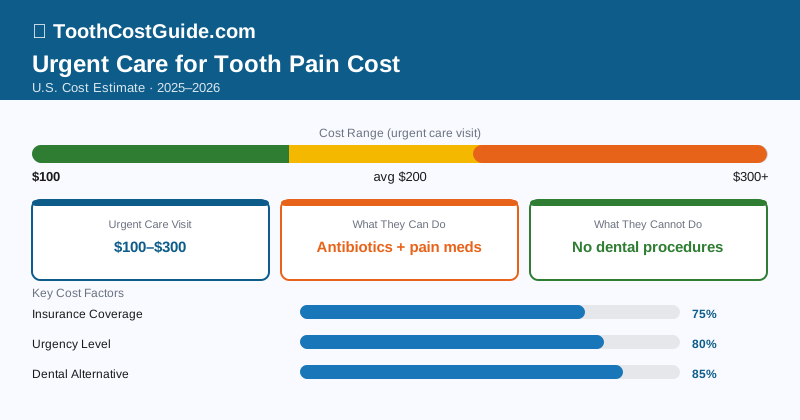
Saturday afternoon, severe tooth pain, dentist’s office closed. You’re considering urgent care. Before you go, know this: urgent care will cost you $100–$300 and they will prescribe antibiotics and pain medication — but they cannot touch the tooth. No extraction, no root canal, no filling, no drainage. You’ll walk out with prescriptions that make the weekend survivable, and you’ll still need a dentist on Monday.
That’s not a criticism of urgent care. For what it is — a prescription bridge to definitive dental treatment — it’s a legitimate, relatively affordable option. Just go in with accurate expectations about what it will and won’t accomplish.
| Service | Cost Without Insurance | Cost With Insurance |
|---|---|---|
| Urgent care visit (base fee) | $100–$200 | $20–$75 copay |
| X-ray at urgent care (if taken) | $75–$200 | Covered/low copay |
| Antibiotic prescription (amoxicillin) | $4–$60 | $0–$20 with Rx coverage |
| Pain medication prescription (OTC strength) | $10–$30 | $0–$15 with Rx coverage |
| Follow-up dentist visit (still required) | $100–$300+ | Per dental plan |
What Different Urgent Care Facilities Cost
Not all urgent care is priced equally:
Retail health clinics (MinuteClinic at CVS, Walgreens Health) charge $99–$150 for a basic visit. They handle straightforward prescription requests well and tend to have the shortest wait times.
Standalone urgent care centers run $130–$250 and offer a broader clinical evaluation than retail clinics. Better equipped to assess whether symptoms suggest a serious spreading infection.
Hospital-affiliated urgent care costs $200–$400 — closer to ER pricing without the full ER experience. Reserve these for situations where you think something more serious might be happening.
For the vast majority of “I need antibiotics to get through the weekend” situations, a retail clinic or standalone urgent care does the job at the lower end of this range.
What Urgent Care Can and Can’t Do
Can do:
- Prescribe antibiotics (typically amoxicillin 500 mg three times daily for 7–10 days, or clindamycin for penicillin-allergic patients)
- Prescribe pain medication — prescription-strength ibuprofen, sometimes a short non-opioid pain course
- Take a general facial X-ray if fracture is suspected (not the same as dental X-rays for diagnosis)
- Assess whether symptoms suggest a spreading infection requiring ER care
- Write a formal referral to a dentist or specialist
- Provide documentation for missing work
Can’t do:
- Extract teeth
- Perform root canals
- Place fillings or crowns
- Take diagnostic dental X-rays
- Drain a deep dental abscess
- Provide any definitive dental treatment
The antibiotics help. They suppress the bacterial load in an infected tooth and slow the spread of infection. But antibiotics alone don’t cure a dental infection — the source (the infected tooth) still needs to be addressed by a dentist. Research published in dental literature consistently shows that antibiotics without source control lead to recurrence. The antibiotic buys you time; the dentist fixes the problem.
Insurance Coverage at Urgent Care
This is billed to your medical insurance, not your dental insurance — which is actually an advantage in most cases.
With medical insurance: Most plans cover urgent care at a standard copay of $20–$75. In-network facilities get the lower copay; check before you walk in. Your dental benefits are completely unaffected by this visit.
Without medical insurance: Self-pay rates range from $100–$200 at most standalone urgent care facilities. Many post transparent self-pay pricing online. A 10-day amoxicillin course with a GoodRx coupon runs $4–$10.
Net cost comparison:
- Urgent care + antibiotics with medical insurance: $25–$100 total out of pocket
- Urgent care + antibiotics without insurance: $110–$260 total
- Dentist visit still required afterward: $150–$1,500+ depending on treatment needed
When Urgent Care Makes Sense
Go to urgent care if:
- It’s a weekend or holiday and no dentist is available
- You have clear signs of infection — fever, visible swelling — and need antibiotics to prevent spread
- Your pain is severe enough to need prescription pain management beyond OTC options
- You need a professional assessment of whether your situation requires the ER
Don’t rely on urgent care if:
- You’re using it as a substitute for dental care rather than a bridge to it
- You’re hoping to avoid the dental visit altogether (you can’t — the infection will return)
- Your symptoms suggest a spreading infection (swelling to neck, difficulty swallowing, high fever) — that needs the ER, not urgent care
How to Make the Visit Count
- Try to reach a dentist first. Many practices have after-hours lines. An emergency dental appointment addresses the actual problem; urgent care doesn’t.
- Call ahead. Confirm the urgent care center is comfortable treating dental pain and prescribing dental antibiotics. Not all are — some decline dental cases.
- Ask specifically what can be prescribed. Confirm they’ll prescribe antibiotics appropriate for dental infections and ask about non-opioid pain management options.
- Tell them what antibiotics you’ve taken before. If you’re penicillin-allergic, say so immediately — the standard protocol changes.
- Plan your follow-up while you’re there. Ask the provider to document the referral. Book your dental appointment before you leave urgent care, not after.
Saving Money at Urgent Care
GoodRx for prescriptions. Amoxicillin 30-count (10-day supply) costs $4–$10 at most major pharmacies with a GoodRx coupon. Show it at the pharmacy counter — it’s free to use and requires no sign-up.
Try telehealth first. Platforms like PlushCare, Teladoc, and MDLive offer video consultations for $75–$150. A doctor can assess your symptoms remotely and issue a prescription in many states if appropriate. No driving, no waiting room, often available within minutes at 2 AM. Genuinely useful for the “I just need antibiotics tonight” scenario.
Compare urgent care prices before going. Prices vary significantly by facility. The Solv Health app shows real-time wait times and self-pay pricing for urgent care locations near you.
Don’t use the ER for tooth pain alone. FAIR Health data shows that hospital ER visits for dental pain average $750–$1,200 and deliver the same prescriptions urgent care provides for $100–$300. Reserve the ER for symptoms that suggest spreading infection or airway involvement.
Urgent care for tooth pain is a $100–$300 temporary solution. It buys you a prescription for antibiotics and pain medication to get through until you can see a dentist. You will still need definitive dental treatment — urgent care cannot fix the underlying problem.
If you have facial or neck swelling, a fever above 102°F, difficulty opening your mouth, swallowing, or breathing, go to a hospital emergency room — not urgent care. These symptoms suggest a spreading infection that may require IV antibiotics, surgical drainage, or airway management beyond urgent care capabilities.
The Bottom Line
Urgent care for tooth pain costs $100–$300 without insurance, or $20–$75 with a medical insurance copay. You’ll leave with prescriptions for antibiotics and pain management. You won’t leave with a treated tooth. This is the appropriate short-term bridge when no dentist is reachable and you have signs of infection or need prescription pain relief. Book the dental appointment before the antibiotics run out — the infection will come back without source control.
Frequently Asked Questions
An urgent care visit for tooth pain typically costs $100–$300, depending on your location and the facility. This fee covers the evaluation and prescription medications (antibiotics and pain relievers), but does not include any dental procedures like extractions, fillings, or root canals.
Most health insurance plans cover urgent care visits at $25–$75 out-of-pocket (copay), but dental insurance typically does not cover urgent care visits since they don't provide actual dental treatment. You may be able to apply the urgent care cost toward your health insurance deductible, but check your specific plan first.
Urgent care can examine your tooth, diagnose the problem, and prescribe antibiotics (if infection is present) and pain medication to get you through the weekend or until you see a dentist. They cannot perform any dental procedures like extractions, root canals, fillings, or drainage, so you will still need to follow up with a dentist for permanent treatment.