Does laser dentistry actually deliver better results — or is it mostly a marketing upgrade you’re paying extra for?
The honest answer is: it depends entirely on which procedure you’re talking about. For soft-tissue work and periodontal treatment, lasers offer genuine clinical advantages backed by peer-reviewed research. For hard-tissue cavity preparation, the drill still holds its own. Knowing the difference before you pay the upcharge is worth your time.
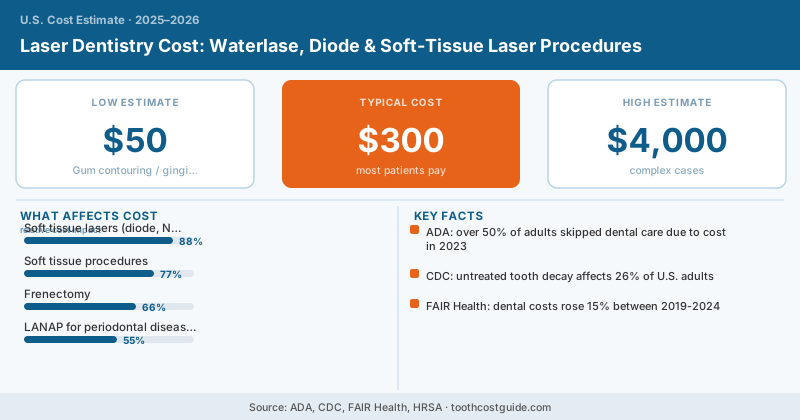
What the Cost Premium Actually Looks Like
| Procedure | Traditional Cost | Laser Cost | Typical Premium |
|---|---|---|---|
| Cavity preparation (filling) | $150–$300 | $225–$500 | +$75–$200 |
| Frenectomy (tongue/lip tie) | $800–$1,500 (surgical) | $250–$600 | Laser is cheaper |
| Gum contouring / gingivectomy | $200–$400 per tooth | $300–$600 per tooth | +$100–$200 |
| LANAP (periodontal treatment) | $1,500–$4,000 (surgery) | $2,000–$6,000 | +$500–$2,000 |
| Canker sore / cold sore treatment | $50–$100 | $75–$150 | +$25–$50 |
| Cavity detection (DIAGNOdent) | Included in exam | Included in exam | No additional charge |
Note: for frenectomy specifically, laser is often less expensive than traditional surgical frenectomy — and meaningfully faster to recover from.
Types of Dental Lasers — They’re Not Interchangeable
Not all lasers do the same thing. Different wavelengths interact differently with tooth structure, water, and soft tissue. Using the wrong laser type for a procedure is like using a scalpel to drill — technically possible, practically wrong.
Hard tissue lasers (Waterlase Er,Cr:YSGG / Er:YAG) can cut enamel and dentin by using the interaction between laser energy and water molecules in the tissue — effectively vaporizing the structure in tiny increments. They can prepare cavities, treat root surfaces, and cut bone. The Waterlase system (Biolase) is the most widely marketed brand. Hard tissue lasers are the only type appropriate for cavity preparation.
Soft tissue lasers (diode, Nd:YAG) operate at wavelengths absorbed by soft tissue pigment rather than water. They’re used for gum reshaping, frenectomies, biopsy of soft tissue lesions, treatment of gum disease, aphthous ulcer relief, and more. These are the most common lasers in general dental practices — less expensive than hard tissue lasers and highly effective for their intended applications.
LANAP (Laser-Assisted New Attachment Procedure) uses the Nd:YAG PerioLase laser specifically for treating moderate-to-severe periodontal disease. It’s a distinct protocol, not just “using a laser for gum disease” — it involves selective removal of diseased pocket lining tissue while leaving healthy tissue intact, followed by laser-induced clot formation to promote reattachment.
Where Lasers Genuinely Excel
Soft tissue procedures. This is where lasers earn their keep. Gum reshaping, frenectomies, pocket epithelium removal during periodontal treatment — all produce less bleeding, less post-op soreness, and faster healing with a diode or Nd:YAG laser compared to scalpel techniques. The tissue seals as it’s cut; sutures are often unnecessary. The ADA has recognized laser frenectomy and gingivectomy as having strong evidence for reduced morbidity compared to conventional surgery.
Frenectomy is the clearest example where laser is a better deal across the board — it’s less expensive than surgical frenectomy, can be done without general anesthesia (important for infant tongue-tie corrections), heals faster, and produces equivalent functional outcomes. $250–$600 vs. $800–$1,500 for surgical — and the recovery is measured in days rather than weeks.
LANAP for periodontal disease is FDA-cleared and has peer-reviewed outcome data supporting its use. A 2018 study in the International Journal of Periodontics & Restorative Dentistry found that LANAP produced comparable bone level maintenance to traditional osseous surgery at 5 years. Some studies show superior soft tissue reattachment. The key advantages: less post-op pain, faster recovery, and no sutures or incision. The disadvantage: significantly higher cost ($2,000–$6,000 for full-mouth treatment vs. $1,500–$4,000 for traditional surgery) and it’s not universally covered by insurance.
Ask two questions before paying the laser premium: (1) Is there peer-reviewed evidence supporting laser for this specific procedure? (2) What’s the practical benefit to me — less pain, fewer appointments, better outcome? For soft tissue and periodontal work, the answers are often yes and meaningful. For hard tissue cavities, the evidence for better outcomes is weaker — the benefit is primarily patient comfort, not clinical superiority.
Where Lasers Don’t Clearly Win
Hard tissue cavity preparation — lasers can remove decay without a drill, which sounds appealing. And for patients with extreme drill anxiety, needle-free cavity prep is a real quality-of-life improvement. But the resulting filling is no better or worse than one placed after drill preparation. The filling material and bonding protocol determine the outcome, not how the cavity was made. Additionally, hard tissue lasers are slower than drills, can’t be used in every location, and still require anesthesia for anything but the shallowest cavities. Paying $75–$200 more for laser cavity prep is a comfort choice, not a clinical necessity.
DIAGNOdent (cavity detection laser) — this gets marketed as “laser dentistry” but it’s really just a diagnostic tool that uses laser fluorescence to detect early decay. Most dentists who have the unit don’t charge extra for it — it’s used during your regular exam. It can detect cavities that aren’t visible on X-rays yet, which is genuinely useful. But it’s not treatment — it’s detection. If your dentist charges a separate fee for DIAGNOdent, ask what it’s for.
The ADA and Evidence Standards
The ADA evaluates dental lasers through its Seal of Acceptance program, which assesses safety and efficacy based on submitted clinical evidence. Not all lasers or laser protocols have earned the ADA Seal — it requires documented clinical data. When evaluating a laser dentistry claim, it’s worth asking whether the specific procedure has peer-reviewed evidence behind it, not just whether the practice owns a laser.
LANAP, laser frenectomy, and soft tissue gingivectomy have the strongest evidence bases. Laser whitening (using lasers or lights to “activate” bleaching gel) has weaker evidence — most research shows the light doesn’t meaningfully accelerate whitening compared to the gel alone.
Is Laser Dentistry Right for You?
Consider it when:
- You need a frenectomy — laser is almost always the better option both clinically and economically
- You have moderate-to-severe periodontal disease and want to avoid traditional gum surgery — LANAP is a legitimate alternative worth evaluating
- You have extreme dental anxiety and the prospect of no drill, no needle is meaningful to you
- Gum reshaping or soft tissue procedures are on your treatment plan
Skip the laser upcharge when:
- The only benefit being offered is “no drill” for a cavity — and you don’t have significant drill anxiety
- The practice can’t articulate a specific clinical advantage for your situation
- The laser procedure isn’t covered by your insurance and the cost difference is substantial
“Laser dentistry” is sometimes used more as a marketing term than a clinical descriptor. Any practice that owns a laser can advertise laser dentistry — but one diode laser used only for occasional canker sore treatment doesn’t make a practice a laser dentistry center. If a practice is charging meaningful premiums across multiple procedures for laser use, ask specifically which type of laser they’re using and why it’s the right tool for your specific treatment. A confident, evidence-based answer is what you’re looking for.
Frequently Asked Questions
For small-to-medium cavities in certain locations, lasers can prep the tooth without anesthesia and with less vibration than a drill — which some patients genuinely prefer. But clinical evidence doesn't show better outcomes for the filling itself. The restoration quality depends on the material and bonding technique, not how the cavity was prepped. The drill is faster, works on any tooth in any location, and produces equivalent results. If needle-free dentistry appeals to you, ask whether your cavity qualifies — not every cavity is laser-compatible.
For soft tissue procedures, yes — significantly. Laser gum treatments produce less post-op bleeding, soreness, and swelling than scalpel techniques, and many don't require sutures. For hard tissue (cavity preparation), it depends on the cavity. Shallow cavities in dentin can sometimes be prepped without anesthesia using a laser. Deeper cavities still need local anesthesia because the laser generates heat as it goes deeper. Don't expect completely needle-free dentistry for anything but minor cases.
Some plans cover LANAP — but it varies significantly. LANAP is FDA-cleared for treating periodontal disease, and it's typically billed under existing periodontal surgical CDT codes. Some insurers cover it at the same rate as traditional periodontal surgery (usually 50% after deductible for major services); others specifically exclude 'laser procedures' in their plan language. Call your insurer before scheduling and ask specifically about LANAP coverage under codes D4261 or D4262. Get the answer in writing.