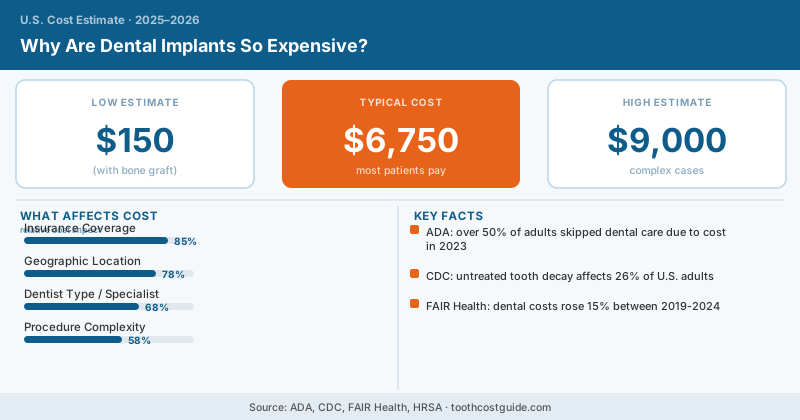
A single dental implant — one tooth — costs $3,000 to $6,000 out of pocket for most Americans. That’s more than a month’s rent in many cities. If you’ve just been quoted that figure, your first reaction is probably: why does a fake tooth cost this much?
The honest answer is that dental implants aren’t really “fake teeth.” They’re surgical-grade titanium posts placed in living bone, topped with laboratory-fabricated crowns designed to last 20+ years. Every step of that process costs money — and most of that money goes somewhere specific.
What You’re Actually Paying For
Here’s the full cost breakdown per single implant:
| Component | Typical Cost |
|---|---|
| Dental implant fixture (titanium post) | $300–$600 |
| Abutment (connector piece) | $275–$450 |
| Implant crown (lab-fabricated) | $1,000–$1,800 |
| Implant placement surgery | $1,500–$2,500 |
| Pre-surgery CT scan (3D imaging) | $150–$400 |
| Bone graft (if needed) | $300–$3,000 |
| Sinus lift (if needed) | $1,500–$4,000 |
| Total (no complications) | $3,000–$5,750 |
| Total (with bone graft) | $4,500–$9,000+ |
The Four Real Reasons Implants Cost So Much
Surgical training and specialist fees. Placing an implant isn’t the same as filling a cavity. Oral surgeons and periodontists who place implants complete 2–4 years of specialty training beyond dental school. That training, plus the ongoing education required to stay current on implant systems, gets built into their hourly rate. A procedure that takes 60–90 minutes reflects years of preparation.
The materials themselves. Implant fixtures are Grade 4 or Grade 5 titanium — the same biocompatible alloy used in hip replacements and aerospace applications. The crown on top is milled from a zirconia or ceramic block in a dental lab by a licensed dental technician. According to the ADA, dental laboratory fees account for a significant portion of restorative dentistry costs, and implant crowns are among the most technically demanding lab products.
Advanced imaging technology. Modern implant placement almost always requires 3D cone beam CT (CBCT) imaging to map bone density, nerve location, and sinus proximity before surgery. That scanner costs $80,000–$120,000. When your dentist charges $200 for a CBCT scan, they’re amortizing that cost across hundreds of patients.
Multiple appointments spread over months. A standard implant involves at least 3–5 separate visits: consultation, imaging, implant surgery, healing check (3–6 months later), abutment placement, and crown delivery. Each visit requires staff time, sterilization, supplies, and overhead.
After the titanium post is placed, osseointegration happens — the bone literally grows into and fuses with the implant. This isn’t something that can be rushed. Skipping this healing phase leads to implant failure. The long timeline means your dentist’s chair and team are involved across half a year, not just one afternoon.
What Does Overhead Really Look Like?
Every dental procedure carries a hefty overhead burden that patients don’t typically see. The ADA Health Policy Institute found that the average dental practice spends 60–75% of collections on overhead — staff salaries, rent, equipment leases, supplies, and malpractice insurance. For an implant case at $4,500, the dentist may net $1,100–$1,800 after expenses.
A 2024 analysis by FAIR Health found that implant procedure fees have risen approximately 12% since 2019, driven mostly by lab costs and equipment depreciation.
Geography matters too. The same implant that costs $3,500 in rural Oklahoma runs $5,800 in Manhattan — not because Manhattan dentists are greedier, but because their rent, staff wages, and regulatory overhead are higher.
Why Insurance Barely Helps
Most dental insurance plans either exclude implants entirely or cap coverage at $1,000–$1,500 per year. Since implants are classified as a “major” restorative procedure — and many insurers consider them “elective” compared to bridges — coverage is minimal.
If your plan does cover implants, watch for the “missing tooth clause” — many policies won’t cover a tooth lost before your coverage started. Always verify this before assuming your insurance will help.
Ways to Lower the Out-of-Pocket Cost
- Dental schools — Accredited programs (NYU, UCLA, University of Illinois) place implants for 40–60% less. Procedures take longer but are supervised by experienced faculty.
- Dental discount plans — Plans like Aetna Vital Savings or Careington offer 15–25% off implant fees.
- Financing — CareCredit and Lending Club offer 12–24 month promotional financing. Many practices also offer in-house payment plans.
- Dental tourism — Patients often save 50–70% on implants in Mexico (Los Algodones) or Costa Rica. Quality varies; research the clinic carefully.
- All-on-4 if replacing multiple teeth — If you’re missing several teeth, All-on-4 implant bridges average $20,000–$30,000 per arch but are far cheaper than individual implants for each tooth.
The Bottom Line
Dental implants are expensive because they involve a surgical procedure, specialist training, high-end materials, precision lab work, and multiple appointments across 6+ months. The cost isn’t arbitrary — it reflects genuine complexity. The good news: with proper care, you likely won’t need to do this again for 20–25 years, making the per-year cost more reasonable than it initially appears.
Frequently Asked Questions
A single dental implant typically costs $3,000 to $6,000 out of pocket for most Americans. This price covers the surgical placement of the titanium post, the abutment, and the crown, though some practices break down costs separately for each component.
Most traditional dental insurance plans do not cover dental implants, as they are considered a cosmetic or elective procedure. However, some premium dental plans may cover 10-50% of implant costs, and you should verify your specific policy since coverage varies widely by plan.
The complete dental implant process typically takes 3 to 6 months from initial surgery to final crown placement. This timeline includes the initial surgery, a healing period of 3-6 months while the bone integrates with the titanium post, and then the final abutment and crown placement during subsequent visits.