Most patients assume dentists are simply charging what the market will bear — pocketing most of what you pay. The reality is more complicated. The average general dentist collects roughly $700,000–$900,000 per year, but according to the ADA Health Policy Institute, the average dentist nets about $200,000–$250,000 after expenses. That means 60–75% of every dollar you pay disappears before your dentist sees it.
That’s not a justification for high prices — it’s an explanation. Understanding where dental costs come from helps you make smarter decisions about when to negotiate, which providers to use, and why prices vary so dramatically between practices.
Where Your Money Actually Goes
| Expense Category | % of Practice Collections |
|---|---|
| Staff salaries (hygienists, assistants, front desk) | 25–30% |
| Dental supplies and lab fees | 8–12% |
| Facility rent or mortgage | 5–10% |
| Equipment depreciation and maintenance | 4–6% |
| Malpractice insurance | 1–3% |
| Business/liability insurance, utilities | 2–4% |
| Marketing and technology | 2–4% |
| Total overhead | 60–75% |
| Dentist take-home (net) | 25–40% |
Staff: The Single Biggest Cost
Dental hygienists earn $70,000–$90,000/year in most U.S. markets. Dental assistants earn $40,000–$55,000. A receptionist or office manager adds another $40,000–$60,000. For a small 2-chair practice, total staff payroll easily runs $180,000–$250,000 per year — before a single supply is purchased or lease payment is made.
When you pay $150 for a cleaning, a significant portion of that funds the hygienist who spent 45–60 minutes with you, the assistant who set up the room, and the front desk staff who handled your scheduling and billing.
Equipment: More Expensive Than You Think
A dental chair with delivery unit runs $8,000–$20,000. A digital X-ray system: $15,000–$40,000. A CBCT (3D cone beam scanner): $80,000–$130,000. CAD/CAM milling machines for same-day crowns: $120,000–$200,000. An autoclave sterilization unit: $3,000–$8,000.
Most of this equipment has a useful life of 10–20 years but requires regular servicing contracts ($500–$5,000/year per major unit). A modestly equipped 2-chair practice has $200,000–$400,000 in equipment alone — all of which is depreciated and maintained from patient revenue.
When a dentist charges $200–$400 for a 3D scan, they’re not just charging for 10 minutes of your time — they’re amortizing a $100,000+ piece of equipment across hundreds of cases. A practice that does one scan per week for 10 years uses $20/week toward equipment payoff alone, before factoring in service contracts, software licenses, or the staff time to interpret and document the images.
Lab Fees: The Hidden Cost in Every Crown
Most patients don’t realize that the porcelain crown your dentist places was made by someone else — a dental laboratory technician working off impressions or digital scans. Lab fees for a single crown run $150–$500 depending on the lab and material. High-end labs in the U.S. charge $350–$600 per unit. Dentists who outsource to overseas labs pay less — $50–$150 per unit — but quality can vary.
When your crown costs $1,500, roughly $200–$400 of that goes directly to the lab. The dentist sees none of that — it’s a pass-through cost.
Education Debt: Dentists Graduate Owing $300,000+
The average dental school graduate carries $301,583 in student loan debt, according to 2023 data from the American Dental Education Association. At a standard 10-year repayment on $300,000 at 7% interest, that’s $3,483/month — or roughly $42,000/year — just in loan payments.
A new dentist who earns $140,000 in their first associateship pays $42,000 in loans, roughly $40,000 in taxes, $12,000 in malpractice insurance, and $8,000 in license and CE fees — leaving around $38,000/year to live on. The dentists charging top-of-market rates are usually senior practice owners who’ve paid off their debt; the ones charging less are often associates or school-clinic providers.
Malpractice Insurance and Regulatory Costs
Dental malpractice insurance runs $4,000–$12,000/year depending on specialty, state, and claims history. Dentists pay state licensing fees, DEA registration (for prescribing), CE requirements, OSHA compliance, HIPAA compliance, and state board continuing education — easily $5,000–$10,000/year in regulatory overhead before treating a single patient.
Geographic pricing variation is real and large. A root canal in Manhattan might cost $1,800; the same procedure in rural Mississippi might cost $700. This isn’t because Manhattan dentists are more skilled — it’s because Manhattan dentists pay $30,000–$60,000/month for commercial space that costs $4,000/month elsewhere.
Why Some Dentists Charge Less
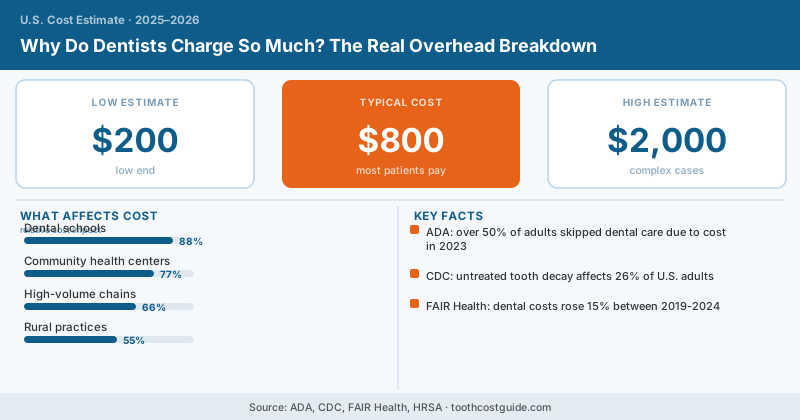
Dental schools can charge 40–60% less because faculty costs are covered by the educational institution, equipment is subsidized, and student time isn’t billed at market rates.
Community health centers operate on grants and government funding that subsidize costs.
High-volume chains (Aspen Dental, Heartland Dental) achieve economies of scale on supplies, staffing models, and marketing — often passing some of those savings to patients.
Rural practices have lower rent and may face less competition.
The Bottom Line
The price of dental care reflects genuine costs: specialized training worth hundreds of thousands in debt, surgical-grade equipment worth millions per practice, highly trained staff, laboratory partners, and a regulatory environment that demands compliance at every step. That doesn’t mean every bill is fair or that you can’t negotiate — you absolutely can, especially at private practices. But understanding what’s behind the price helps you shop more intelligently: seek dental schools for major work, use community health centers for preventive care, and reserve private specialist practices for complexity that actually requires specialist training.
Frequently Asked Questions
Only 25–40 cents of every dollar you pay reaches your dentist as net income. The remaining 60–75% covers staff salaries, equipment, rent, malpractice insurance, continuing education, and other overhead costs that most patients don't see.
No, insurance plans typically cover a percentage of the treatment cost (often 50–80% depending on the procedure), but you're still responsible for your copay or coinsurance regardless of the dentist's underlying expenses. Understanding this distinction helps explain why your out-of-pocket cost doesn't decrease just because a dentist has high overhead.
Overhead percentages are consistent across practices (60–75%), but total overhead varies by location, practice size, and specialization—a cosmetic practice in an urban area may have $200,000+ in annual rent alone, while a rural general practice might pay $30,000. Geographic location and local staff wages are the biggest variables affecting your final treatment costs.