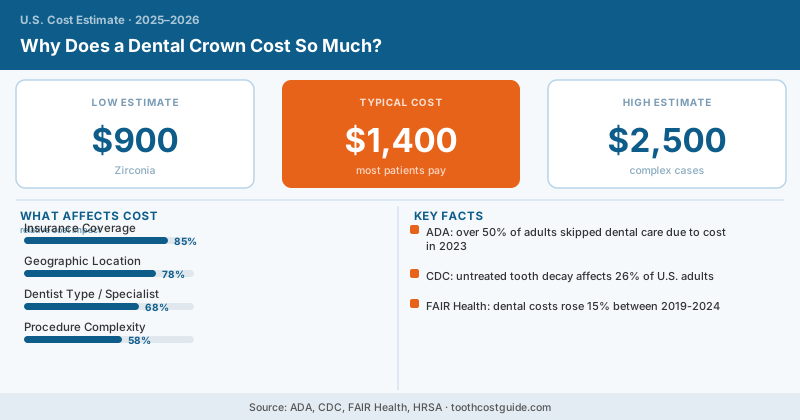
Why does one little cap on a tooth cost as much as a used car payment? It’s the question almost everyone asks when they see a $1,500 crown estimate, and the honest answer surprises people: very little of that number is profit.
A crown isn’t a stock part pulled off a shelf. It’s a custom-manufactured medical device built for one tooth in one mouth, by hand, across two appointments. Once you see where the money goes, the price makes a lot more sense — and you’ll spot which costs you can actually cut.
What a Crown Costs by Type
| Crown Type | Typical Cost | Best For |
|---|---|---|
| Porcelain-fused-to-metal (PFM) | $900–$1,400 | Back teeth, budget-conscious |
| All-ceramic / porcelain | $1,000–$1,800 | Front teeth, cosmetic match |
| Zirconia | $1,000–$1,800 | Durability, grinders |
| Gold / metal alloy | $1,200–$2,500 | Molars, longevity |
| Same-day CEREC | $1,000–$1,800 | One-visit convenience |
Where Your Money Actually Goes
Break the fee apart and the “expensive” label starts to look fair:
- Lab fees — For traditional crowns, a dental lab custom-mills the crown from your impression. That’s a real outside cost, often $150–$300, that comes straight out of the fee before the dentist earns a dime.
- Materials — Zirconia and high-grade porcelain aren’t cheap. Gold tracks the commodity market, which is why gold crowns run highest.
- Chair time — Crowns take two appointments: one to prep the tooth and take impressions, one to cement the final crown. That’s an hour or more of a licensed dentist’s time, plus an assistant.
- Overhead — Practices carry steep fixed costs: sterilization, imaging equipment, staff, rent, malpractice insurance. The American Dental Association notes that practice overhead commonly eats 60–75% of every dollar that comes in.
When ADA practice surveys show overhead consuming 60–75% of revenue, that $1,400 crown leaves the dentist far less than the sticker suggests after the lab, materials, staff, and building costs are paid. The fee reflects the true cost of delivering custom dental work — not markup.
Crown vs. Filling: Why Not Just Fill It?
A common reaction is “can’t they just patch it cheaper?” Sometimes — but not always. A filling works for small to moderate decay. Once too much tooth structure is gone, a filling won’t hold and the tooth can fracture. A crown wraps the entire tooth, which is why it costs more but lasts longer. Our crown vs. filling cost guide walks through exactly when each makes sense.
Beware the bargain crown. A crown priced far below $900 may use cut-rate materials or an overseas lab with inconsistent quality. A poorly fitted crown traps bacteria at the margin, leading to decay underneath and — eventually — a far pricier redo or extraction. Cheap and right are not the same thing.
How to Pay Less Without Cutting Corners
You’re not stuck with the full sticker. Real ways to trim a crown bill:
- Dental schools charge 40–60% less; students do supervised work.
- Discount plans shave 15–40% off member fees.
- Material swaps — a PFM crown on a hidden molar saves money over zirconia with no visible downside.
- Insurance timing — since crowns are usually a 50% major service, scheduling around your annual maximum stretches your benefit further.
For the full menu, see how to reduce dental costs.
Frequently Asked Questions
How long should a crown last for the price? A well-made, well-cared-for crown lasts 10–15 years, and many go longer. Amortized over a decade, that $1,400 works out to under $12 a month — which reframes the upfront sticker considerably.
Why did my crown cost more than my neighbor’s? Material, tooth location, your dentist’s region, and lab quality all vary. Front-tooth crowns demand precise color matching that takes more lab work. Big-city practices carry higher overhead. Two “crowns” can be genuinely different products.
Is a same-day crown worth paying the same price? If your time is tight, yes. You skip the temporary crown and a second visit. The trade-off is that complex cosmetic cases sometimes still benefit from a dedicated lab’s craftsmanship on visible front teeth.
The crown isn’t overpriced — it’s a hand-built device with real costs baked in. Knowing that, your job is to control the levers you can: material, provider, and timing.
Frequently Asked Questions
A crown costs $1,000–$1,800 because the price covers far more than the cap itself. You're paying for the dentist's time across two visits, a dental lab that custom-mills the crown (often $150–$300 of the fee), high-grade materials like zirconia or porcelain, the impression and prep work, and the practice's overhead. Labor and lab work — not profit — make up most of the bill.
Material and location drive most of the difference. Porcelain-fused-to-metal crowns run $900–$1,400, while all-ceramic and zirconia crowns reach $1,000–$1,800 because the materials and milling cost more. Gold crowns can hit $2,500 due to metal prices. Front teeth often cost more than molars because they demand better cosmetic matching.
Usually, yes — crowns are typically classified as a major service covered at 50% after your deductible and any waiting period. On a $1,400 crown, insurance might pay around $700, leaving you the rest. But the annual maximum (around $1,500 per the NADP) can cap how much help you actually get if you need other work the same year.
Not always cheaper, but it can save you a second visit and a temporary crown. CEREC crowns are milled in-office in about an hour, so you skip the lab fee but pay for the practice's expensive milling equipment instead. Prices land in the same $1,000–$1,800 range; the real savings is your time.
Yes. Dental school clinics charge 40–60% less because students do the work under supervision. Dental discount plans can knock 15–40% off the fee. And asking your dentist about a less expensive material — like PFM instead of zirconia for a back molar nobody sees — can trim the bill without hurting durability.