Antibiotics get prescribed for wisdom tooth infections every day. They work — temporarily. The infection clears up, the pain subsides, and then, reliably, it comes back. That’s because antibiotics treat the symptoms of the infection without addressing the structural reason the infection keeps happening: an impacted or partially erupted wisdom tooth that can’t be cleaned.
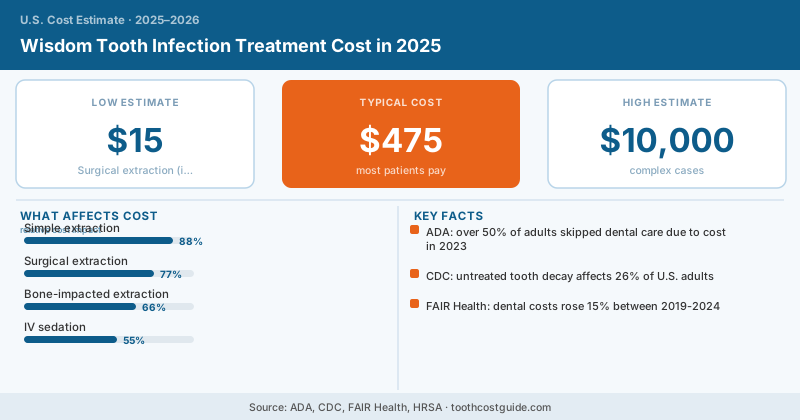
The actual fix — the one that stops the cycle — is almost always removal. Here’s what treating a wisdom tooth infection costs at each stage.
Cost Breakdown
| Treatment | Cost |
|---|---|
| Dental exam + x-rays (diagnosis) | $75–$250 |
| Antibiotics prescription | $15–$75 |
| Pericoronitis irrigation/debridement | $75–$200 |
| Simple wisdom tooth extraction | $150–$400 |
| Surgical extraction (impacted) | $300–$650 per tooth |
| Bone-impacted extraction (deep, complex) | $400–$800 per tooth |
| IV sedation (if used) | $300–$600 |
| Hospital/ER treatment (spreading infection) | $1,500–$10,000+ |
Understanding Pericoronitis
The most common wisdom tooth infection isn’t a fully abscessed tooth — it’s pericoronitis, an infection of the soft tissue flap (the operculum) that partially covers a wisdom tooth that hasn’t fully erupted. Food, bacteria, and debris collect under this flap and can’t be removed with normal brushing.
Pericoronitis causes localized pain, swelling, bad taste, and sometimes difficulty opening the mouth (trismus). Your dentist or oral surgeon can irrigate and clean under the flap ($75–$200) to provide short-term relief. This stops the acute episode. It doesn’t stop the next one.
The American Association of Oral and Maxillofacial Surgeons reports that the majority of impacted wisdom tooth infections are pericoronitis cases. Recurrence rates without extraction are high, particularly for lower wisdom teeth with angled or horizontal impaction.
When It’s More Than Pericoronitis
A wisdom tooth can also develop a standard dental abscess — bacteria infecting the pulp and surrounding bone. This is distinguishable from pericoronitis by deeper, more constant pain, sensitivity to pressure, and swelling that may extend to the jaw or neck.
Spreading dental infections are genuine medical emergencies. Odontogenic infections (originating from a tooth) can spread to the floor of the mouth, neck, and in rare but documented cases, the airway. Ludwig’s angina — a potentially fatal spread of dental infection to the submandibular space — is most often associated with lower tooth infections.
If you have any of these symptoms with wisdom tooth pain, go to an emergency room, not a dental office:
- Swelling extending below the jaw or to the neck
- Difficulty swallowing or breathing
- Fever above 101°F with facial swelling
- Inability to open the mouth more than two fingers wide
ER treatment for spreading dental infection: $1,500–$10,000+ depending on severity, whether IV antibiotics or surgical drainage are needed, and hospitalization.
Antibiotic course → pain resolves → infection returns in 6–12 weeks → another antibiotic course → repeat. Each cycle costs $75–$150 in prescription and exam fees. After three cycles, most patients have spent $225–$450 and still have the wisdom tooth. A straightforward extraction would have cost $150–$400 and ended the problem at the start. If you’re on your second infection from the same wisdom tooth, ask your dentist directly about extraction rather than another round of antibiotics.
Extraction Costs: Simple vs. Surgical vs. Bone-Impacted
Simple extraction ($150–$400): The wisdom tooth has fully erupted into the mouth, has a straight root, and can be removed with forceps after local anesthesia. Uncommon for wisdom teeth — most have some degree of impaction.
Surgical extraction ($300–$650): The tooth requires a gum incision and possibly removal of a small amount of bone to access and extract. Most partially and fully impacted wisdom teeth fall in this category. Done under local anesthesia in an oral surgeon’s office.
Bone-impacted extraction ($400–$800): The tooth is fully covered by bone, requires more significant bone removal, and may need to be sectioned (cut into pieces) for removal. The most complex single-tooth extraction category.
If all four wisdom teeth are infected or at risk, removing all four at once is usually more cost-effective than removing them individually over time — the sedation fee is a fixed cost whether you remove one tooth or four.
IV sedation ($300–$600, usually billed separately from extraction fees) is optional but widely used for wisdom tooth surgery. It’s not general anesthesia — it’s deeper-than-local sedation that most patients find worthwhile for surgical extractions.
Does Insurance Cover Wisdom Tooth Infection Treatment?
Most dental insurance plans cover wisdom tooth extractions, though coverage level varies:
- Simple extraction: Often covered at 80% under basic restorative, or 50% under major restorative
- Surgical/impacted extraction: Usually covered at 50% under major restorative, subject to annual maximum
- IV sedation: Covered by many plans when medically necessary for surgical extractions; not covered by others
- Antibiotics: Covered under your medical prescription benefit, not dental
According to the CDC, approximately 10 million wisdom teeth are extracted annually in the United States, making it one of the most common dental procedures — and most insurers have it well-categorized in their coverage. Submit a predetermination before scheduling to confirm exact coverage.
Don’t wait for the infection to “clear up on its own” before calling a dentist. An untreated wisdom tooth infection can progress from a manageable outpatient extraction ($400) to a hospital admission with IV antibiotics and surgical drainage ($5,000–$15,000) within days. Dental infections move faster than most people expect. Swelling that extends below the jawline or difficulty breathing requires a same-day emergency room visit, not a dental appointment.
Ways to Save on Wisdom Tooth Removal
Oral surgery school clinics: Oral and maxillofacial surgery residency programs at dental schools often treat wisdom tooth cases at 40–65% discounts. Residents are post-dental school graduates with specialized surgical training.
Remove all four at once: If multiple wisdom teeth are infected or symptomatic, one surgical session under one sedation fee is considerably cheaper than multiple sessions.
Dental school general clinics: For fully erupted, simple extractions, a dental school clinic charges $75–$200 per tooth versus $150–$400 at a private practice.
HSA/FSA: Extractions and associated anesthesia are fully qualified expenses. Pre-tax payment provides an effective 22–37% discount.
Bottom Line
A wisdom tooth infection costs $150–$650 to address with extraction — the treatment that actually resolves it. Antibiotic courses provide temporary relief at $75–$150 each but don’t fix the underlying structural problem. For spreading infections with systemic symptoms, emergency treatment can cost $1,500–$10,000+. Act early, extract the tooth if your dentist recommends it, and don’t mistake two weeks of antibiotic-driven symptom relief for resolution of the problem.
Frequently Asked Questions
Treatment costs range from $150–$3,500+ depending on severity and what's needed. A simple antibiotic prescription runs $150–$300, while extraction of an impacted wisdom tooth costs $800–$2,500, and surgical removal under general anesthesia can reach $3,500 or more.
Most dental plans cover 50–80% of extraction costs after your deductible ($50–$150), but antibiotic prescriptions are typically covered by medical insurance instead. Orthodontic complications or infections classified as preventive may have different coverage limits, so check your specific plan details.
No—antibiotics clear the infection temporarily but don't address the underlying structural problem, so the infection returns within weeks or months. The only permanent solution is extraction or surgical removal of the impacted or partially erupted tooth, which typically takes 1–2 weeks to recover from.