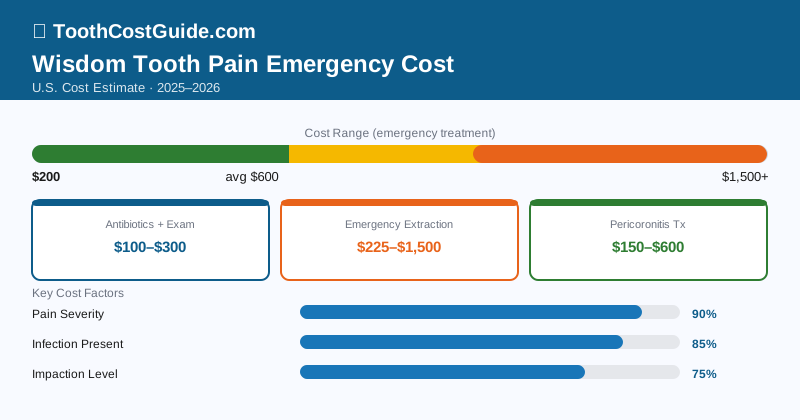
Wisdom tooth pain follows a predictable pattern for a lot of people: it shows up around age 17–25, often when a tooth is only partially erupted, and it tends to arrive at the worst possible time — finals week, a holiday weekend, the night before something important. The gum tissue around a partially erupted wisdom tooth creates a pocket where bacteria accumulate, and when that pocket gets inflamed, you feel it immediately.
The good news is that treatment is well-established and costs are predictable. Here’s what you’re looking at.
| Situation | Treatment | Cost (No Insurance) |
|---|---|---|
| Pericoronitis (gum flap infection) | Antibiotics + irrigation | $150–$400 |
| Pericoronitis (recurring) | Extraction | $300–$700 |
| Impacted wisdom tooth pain | Extraction (soft tissue impaction) | $300–$450 |
| Impacted wisdom tooth pain | Extraction (bony impaction) | $400–$800 |
| Wisdom tooth abscess | Antibiotics + extraction | $400–$900 |
| All 4 wisdom teeth removed | Package extraction | $1,000–$3,000 |
| Emergency exam + panoramic X-ray | Diagnosis | $150–$350 |
| IV sedation (optional, oral surgeon) | Comfort option | $300–$800 additional |
What’s Actually Causing the Pain
Getting this right determines how much you spend and what happens next.
Pericoronitis: The most common cause of wisdom tooth pain. A partially erupted wisdom tooth has a flap of gum tissue (operculum) partially covering it. Food and bacteria collect under that flap and cause inflammation, sometimes infection. Symptoms: soreness, swelling of the gum around the tooth, bad taste, sometimes swollen lymph nodes in the neck. Treatment ranges from antibiotics and irrigation (if mild) to extraction (if recurring or severe).
True impaction: When a wisdom tooth can’t fully erupt because it’s blocked by adjacent teeth or bone. It may be angled horizontally, mesially, distally, or simply buried. Pain can be constant, can radiate into the jaw, ear, or temple, and isn’t necessarily tied to gum swelling. Extraction is typically the only resolution.
Abscess: An infection that’s developed in the root or surrounding bone. Often presents with throbbing pain, swelling in the face or jaw, fever, and sensitivity to pressure. Antibiotics are usually started before extraction to get the infection controlled — extracting a tooth with active abscess is more complex.
Distinguishing pericoronitis from abscess: Pericoronitis tends to involve the gum tissue directly around the tooth. An abscess typically involves swelling that’s more diffuse, sometimes involving the cheek or neck. Fever is more common with abscess. Any swelling extending beyond the immediate tooth area, especially toward the throat or neck floor, is a serious warning sign.
What Affects the Cost
Whether the tooth is erupted, partially erupted, or fully impacted. An erupted wisdom tooth that’s accessible gets removed as a simple extraction ($150–$300). A partially erupted or buried tooth requires surgical extraction — gum tissue is cut and reflected, bone may be removed, the tooth may need to be sectioned into pieces. That costs $300–$800 per tooth.
The impaction angle and depth. Horizontal and deep bony impactions are the most time-consuming and technically demanding. Oral surgeons reach the higher end of that $400–$800 range for these. A mesially angled partial impaction is more straightforward.
Who performs it. General dentists handle accessible wisdom teeth but typically refer complex impactions to oral and maxillofacial surgeons. OMS fees run 20–40% higher than general dentist fees. Most insurance pays the same allowable regardless of who performs the procedure, subject to in-network rates.
Sedation. Most emergency wisdom tooth procedures are done with local anesthesia only. If you want IV sedation — and many people do — add $300–$800 for that option. IV sedation requires an oral surgeon.
Emergency timing. Same-day appointments and weekend calls add $75–$200 in emergency surcharges at most practices.
Treatment Options and What Each Costs
Antibiotics alone — $10–$60 with GoodRx
For mild pericoronitis without significant swelling, a dentist may prescribe amoxicillin or metronidazole to reduce inflammation before scheduling extraction. This buys time but doesn’t solve the underlying problem. A wisdom tooth that’s caused one infection episode will almost certainly cause another.
Irrigation and debridement — $75–$200
The dentist uses a syringe to flush debris and bacteria from under the gum flap with saline or chlorhexidine solution. Provides relief without extraction. Appropriate for a first pericoronitis episode as a temporary measure while scheduling extraction.
Emergency extraction — $300–$800 per tooth
The definitive treatment. Removes the source of infection and pain permanently. For a single problematic wisdom tooth, this is almost always the most cost-effective long-term solution. Treating pericoronitis repeatedly with antibiotics costs money each time and doesn’t prevent recurrence.
All four wisdom teeth — $1,000–$3,000
If all four will eventually cause problems (or are already problematic), removing them together in one appointment under sedation saves significantly compared to four separate procedures. One set of prep fees, one sedation charge, one recovery period. Most oral surgeons offer a per-tooth discount when doing multiple extractions simultaneously.
Operculectomy — $200–$400
Less common: surgical removal of just the gum flap (operculum) without extracting the tooth. Only appropriate when the wisdom tooth is well-positioned and close to full eruption — meaning the flap removal would allow it to erupt completely and function normally. When the tooth is impacted or poorly positioned, this doesn’t solve the problem.
With Dental Insurance
Wisdom tooth extractions are generally covered under the oral surgery benefit:
- Simple extraction of an erupted tooth: 75–90% covered under basic oral surgery
- Surgical extraction of impacted tooth: 60–80% covered under major oral surgery
Sample math: An impacted extraction billed at $600 with 60% coverage: insurance pays $360, you pay $240 (after meeting your deductible).
Annual maximum trap: All four wisdom teeth removed at once can total $2,000–$4,000. If your plan’s annual maximum is $1,500, you’ll pay the difference after coverage. If this isn’t an emergency, consider splitting the procedure across two calendar years — remove two in December, two in January of the following year.
Without insurance: Dental school oral surgery clinics are the best option. Extractions including complex impacted wisdom teeth are performed by oral surgery residents under faculty supervision. Cost: $150–$400 per tooth — roughly half of private practice rates.
What To Do Right Now
For severe pain, significant swelling, or fever: Call a dentist or oral surgeon for same-day evaluation. Don’t wait this one out.
For mild pericoronitis (soreness, no major swelling):
- Rinse with warm saltwater every few hours
- Take ibuprofen 400–600mg every 6 hours for pain and inflammation
- Use a curved tip irrigation syringe (available at pharmacies, $5–$10) to flush under the gum flap
- Apply clove oil to the gum with a cotton swab for topical relief
- Call your dentist for an appointment — urgent but not ER-level
Don’t treat pericoronitis with antibiotics more than once. If a wisdom tooth has caused two gum infections, extraction is the appropriate next step. Antibiotics treat the current episode; they don’t change the anatomy that keeps causing the problem.
The Serious Warning Signs
Wisdom tooth infection with swelling that spreads to the cheek, neck, or floor of the mouth is a serious emergency. These infections can spread rapidly along fascial planes. If you have difficulty opening your mouth, difficulty swallowing, or fever above 102°F with wisdom tooth swelling, go to an emergency room immediately.
Spreading neck swelling is the specific red flag — this pattern of infection (called Ludwig’s Angina at its most severe) can compromise the airway. It’s rare, but it’s not something to observe and see how it goes in the morning. Emergency room, immediately.
Saving Money on Wisdom Tooth Removal
Dental school oral surgery clinics. Half the private practice price, supervised care from residents who are fully trained dentists. Look up dental schools near you and call their oral surgery department.
All four at once. If multiple wisdom teeth need to come out, consolidating saves on overhead: one emergency exam, one sedation fee, one recovery.
In-network matters. For insured patients, staying in-network with oral surgeons prevents balance billing that can significantly increase your share.
Time elective removals strategically. If the situation isn’t an emergency and you’ve already hit your annual insurance maximum, schedule after January 1 to maximize a fresh annual maximum.
Frequently Asked Questions
Emergency wisdom tooth extraction typically costs $200–$800 per tooth, depending on complexity and whether the tooth is fully erupted or impacted. If the extraction requires surgical removal by an oral surgeon rather than a general dentist, you can expect costs at the higher end of that range, potentially reaching $1,500 for severely impacted teeth.
Most dental insurance plans cover 50–80% of emergency extraction costs after you meet your deductible, though many plans exclude or limit coverage for preventive or elective wisdom tooth removal. Out-of-pocket costs typically range from $100–$600 per tooth depending on your plan's coverage level and annual maximum benefits.
Antibiotics for an acute wisdom tooth infection cost $10–$60 and may temporarily relieve pain caused by bacterial infection, but they do not solve the underlying problem of a partially erupted tooth or impaction. Most dentists recommend antibiotics only as a short-term emergency measure while you schedule an extraction, which is the only permanent solution.