Nearly half of American adults over 30 have gum disease. Not the “your gums bleed a little when you floss” kind — the CDC’s National Health and Nutrition Examination Survey found that 47.2% of adults 30 and older have periodontitis, the kind that permanently destroys bone. Among adults over 65, that number hits 70.1%.
Here’s what most patients don’t know: you can have moderate periodontitis and feel absolutely nothing. No pain, no obvious symptoms beyond some bleeding when you brush. By the time teeth start getting loose, significant irreversible damage has already happened.
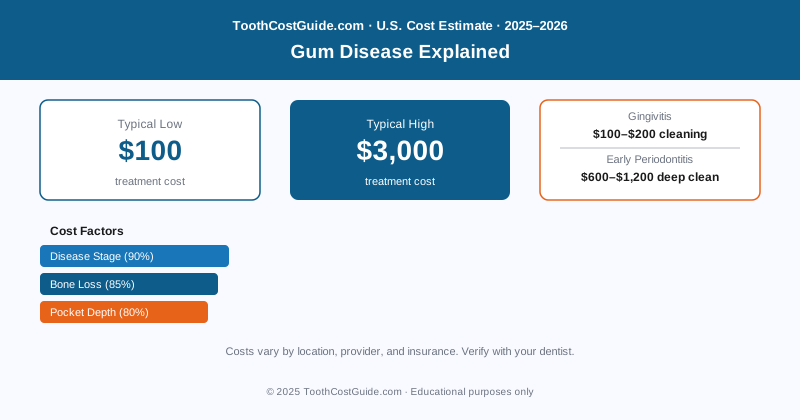
Knowing the difference between gingivitis and periodontitis — and which stage you’re in — is the difference between a $150 cleaning and a $2,000 surgical procedure.
What Gum Disease Actually Is
Periodontal disease is a bacterial infection of the structures that support your teeth: the gums, periodontal ligament, cementum, and alveolar bone. It starts with plaque — the sticky bacterial film that forms on teeth daily — and gets worse when that plaque isn’t removed consistently.
Bacteria in plaque release toxins that trigger an inflammatory response. That response causes redness, swelling, and bleeding. Over time, when the infection isn’t controlled, that same inflammation destroys the ligament and bone holding your teeth in place.
The critical distinction: gingivitis is inflammation confined to the gum tissue, with zero bone loss. It’s reversible. Periodontitis involves bone loss. It’s not reversible — the bone doesn’t come back — though it can absolutely be arrested.
Gingivitis: Stage 0 and Stage 1
Healthy gums don’t bleed when you floss. They’re pink, firm, and fit snugly around the teeth with pocket depths of 1–3mm. Bleeding during brushing or flossing isn’t normal — it’s gingivitis.
Stage 1 gingivitis shows up as red, swollen gums that bleed when gently probed. No bone loss, no attachment loss. Pocket depths stay at 1–3mm. This stage is entirely reversible with better home care and a professional cleaning.
Bleeding gums are not normal and should never be dismissed. Healthy gum tissue doesn’t bleed when you floss gently. Bleeding is your body’s inflammatory response to bacteria — it’s Stage 1 gum disease waving a red flag. Most people notice it, assume it means they’re brushing too hard, and stop flossing. That’s exactly backwards.
Treatment: Professional prophylaxis (regular cleaning) plus improved home care. Cost: $100–$200 for the cleaning. Most insurance covers preventive cleanings at 100%.
Early Periodontitis: Stage 2
Bone loss has started. The inflammatory process has begun destroying connective tissue and bone. Pocket depths are now 2–3mm with 1–2mm of clinical attachment loss. X-rays may show early horizontal bone loss.
Patients almost always feel nothing at this stage. A thorough probing during your dental exam is the only reliable way to find it.
Treatment: Scaling and root planing (SRP) — the deep cleaning — combined with improved home care. Unlike a regular cleaning that works above the gumline, SRP removes calculus and bacterial toxins from below the gumline and smooths root surfaces to encourage gum reattachment.
Cost: $600–$1,200 for a full-mouth deep cleaning, typically done in two appointments. Insurance usually covers SRP at 80% after your deductible.
Moderate Periodontitis: Stage 3
Pocket depths reach 4–6mm. Bone loss is measurable. There may be some tooth mobility. Bleeding on probing is consistent. This is the stage behind most of that 47% CDC number.
Treatment: Full-mouth SRP, with reassessment at 4–6 weeks. If pockets don’t reduce to 4mm or less after SRP, surgical options become necessary. Periodontal maintenance every 3–4 months afterward is required indefinitely — not optional.
Cost: Deep cleaning $600–$1,200 + ongoing maintenance at $100–$200 per visit (3–4 visits/year = $300–$800/year going forward). Some patients also need antibiotic therapy — locally delivered antibiotics placed directly into pockets run $50–$150.
Severe Periodontitis: Stage 4
Pocket depths exceed 6mm. Bone loss is often 50% or more around affected teeth. Teeth may be visibly mobile. Bite may have shifted. Some teeth may already be lost.
At this point, SRP alone usually isn’t enough. Surgery is needed to access and decontaminate deep pockets, attempt bone regeneration, or reduce pocket depths.
Surgical options:
- Osseous surgery (flap surgery): Gum tissue is reflected to clean root surfaces and reshape bone. $1,000–$3,000 for 1–4 teeth.
- Bone grafting: Regenerates lost bone around teeth. $200–$3,000 per site depending on graft material and extent.
- Guided tissue regeneration (GTR): A membrane encourages bone and ligament regrowth. $1,500–$4,000 per site.
| Stage | Pocket Depth | Bone Loss | Treatment | Estimated Cost |
|---|---|---|---|---|
| Gingivitis | 1–3mm | None | Regular cleaning | $100–$200 |
| Early periodontitis | 3–4mm | Early (1–2mm) | Deep cleaning (SRP) | $600–$1,200 |
| Moderate periodontitis | 4–6mm | Moderate | SRP + maintenance | $800–$1,500 + ongoing |
| Severe periodontitis | 6mm+ | Significant | Surgery + bone graft | $1,000–$5,000+ |
The Systemic Health Connection
The American Academy of Periodontology has thoroughly documented the links between periodontitis and systemic disease. This isn’t fringe science.
Heart disease: People with periodontitis have 2–3 times higher risk of cardiovascular events. Oral bacteria have actually been found in arterial plaques.
Diabetes: The relationship runs both ways. Uncontrolled diabetes worsens gum disease; severe gum disease makes blood sugar harder to manage. A 2013 study in the Journal of Clinical Periodontology found that SRP reduced HbA1c levels in diabetic patients by an average of 0.36% — a clinically meaningful improvement.
Pregnancy: Periodontitis during pregnancy is associated with preterm birth and low birth weight. The AAP recommends periodontal evaluation as part of prenatal care.
Respiratory disease: Oral bacteria aspirated into the lungs are linked to pneumonia and COPD flare-ups, particularly in older adults.
Periodontal Maintenance: The Lifelong Commitment
Here’s what many patients don’t get after completing SRP: they no longer qualify for regular preventive cleanings as their main care. They need periodontal maintenance — a different procedure that includes continued subgingival scaling, pocket depth reassessment, and ongoing disease monitoring.
Every-3-to-4-month maintenance visits aren’t negotiable for periodontitis patients. Research consistently shows that patients who stick to the schedule maintain their results; those who skip appointments typically see disease reactivation within 6–12 months.
The bacteria responsible for periodontitis repopulate treated pockets within 8–12 weeks. That’s why every-3-month maintenance exists — it disrupts the bacterial cycle before it can re-establish. Going back to twice-a-year cleanings after completing SRP is one of the most common mistakes periodontitis patients make, and it often results in needing SRP again within 2–3 years.
At-Home Care That Actually Moves the Needle
For gingivitis and early periodontitis, what you do between appointments matters as much as the appointments themselves. Daily plaque removal below the gumline requires:
- Interdental cleaning: Floss, interdental brushes, or a water flosser. The ADA considers any of these effective; water flossers are particularly useful for patients with periodontitis.
- Electric toothbrush: Meta-analyses consistently show oscillating-rotating electric brushes reduce gingivitis and plaque more effectively than manual brushing.
- Antimicrobial rinse: Chlorhexidine (prescription) is the gold standard for acute gingivitis control. OTC options with cetylpyridinium chloride or essential oils offer modest benefit.
The total cost of solid home care — electric toothbrush, floss, antimicrobial rinse — runs about $50–$150 upfront and $20–$40/month to maintain. For someone with early periodontitis, that investment can mean the difference between controlling the disease and needing surgery.