Your annual dental benefit cap is probably $1,500. That same number was common in the 1960s. Adjusted for inflation, it would need to be around $14,000 today to have equivalent purchasing power — and yet here we are, still arguing with insurers over a single crown that blows through your entire yearly limit in one afternoon.
Dental insurance isn’t like medical insurance. It’s really a discount plan with a hard spending ceiling. The sooner you understand the structure, the fewer nasty surprises you’ll get at checkout.
The 100/80/50 Rule Explained
Every dental plan organizes covered services into three tiers, and dentists just call it “the 100/80/50 rule” because that’s what it is.
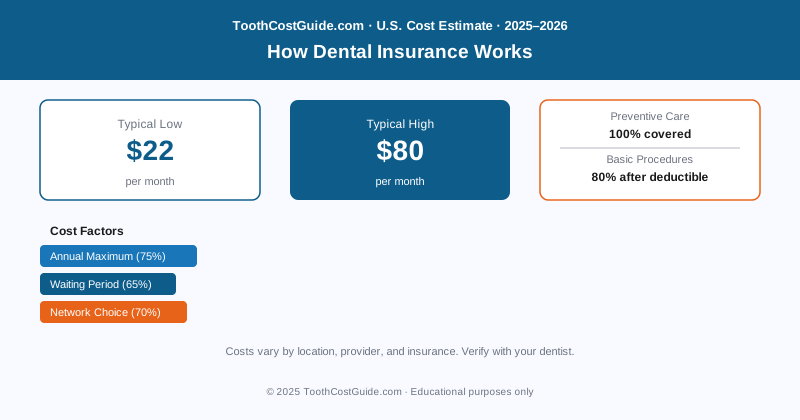
Preventive care — covered at 100%: Cleanings, exams, and X-rays twice a year. Insurance pays fully because keeping your teeth healthy is cheaper for them than paying for crowns and root canals later.
Basic procedures — covered at 80% (after your deductible): Fillings, simple extractions, and some periodontal treatment. You pay 20%, they pay 80%. A $250 filling becomes roughly $50 out of pocket — once you’ve cleared your deductible first.
Major procedures — covered at 50%: Crowns, bridges, dentures, oral surgery. This is where patients get blindsided. A $1,500 crown? Insurance pays $750. You pay $750 — assuming you haven’t burned through your annual maximum already.
Some plans tack on a separate orthodontic benefit — a lifetime maximum of $1,000–$2,000 per person for braces or clear aligners.
The Annual Maximum Problem
The average dental insurance annual maximum is $1,000–$2,000. That figure was set in the 1960s and has barely budged. Adjusted for inflation, a $1,000 benefit from 1970 would need to be roughly $7,500 today to have the same purchasing power. A single crown can consume your entire annual benefit in one appointment.
Here’s a real-world example. Say you need a crown ($1,500) and two fillings ($200 each) in one year, plus your usual cleanings:
- Cleanings: Free under preventive
- Fillings: $400 total, insurance pays 80% = $320 covered, you pay $80
- Crown: $1,500, insurance pays 50% = $750 covered, you pay $750
- Total insurance paid: $1,070
- You’ve hit a $1,000 maximum. Anything else that year? Entirely on you.
With a $1,500 cap you might squeak by. But one extra filling, one emergency visit — you’re paying full freight.
Deductibles: The First-Dollar Hurdle
Most plans carry a $50–$150 annual deductible. It applies to basic and major work — not preventive. So your first filling of the year costs you the full deductible before the 80% kicks in.
With a $100 deductible and a $250 filling: you pay $100 deductible + 20% of the remaining $150 = $130 out of pocket. Not the $50 you calculated in your head.
| Plan Type | Monthly Premium | Annual Maximum | Deductible |
|---|---|---|---|
| Basic individual (HMO-style) | $15–$25 | $1,000 | $50–$100 |
| Mid-tier individual (PPO) | $30–$50 | $1,500 | $100 |
| Premium individual (PPO) | $50–$80 | $2,000 | $100–$150 |
| Employer group plan | $8–$20/mo employee share | $1,500–$2,000 | $50–$100 |
| Family plan (PPO) | $80–$150 | $1,500–$2,000/person | $150 family max |
Waiting Periods: The Trap for New Enrollees
You sign up for dental insurance in January because you know you need a crown. February comes. Your dentist is ready. But many plans won’t cover major procedures until you’ve been enrolled 6–12 months. This is the waiting period, and it trips up patients constantly.
Typical structure:
- Preventive: No wait — cleanings and exams covered from day one
- Basic procedures: 3–6 months
- Major procedures: 6–12 months
If you know big work is coming, enroll early. Sign up in October and you could qualify for major coverage by April.
In-Network vs. Out-of-Network: The Fee Schedule Difference
In-network means your dentist agreed to the insurer’s contracted rates — usually 15–40% below their standard fees. Your out-of-pocket costs are calculated on those lower numbers.
Out-of-network dentists charge their full fee. Your insurer still pays their standard percentage, but bases it on “usual, customary, and reasonable” (UCR) rates — which may be far below what your dentist actually charges. You’re responsible for the gap.
Example: your out-of-network dentist charges $2,000 for a crown. The insurer’s UCR rate is $1,200. They pay 50% of $1,200 = $600. Your bill: $2,000 − $600 = $1,400. That stings.
A porcelain crown typically costs $1,200–$1,800 at an in-network dentist. With a $1,500 annual maximum (already used $200 on fillings), you have $1,300 of benefit left. Insurance pays 50% of the crown ($650–$900). Your out-of-pocket: $550–$900.
Without insurance, the same crown runs $1,000–$2,000+ depending on material and location. Dental savings plans (discount plans) often negotiate that down to $700–$1,100 — potentially better value if you don’t need much preventive work.
The Missing Tooth Clause
Some plans include a missing tooth clause: if you were already missing a tooth before the policy started, they won’t cover replacing it. Ever. An implant or bridge for that tooth is permanently excluded.
Always check for this clause before enrolling — especially if you’ve had extractions in the past.
Pre-Authorization: Ask Before You Drill
For major work — crowns, bridges, implants — most plans let you submit a pre-authorization request before treatment starts. Your dentist sends the treatment plan; the insurer responds with what they’ll cover.
Pre-auth isn’t a guarantee (they can still deny later), but it gives you a real cost estimate so you’re not blindsided. Ask your dentist’s office to submit pre-auth on anything over $500.
Orthodontic Riders
Orthodontic coverage is almost never in a base dental plan. It’s an add-on rider, typically $15–$30 more per month, with a separate lifetime max of $1,000–$2,000 per person.
That sounds decent until you see that traditional braces run $4,000–$7,000 and clear aligners like Invisalign go $4,000–$8,000. The rider covers maybe a quarter of actual costs.
When Dental Insurance Is Actually Worth It
Run the math on your situation. Two cleanings per year at $150–$200 each = $300–$400 in value from a $25/month ($300/year) policy. You’re basically even on prevention alone — add one filling and you come out ahead.
The calculus flips when you have gum disease, need multiple restorations, or are planning implants. For complex cases, a dental savings plan often beats traditional insurance — especially when waiting periods would delay your care anyway. According to the ADA’s Health Policy Institute, roughly 40% of adults have no dental coverage at all, and many who do still skip care due to cost. Knowing exactly what your plan covers — and where it stops — is the difference between using it effectively and getting a $1,400 surprise bill.