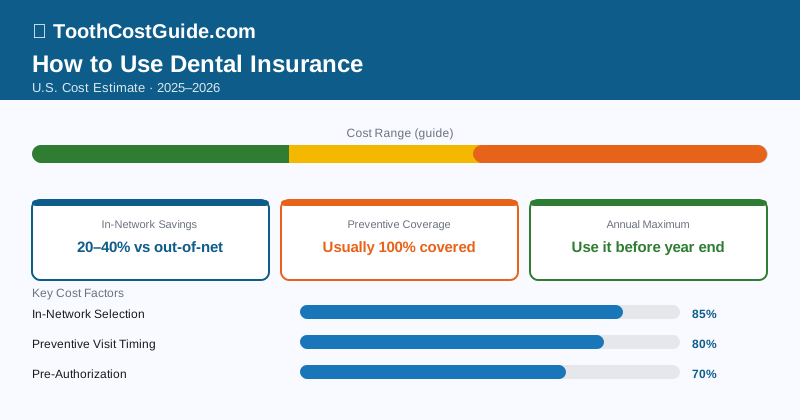
Most people with dental insurance don’t use it to its full potential — missing free preventive benefits, seeing out-of-network dentists unknowingly, or losing unused benefits at year-end. Using dental insurance correctly can save you hundreds of dollars per year compared to using it incorrectly or passively. Here’s a complete step-by-step guide to getting the most from your dental coverage.
| Insurance Task | When to Do It | Why It Matters |
|---|---|---|
| Understand your benefits | Before first visit | Avoid surprise bills |
| Find in-network dentist | Before scheduling | Save 20–40% on negotiated rates |
| Call to verify coverage | Before treatment | Confirm current network status |
| Use preventive benefits | Twice yearly | Free care; catches problems early |
| Request pre-authorization | Before major work | Know exact cost before committing |
| Submit claims (if needed) | Within 90–365 days | Gets you reimbursed |
| Track annual maximum | Throughout year | Strategically schedule remaining work |
| Schedule year-end work | October–November | Maximize benefits before reset |
Step 1: Understand Your Benefits Before Your First Visit
Before you schedule a dental appointment, read your plan documents. Key items to understand:
Your Summary of Benefits and Coverage (SBC): Every dental plan must provide this document. It summarizes what’s covered, what’s excluded, your deductible, annual maximum, and cost-sharing percentages. Find it in your member portal or call your insurer.
The three service tiers and what’s in each:
- Preventive: Cleanings, exams, X-rays — usually covered 100% from day one
- Basic: Fillings, simple extractions, periodontal scaling — usually covered 70–80% after deductible
- Major: Crowns, bridges, dentures, root canals — usually covered 50% after deductible and waiting period
Your deductible: How much you pay before insurance starts paying for basic/major services. Typically $50–$100 per year per person. Preventive care is usually deductible-free.
Your annual maximum: The total amount the insurer will pay per year. Once you hit this, you pay 100% of remaining costs. Typically $1,000–$2,000.
Waiting periods: How long you must wait before certain services are covered. Major services commonly have a 6–12 month wait.
Your coinsurance percentages: The percentage you pay after the deductible. If the plan pays 80% for fillings, you pay 20%.
The most common insurance mistake is not knowing what’s covered and getting surprised by a bill. Spending 20 minutes reading your plan’s Summary of Benefits before your first dental appointment eliminates most coverage surprises.
Step 2: Find an In-Network Dentist
Using an in-network dentist is the single most important action you can take to maximize dental insurance value.
Why in-network matters so much:
- In-network dentists have signed a fee contract with your insurer — typically 20–40% below standard market rates
- When insurance pays 50% of a crown, it’s paying 50% of the discounted contracted rate, not 50% of whatever the dentist normally charges
- You cannot be charged more than the contracted rate by an in-network dentist
- Out-of-network dentists can charge anything — your insurance pays a reduced “allowable amount” and you’re responsible for the rest
How to find in-network dentists:
- Log into your insurer’s member portal (available from most carriers 24/7)
- Use the “Find a Dentist” or “Provider Search” tool
- Filter by: zip code, plan name (HMO vs PPO vs Premier), dentist specialty (general, pediatric, orthodontist)
- Print or save the list of nearby in-network dentists
IMPORTANT: Verify before you book. Online directories are often out of date. Dentists join and leave networks frequently. Always call the dental office directly and say: “I have [Insurer Name] [Plan Name]. Are you currently in-network for that plan?” Ask for the in-network plan name specifically — dentists may participate in some of a carrier’s plans but not others (e.g., Delta Dental PPO but not Delta Dental Premier).
If your current dentist is out-of-network: Before abandoning your dentist, ask: “Would you be willing to join [Insurer Name]’s network?” Many dentists will apply to join for an established patient. If they can’t or won’t, get a detailed cost estimate of what your out-of-pocket would be before deciding to stay.
Step 3: Schedule and Use Your Preventive Benefits First
Preventive care is covered at 100% from day one on virtually every plan — no deductible, no waiting period, no cost to you. Two cleanings and one or two exams per year are included in your plan at no charge.
What’s typically included as preventive:
- 2 routine cleanings per year (prophylaxis)
- Annual comprehensive exam
- Periodic exams (sometimes limited to 1–2 per year)
- Dental X-rays (bitewing X-rays annually; full series every 3–5 years)
- Fluoride treatments for children (sometimes adults too)
- Dental sealants for children
- Oral cancer screenings
Why to use preventive benefits immediately:
- Finding a cavity when it’s small = a $100–$200 filling, covered at 80%
- Missing preventive care lets the cavity grow = a $1,500 crown, covered at only 50%
- Early periodontal disease caught at a cleaning = $200 treatment
- Advanced periodontal disease missed = $2,000 in deep cleaning, surgery
Call to make your first appointment within 30 days of coverage starting. You’re paying premiums from day one; start receiving benefits immediately.
Step 4: Get Pre-Authorization for Major Work
For any procedure estimated at over $200, ask your dentist to submit a pre-authorization (also called a predetermination or pre-treatment estimate) to your insurance company before work begins.
How it works:
- Your dentist submits the planned procedure codes and tooth numbers to your insurer
- The insurer reviews it and responds with a written Explanation of Benefits (EOB) showing what they would pay
- You know your out-of-pocket cost before committing to the procedure
- The pre-authorization is not a guarantee of payment (circumstances can change) but is a strong indicator
When to always get pre-authorization:
- Crowns ($1,000–$1,800): Insurance typically pays 50% — knowing the exact amount before treatment is critical
- Root canals ($700–$1,400): Often covered, but exclusions apply in some cases
- Dentures ($1,000–$3,500/arch): Verify coverage before starting an expensive, multi-appointment process
- Implants ($3,000–$5,000): Coverage varies widely; a predetermination is essential
- Orthodontics: Verify lifetime benefit remaining and waiting period status
What to do if the pre-authorization shows less coverage than expected:
- Ask your dentist’s billing staff to explain the difference
- Call the insurer to clarify — sometimes pre-auth amounts can be appealed or corrected
- Research whether you have a waiting period still active
- Consider phasing treatment to maximize coverage timing
Step 5: Understand Your Explanation of Benefits (EOB)
After any dental claim is processed, your insurer sends an Explanation of Benefits — either by mail or digitally. This is not a bill; it’s an explanation of what your insurance paid and what you owe.
Key fields on an EOB:
- Service date: When the procedure was performed
- Procedure code: The dental billing code (CDT code) for each service
- Billed amount: What the dentist charged
- Allowable amount: The contracted (negotiated) rate for in-network, or the plan’s UCR rate for OON
- Plan paid: How much the insurance paid
- Member responsibility: Your deductible + coinsurance amount = what you owe
- Remark codes: Short codes explaining adjustments or denials
Common EOB issues:
- Denied — service not covered: Check if the service is excluded or in a waiting period
- Denied — not medically necessary: The insurer reviewed clinical information and determined the procedure wasn’t necessary. This can be appealed with documentation from your dentist.
- Paid at a reduced amount: Common for out-of-network claims or when “least expensive alternative treatment” provisions apply
- Pending — additional information required: Call your insurer to find out what they need
Step 6: Track Your Annual Maximum and Plan Year-End
Keep track of how much insurance has paid so far this year. Your member portal typically shows claims history and remaining annual maximum. If you’ve had a crown and multiple fillings, you may be close to your limit.
Year-end strategies:
- October–November: Review remaining benefits. If you have $800 left on a $1,500 maximum, consider scheduling needed work (filling, night guard) before year-end.
- December: Last chance to use remaining benefits. Schedule cleanings if you haven’t had the second one.
- December + January split: For major work with two stages (implant post + crown, or a large bridge), schedule stage one in December and stage two in January to use two years of annual maximums.
What doesn’t roll over: Annual maximum benefits that aren’t used don’t carry over to next year. If your plan covers $1,500 and you only used $400, you lose the remaining $1,100 potential benefit at year-end.
Step 7: File Claims for Out-of-Network Care
If you see an out-of-network dentist, you may need to file claims yourself (though many offices will do this for you).
How to file an OON dental claim:
- Get a detailed receipt from the dentist with CDT procedure codes, tooth numbers, and the dentist’s NPI number
- Download your insurer’s claim form from the member portal or call to request one
- Complete the form and attach the receipt
- Submit by mail or through the member portal (most insurers now accept digital submissions)
- Keep copies of everything submitted
- Expect 2–4 weeks for processing; check the member portal for status
How to Save Money
Use all preventive benefits every year. Two free cleanings per year is often $200–$300 in value — use it. This is the highest-ROI benefit you have.
Schedule appointments early in the day to avoid cancellations. Morning appointments have the lowest cancellation rates and the most availability. Getting in for your second cleaning in October/November leaves time to address any issues found before year-end.
Ask for a detailed treatment plan in writing. Before any major work begins, get a written treatment plan with procedure codes and estimated costs. Take it home, call your insurer, and understand your liability before consenting to treatment.
Use the same practice for all family members. In-network practices that see your whole family may offer loyalty benefits and are more likely to work with you on phasing treatment, insurance billing details, and scheduling to maximize benefits.
Never assume a dental procedure is covered without verifying. Even “cleanings” can be billed differently (preventive vs. periodontal maintenance) and may have different coverage rates. Ask your dentist’s billing coordinator exactly what CDT code they’ll use for each service before the appointment.
Using dental insurance well is a skill: find in-network dentists (and verify current status), use 100%-covered preventive care twice a year, always get pre-authorizations before major work, track your annual maximum, and schedule remaining work before year-end reset. These steps alone save most policyholders $200–$500 more per year than passive insurance use.
Bottom Line
Dental insurance only delivers full value when used actively. The steps: know your benefits before your first visit, use in-network dentists only (verify status by phone), schedule both free preventive cleanings each year, get written pre-authorizations for major work, review your EOB for every claim, and track remaining annual maximum benefits to schedule year-end procedures before they expire. Policyholders who actively manage their dental insurance get 40–50% more value from the same plan compared to those who passively wait for bills to arrive.