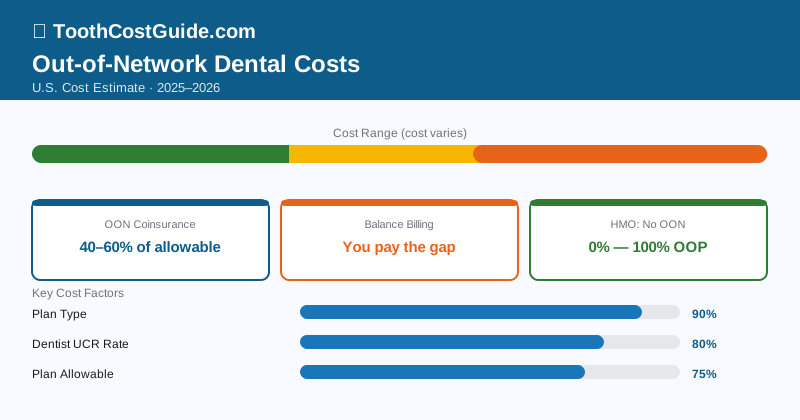
Seeing an out-of-network dentist can easily cost you 2–3 times more than an in-network visit — and many patients are surprised to receive large balance bills after assuming their insurance covered most of the cost. Out-of-network dental coverage exists on PPO plans, but it works very differently from in-network benefits. Understanding “allowable amounts,” balance billing, and how to protect yourself can save hundreds of dollars per visit.
| Procedure | In-Network Cost | Plan Allowable | OON Dentist Fee | Your OON Bill |
|---|---|---|---|---|
| Cleaning (prophylaxis) | $0 | $100 | $150 | $50–$75 |
| Filling (1 surface composite) | $30–$50 | $150 | $250 | $130–$175 |
| Crown (porcelain) | $500–$700 | $900 | $1,600 | $860–$1,160 |
| Root canal (molar) | $400–$600 | $900 | $1,400 | $770–$1,040 |
| Extraction (simple) | $50–$100 | $150 | $250 | $145–$170 |
| Dental implant | $1,700–$2,500 | $1,500 | $4,000 | $2,750–$3,250 |
How Out-of-Network Dental Coverage Works
PPO plans allow out-of-network use — this is a defining feature of the PPO (Preferred Provider Organization) model. Unlike HMOs, which pay nothing for out-of-network care except emergencies, PPOs continue to pay even when you see a non-participating dentist. However, the way they calculate what they pay creates significant exposure for patients.
The “allowable amount” problem: When you see an out-of-network dentist, the insurance company doesn’t pay based on the dentist’s actual fee. Instead, it pays based on its own “allowable amount” — a number the insurer sets based on the prevailing fee in your geographic area (often the UCR rate: Usual, Customary, and Reasonable). If the plan’s allowable for a crown is $900 and your dentist charges $1,600:
- Insurance pays 50% of $900 = $450
- You pay the remaining 50% of $900 = $450
- You also pay the balance between $900 (allowable) and $1,600 (actual fee) = $700
- Your total out-of-pocket: $450 + $700 = $1,150
Compare this to the same crown in-network:
- Insurance pays 50% of the negotiated rate ($1,200) = $600
- You pay 50% = $600
- No balance billing (in-network dentists cannot balance bill)
- Your total: $600
The difference: $1,150 (out-of-network) vs. $600 (in-network) = $550 more for the same procedure.
Balance billing: The $700 difference between the plan’s allowable and the dentist’s actual fee is called “balance billing” or a “balance bill.” Out-of-network dentists are free to charge their standard rates without restriction. They are not limited to the plan’s allowable amount. You are responsible for the full balance.
HMO plans and out-of-network: Dental HMOs generally provide no coverage whatsoever for out-of-network care. If you see an out-of-network dentist with a dental HMO, you pay 100% of the bill. Period. The only exception is dental emergencies when no in-network dentist is available.
With an out-of-network PPO dentist, you face two separate costs: your coinsurance percentage AND the gap between the dentist’s fee and the plan’s allowable amount (balance billing). Always call your insurance to get the plan’s allowable amount for your procedure BEFORE seeing an out-of-network provider so you know your total exposure.
Costs & Coverage Details
Typical out-of-network PPO coverage:
- Most PPO plans pay 40–60% of the “allowable amount” for out-of-network major services
- Some plans pay in-network coinsurance percentages (e.g., 50% of allowable for major) but apply to a different allowable amount
- A minority of PPO plans have no out-of-network benefit for certain service categories
PPO plan tiers and OON coverage:
- “PPO only” plans: Cover only in-network dentists — common for employer HMO-style PPOs
- “PPO + out-of-network”: Cover OON at reduced benefit (most individual market PPOs)
- “Indemnity plans”: Pay a fixed percentage of any dentist’s fee — better OON coverage, higher premium
Usual, Customary, and Reasonable (UCR) rates: Dental insurers use UCR databases to set allowable amounts for out-of-network claims. The UCR supposedly represents the fee that most dentists in a geographic area charge for a given service. In practice, UCR rates are often set conservatively and may lag actual market fees by years. This means even “reasonable” dentist fees can exceed UCR, triggering balance bills.
Geographic variation in OON exposure: In high-cost cities (New York, San Francisco, Boston), dentists commonly charge 150–300% of UCR, meaning balance bills can be enormous. In lower-cost areas, dentist fees are closer to UCR and balance billing is less severe.
Emergency out-of-network care: If you have a dental emergency in a city where you don’t know any dentists, you may need to go out-of-network. Most PPO plans cover emergency OON care at the same OON rate, meaning you still face balance billing. Keep $500–$1,000 in an emergency dental fund or HSA for this scenario.
Pros and Cons
Out-of-network dental care — Pros:
- Access to any licensed dentist — including specialists without referrals
- Ability to maintain continuity with a trusted dentist even if they leave your plan
- Access to dentists in emergency situations anywhere in the country
- No network approval needed for specialist care (oral surgeons, periodontists, endodontists)
Out-of-network dental care — Cons:
- Balance billing can add hundreds to thousands per procedure
- Insurance pays less (lower coinsurance on some plans for OON)
- Applied to a lower “allowable amount” that may significantly under-represent actual fees
- No protection from fee increases by the dentist
- Administrative burden of submitting OON claims yourself in some cases
Who Out-of-Network Costs Affect Most
People who are emotionally attached to their dentist — long-time patients who don’t want to switch even when their dentist leaves their insurance network. The relationship has value, but balance billing can cost $500–$2,000 per year on major procedures.
People in areas with limited networks — some rural or underserved areas have few in-network providers. Out-of-network use is effectively mandatory in these locations.
People with complex dental needs — those requiring specialized care from periodontists, oral surgeons, or prosthodontists who may not participate in most networks.
Out-of-state patients — while traveling, you may need emergency dental care from an OON provider. PPO plans provide some coverage, but balance billing applies.
How to Avoid or Minimize Out-of-Network Costs
Always verify in-network status before any appointment. Call your insurance company with the dentist’s NPI (National Provider Identifier) or name to confirm current network participation. Online directories are often out of date — a dentist listed as in-network may have left the network. A phone call takes 5 minutes and can save you hundreds.
Get a pre-treatment estimate before major OON work. For any procedure costing over $200, ask your dentist to submit a pre-treatment estimate (predetermination) to your insurance before work begins. The insurer will respond with exactly what they’ll pay based on their allowable and your coinsurance — giving you a clear picture of your total cost before you commit.
Ask OON dentists to accept the plan’s allowable. Some dentists — especially if they want to retain your business — will agree to accept the insurance allowable as payment in full, eliminating balance billing. Ask explicitly: “Will you accept my insurance’s allowable amount as full payment for this procedure?” It’s not guaranteed, but many dentists agree to avoid losing a patient.
Switch to a PPO plan with better OON benefits. “Indemnity” dental plans pay a percentage of any dentist’s actual fee rather than a limited allowable amount, greatly reducing balance billing exposure. These plans cost more in premiums but may save money if you frequently see OON providers.
Consider switching your dentist to in-network. If your current dentist is not in-network, ask them: “Do you accept [Your Plan Name]?” Many dentists will join a network for an established patient. It’s worth asking before assuming they don’t participate.
Use an HSA or FSA for balance bills. Balance bills are qualified medical expenses. Pay them with pre-tax HSA or FSA dollars to reduce the effective cost by 20–37% depending on your tax bracket.
The Surprise Billing Law (No Surprises Act), which protects patients from surprise medical bills, does NOT apply to dental care in most cases. Dental is largely exempt. Always confirm costs before treatment — you have no federal protection against large surprise dental balance bills.
Out-of-network dental costs can be dramatically higher than in-network costs due to balance billing — the gap between your dentist’s fee and the insurance company’s allowable amount. For major procedures like crowns and implants, OON balance bills can exceed $500–$1,500 per procedure. Always verify in-network status before appointments, get predeterminations for major work, and ask OON dentists to accept the plan allowable before assuming the bill is unavoidable.
Bottom Line
Out-of-network dental coverage exists on PPO plans but comes with significant costs: reduced coinsurance percentages applied to an “allowable amount” that may be far below the dentist’s actual fee, with the balance billed directly to you. A single out-of-network crown can cost $500–$1,000 more than the same procedure in-network. Protect yourself by verifying in-network status before every appointment, getting predeterminations for major work, and asking OON dentists to accept the plan allowable. When balance bills do arrive, use pre-tax HSA/FSA funds to reduce their effective cost.