Most patients hear “you need to come in every three months now” after their deep cleaning and assume it’s an upsell. It isn’t. Periodontal maintenance is one of the most evidence-supported protocols in all of dentistry — and the cost of skipping it almost always exceeds the cost of showing up.
Here’s what you’re paying for, why it costs more than a regular cleaning, and how to manage the expense over time.
What Periodontal Maintenance Actually Is
Periodontal maintenance (CDT code D4910) is a specific clinical procedure for patients who have been treated for gum disease. It’s not the same as a standard prophylaxis cleaning, and it shouldn’t be billed as one.
A regular cleaning (D1110) is designed for patients with healthy gums. It removes plaque and tartar above the gumline and in shallow crevices. It takes about 45 minutes and assumes your gums are in good shape.
Periodontal maintenance goes deeper — literally. The procedure includes:
- Scaling above and below the gumline in previously diseased pockets
- Pocket depth measurements to check for disease reactivation
- Assessment of bone levels and tissue attachment
- Subgingival irrigation if needed
- Full documentation against your baseline pocket map
It takes 60–90 minutes and requires your specific disease history. That’s why it costs more — and why it’s not interchangeable with a regular cleaning.
What You’ll Pay
| Setting | Cost Per Visit (No Insurance) |
|---|---|
| General dentist office | $110–$180 |
| Periodontist’s office | $150–$250 |
| High-cost metro area (NYC, SF, LA) | $200–$300 |
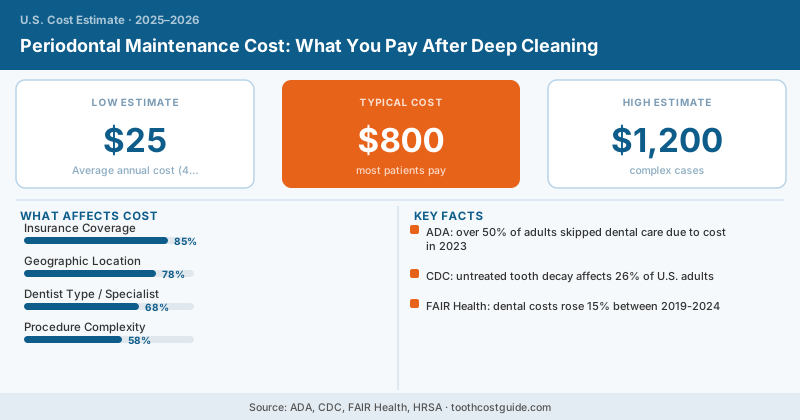
| Annual total at 4 visits per year | $440–$1,000+ |
| With typical insurance (70–80% coverage) | $25–$75 out-of-pocket per visit |
Geography moves the number significantly. In smaller cities and rural markets, periodontal maintenance runs $110–$150 per visit. In expensive coastal metros, $200–$250 is common. The procedure itself is identical — overhead and regional fee schedules drive the difference.
Why Every Three Months?
The 3-month interval isn’t arbitrary dentist scheduling. It’s based on bacterial biology.
Research published in the Journal of Clinical Periodontology established that periodontal pathogens — particularly Porphyromonas gingivalis and Tannerella forsythia — repopulate previously diseased pockets to tissue-damaging levels in approximately 11–12 weeks. A maintenance visit at the 3-month mark disrupts that cycle before bacteria reach concentrations that cause active bone loss.
The American Academy of Periodontology recommends the 3-month interval for most treated periodontitis patients. Some patients with mild disease and excellent home care compliance may eventually be extended to 4-month intervals — but that’s a clinical decision made by your periodontist after demonstrated stability, not a default.
The 3-month schedule is based on your pocket depths, bone loss pattern, risk factors (smoking, diabetes, genetics), and how well your gums responded to initial treatment. If you think your interval should change, have that conversation with your periodontist and ask them to explain the clinical reasoning. Don’t just start stretching the visits out without that discussion — the consequences show up slowly, and then all at once.
What Happens at Each Maintenance Visit
Knowing exactly what you’re getting makes the cost feel more concrete.
Updated health history. New medications, systemic health changes, and symptoms all affect gum health. Blood pressure medications, calcium channel blockers, and some antidepressants can cause gingival overgrowth or change how your tissue responds to bacteria.
Pocket probing. Your hygienist or periodontist measures pocket depths around every tooth and compares them to your baseline. An increase of even 1–2 millimeters in a previously treated area signals reactivation.
Scaling and debridement. All calculus and biofilm are removed above and below the gumline. Areas with deeper pockets or signs of inflammation get more thorough attention. This isn’t the same motion as a regular cleaning — it goes into sulcular spaces that routine prophylaxis doesn’t reach.
Radiographs (selectively). Not at every visit, but your provider takes updated bitewings annually to monitor bone levels over time. These may add $25–$80 to a visit’s cost.
Home care review. How you clean the gumline and between teeth matters as much as what happens in the chair. Technique gets reviewed and corrected at every visit. Compliance with home care is one of the strongest predictors of long-term maintenance success.
How Insurance Handles It
The CDC estimates that nearly half of US adults 30 and older have some form of periodontal disease — so insurers are very familiar with D4910. Most PPO plans cover periodontal maintenance, but the details matter.
Coverage tier. Periodontal maintenance is usually covered at 70–80% after deductible — not at the 80–100% rate typical for preventive cleanings. The difference shows up on your explanation of benefits as “basic restorative” or “periodontal” rather than “preventive.”
Frequency limits. Most plans cover 2–4 maintenance visits per year. If your periodontist recommends 4 visits and your plan covers 2, you’re self-paying for visits 3 and 4. Know your plan’s limit before assuming all visits are covered.
Alternating coverage strategy. Some plans let you alternate a periodontal maintenance visit (D4910) at your periodontist with a prophylaxis visit (D1110) at your general dentist — drawing from two different benefit categories to increase covered visits. Ask your insurance coordinator whether your plan allows this arrangement.
Annual maximum depletion. If you’ve used your plan’s annual maximum on other treatment, maintenance visits fall out-of-pocket regardless of coverage percentage. Time your care accordingly.
| Insurance Scenario | What You Pay Per Visit |
|---|---|
| No insurance, general dentist | $110–$180 |
| PPO plan, 80% coverage, $50 deductible (used) | $22–$36 |
| PPO plan, 70% coverage | $33–$54 |
| Plan maximum already exhausted | Full cost ($110–$250) |
| Medicaid (adult, where covered) | $0–$10 copay |
Reducing the Cost Over Time
FSA or HSA funds cover periodontal maintenance as a qualified dental expense. If you’re on a 4-visit-per-year schedule, pre-fund your FSA with an estimate of the annual cost. Pre-tax dollars give you an effective 22–37% discount based on your tax bracket.
Dental school periodontology clinics charge 40–60% of private practice rates for maintenance visits. Supervision by faculty periodontists means the care is clinically sound — it just takes longer. If you have flexibility in your schedule, this is the single biggest cost lever.
Community health centers (FQHCs) offer periodontal maintenance on a sliding-scale fee basis. In some markets, this brings the per-visit cost under $50 for qualifying patients.
Don’t skip and need re-treatment. This is the most important cost-saving advice. A round of scaling and root planing costs $800–$1,600 and is the treatment required when periodontal disease reactivates. Four maintenance visits at $150 each costs $600. Skipping maintenance to save money is one of the most reliably expensive decisions in dental care.
If you’re told you can return to regular 6-month cleanings after a period of maintenance, get that confirmation specifically from your periodontist — not just from a front desk coordinator or hygienist. Stepping down from D4910 to D1110 requires a formal assessment of your periodontal stability. Some practices step patients down prematurely, which increases relapse risk. If you’ve had bone loss and active periodontitis, most evidence supports lifetime maintenance as the standard of care.
The Long-Term Financial Case
A landmark study published in the Journal of Periodontology tracked periodontal patients over 10 years. Patients who complied with regular maintenance retained significantly more teeth and showed far less bone loss progression than those who were irregular or non-compliant.
Losing a tooth to untreated periodontal disease and replacing it with an implant costs $3,000–$5,000. Replacing multiple teeth costs proportionally more. Lifetime periodontal maintenance — even at four visits per year — costs a fraction of that.
It’s not a pleasant expense. But it’s a legitimate one.