The quote for your dental crown was $1,400. Then your dentist added a line item you didn’t expect: “post and core buildup — $350.” What is that, exactly, and do you actually need it?
Short answer: after a root canal, the tooth is often hollowed out and brittle enough that a crown alone won’t grip adequately. The post and core creates the internal scaffold that makes a durable crown possible. It’s not upselling — it’s engineering.
The ADA’s procedure code data shows that post and core buildups (CDT codes D2952–D2954) are performed on roughly 40% of teeth that receive full-coverage crowns. That’s a meaningful percentage — and most patients never knew the procedure existed until the bill showed up.
What a Post and Core Actually Is
After a root canal, the pulp chamber and canal are cleaned and sealed with gutta-percha. What’s left is a tooth shell: intact on the outside but hollow through the middle, with no living tissue to give it flexibility or self-repair ability. Endodontically treated teeth fracture at higher rates than vital teeth.
A post — either a prefabricated metal alloy post or a cast gold/fiber post — is cemented into the cleaned canal space, typically extending 4–6mm into the root. It doesn’t strengthen the root itself; it anchors the core material that sits above it.
The core is composite resin or amalgam built up around the post to recreate a “tooth stub” with enough height, width, and retention to support a full-coverage crown. Without this buildup, a crown placed on a heavily compromised tooth has very little to grip.
Post and Core Cost Breakdown
| Procedure | Typical Cost | Notes |
|---|---|---|
| Prefabricated post + composite core | $200–$500 | Most common; done same visit as crown prep |
| Cast post and core (lab-fabricated) | $400–$800 | Requires two appointments |
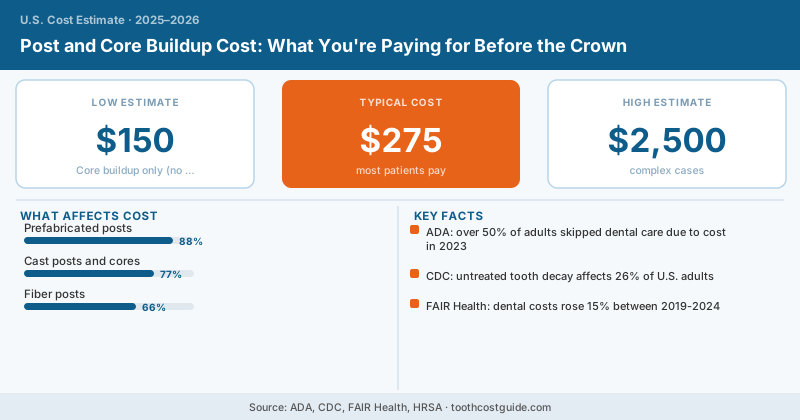
| Core buildup only (no post) | $150–$400 | Used when natural structure is adequate |
| Fiber post + core | $250–$550 | Tooth-colored; preferred in visible areas |
| With crown (total package) | $1,200–$2,500 | Post/core + crown combined estimate |
Prices vary significantly by region, dentist specialty (prosthodontist vs. general dentist), and the material selected. Urban practices in high cost-of-living states typically run 20–30% higher than rural practices.
Prefabricated vs. Cast Posts
Prefabricated posts — made of titanium alloy, stainless steel, or fiber-reinforced composite — come in standard sizes and are placed in a single appointment. The dentist selects the right diameter, cements it, and builds up the core in the same visit. This is the standard approach for most posterior teeth (molars, premolars) and front teeth with adequate canal geometry. Cost: $200–$500.
Cast posts and cores are custom-fabricated by a dental lab. Your dentist takes an impression of the prepared canal, sends it to a lab, and seats the finished cast post at a second appointment 1–2 weeks later. They’re recommended for unusually shaped canals or when maximum precision and retention are critical — typically in complex prosthodontic cases. Cost: $400–$800, and you’re paying for both the lab fee and two appointments.
Fiber posts (typically carbon or quartz fiber in a resin matrix) are tooth-colored and transmit stress more similarly to natural dentin than metal. They’re increasingly preferred in aesthetic zones — front teeth visible when you smile — where a dark metal shadow through a porcelain crown would be visible. Comparable in cost to prefabricated metal posts.
Not every crown-prep tooth needs a post. If enough natural tooth structure remains above the gumline — generally, at least two walls of tooth structure at least 2mm tall — a core buildup with composite resin alone may provide sufficient retention. Your dentist evaluates this during the crown preparation appointment. The core-only approach is cheaper ($150–$400) and avoids the risks associated with post placement, including root fracture. Don’t assume you need a post just because the treatment plan includes one — ask your dentist to show you the clinical photos and explain why post placement is recommended for your specific tooth.
How It’s Billed
The CDT codes involved:
- D2952 — cast post and core in addition to crown
- D2953 — each additional cast post (same tooth)
- D2954 — prefabricated post and core in addition to crown
- D2950 — core buildup, including any pins (no post)
Insurance plans typically require the crown claim to be submitted alongside the post and core claim. If your plan covers crowns at 50%, it usually covers the buildup at the same percentage. Pre-authorization takes 3–5 business days and is strongly worth requesting before you commit.
Alternatives and What to Watch For
If a tooth needs a post and core but the root itself is compromised — cracked below the gumline, severely resorbed, or fractured — the buildup won’t save it. Your dentist should take a periapical X-ray and ideally a CBCT scan to evaluate root integrity before recommending a post and core. If the root can’t support the post, extraction followed by implant or bridge is the more honest treatment path.
A post and core is not a cure for a cracked root. If your tooth has a vertical root fracture — often identified by pain on biting in a specific direction, localized gum swelling, or a sinus tract near the root — placing a post will not save the tooth. Get a second opinion before committing to a post, core, and crown on a tooth that a different dentist would extract. The combination of post, core, crown, and eventual extraction is the most expensive outcome in restorative dentistry.
Frequently Asked Questions
A post is a metal or fiber rod cemented into the root canal space — it anchors everything to the remaining root. A core is the composite or amalgam material built up around and over that post to recreate a tooth shape large enough for a crown to grip. They're usually done together in the same appointment, which is why you'll see them billed as 'post and core' — but they're two separate CDT codes and two separate charges. Some teeth only need a core buildup without a post, particularly when enough natural tooth structure remains above the gumline to support the core on its own.
Often yes, at least partially. Most PPO dental plans classify a post and core buildup as a basic or major restorative service, covering 50–80% after your deductible. However, many plans require that the crown on top also be covered — they won't pay for the foundation without the finished restoration. Pre-authorization is strongly recommended. Some plans have frequency limitations (e.g., once per tooth per 10 years) and may deny the claim if a prior buildup was placed recently.
You can skip the post if your dentist determines enough natural tooth structure exists. But if your dentist recommends a post and core and you decline, the crown placed over insufficient tooth structure is far more likely to fail — often within 1–3 years. You'll end up paying for the crown twice, plus potentially an emergency extraction if the tooth fractures at the gumline. The post and core is the cheapest part of a crowned tooth's total cost. Cutting it out to save $300 is almost never worth it.