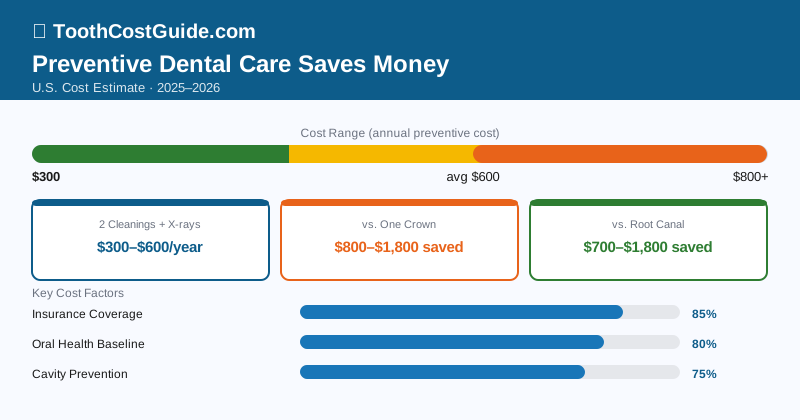
Spending $280–$350/year on two dental cleanings and checkups is the highest-ROI financial decision in healthcare — catching and treating dental problems early costs 10–50x less than treating them after they escalate. A filling caught early costs $150–$300; the same tooth neglected becomes a root canal ($1,000) plus crown ($1,400) or an extraction ($300) plus implant ($4,500). The math is unambiguous.
| Preventive vs. Reactive Cost Comparison | Preventive Cost | If Neglected (typical escalation) | Extra Cost of Neglect |
|---|---|---|---|
| Cavity caught at cleaning → filling | $150–$300 | Root canal + crown: $2,200–$2,800 | $1,900–$2,500 |
| Gum disease caught early → deep cleaning | $250–$400 | Gum surgery: $3,000–$8,000 | $2,600–$7,600 |
| Cracked tooth detected → crown | $1,200–$1,800 | Extraction + implant: $4,000–$6,000 | $2,200–$4,200 |
| Annual cleanings × 10 years | $2,800–$3,500 | 1 infection/tooth loss event | $3,000–$7,000 |
| Child sealants (all 4 molars) | $120–$240 | 4 fillings if decay sets in | $600–$1,200 |
| Fluoride varnish (child, annual) | $30–$50 | Cavity prevention value | $150–$300/cavity |
How It Works
The escalation principle of dental disease: Dental problems almost never stay the same size. A small cavity (decay limited to enamel) that costs $150–$200 to fill, if left untreated, progresses through a predictable and expensive path:
- Enamel cavity: $150–$300 filling
- Dentin cavity (deeper decay): $200–$400 filling
- Pulp involvement (decay reaches the nerve): $800–$1,500 root canal + $1,200–$1,800 crown = $2,000–$3,300
- Abscess/infection: Emergency visit + antibiotics + root canal or extraction = $500–$2,500
- Tooth loss: Extraction ($200–$350) + implant ($4,000–$5,500) or bridge ($3,500–$5,000) = $4,200–$5,850
Each stage costs roughly 5–10x more than the previous one. The patient who “saved money” by skipping a $200 cleaning for 3 years ended up spending $3,000–$5,000 on a root canal, crown, or implant.
Why cleanings specifically prevent disease: Professional dental cleanings remove calculus (hardened plaque) that cannot be removed by brushing or flossing at home. Calculus harbors the bacteria responsible for both tooth decay and gum disease. Without periodic professional removal, calculus builds up below the gumline and causes bone loss — the hallmark of advanced gum disease (periodontitis).
Costs & Savings Details
The 10-year math:
Scenario A — Regular preventive care (2 cleanings/year):
- Cost: $280/year × 10 years = $2,800 in cleanings
- Dental issues likely caught and treated early: 1–2 small fillings over 10 years = $300–$600
- Total 10-year spend: $3,100–$3,400
Scenario B — Skipping cleanings entirely:
- Cost of cleanings saved: $2,800
- Likely issues in 10 years of neglect: 2 root canals, 2 crowns, 1 extraction, 1 implant
- Cost: $2,000 + $2,000 + $2,400 + $300 + $4,500 = $11,200
- Total 10-year spend: $11,200
- Extra cost of not cleaning: $8,100 (nearly 3x more)
Specific high-ROI preventive procedures:
- Dental sealants for children: $30–$60 per tooth. Studies show sealants reduce cavities in sealed molars by up to 80%. A set of 4 sealants costs $120–$240 and can prevent $600–$1,200 in fillings.
- Fluoride varnish: $30–$50 per application. Strengthens enamel and has been shown to reduce cavity incidence by 30–45% in high-risk patients.
- Early gum disease treatment (scaling/root planing): $250–$400/quadrant for treating early-stage gum disease. Untreated, periodontitis leads to bone loss, loose teeth, and ultimately tooth loss requiring implants or dentures ($3,500–$30,000 for full reconstruction).
- Night guard for bruxism: $300–$600 custom-fit. Prevents grinding from destroying crowns, cracking teeth, and causing jaw joint problems that require expensive specialist care.
Eligibility / Who Qualifies
Preventive dental care is available to everyone. Most dental insurance plans cover preventive care at 100% with no deductible because insurers have learned it reduces their costs on the back end. For the uninsured:
- Two annual cleanings at an FQHC cost $0–$30 total for income-qualifying patients
- Dental school cleanings cost $25–$50 each
- In-house dental membership plans typically include 2 cleanings as the base benefit ($150–$400/year total plan cost)
Pros and Cons
Pros
- Dramatically reduces lifetime dental costs
- Covered at 100% by most dental insurance plans
- Creates an ongoing relationship with a dentist who can catch problems early
- Cleanings also screen for oral cancer — early detection saves lives
Cons
- Requires discipline and scheduling
- Upfront cost (but this article demonstrates the substantial ROI)
- Some patients have dental anxiety that makes appointments difficult
Many patients think dental cleanings are only about clean teeth. In reality, the most important thing that happens at a cleaning is the dentist’s examination — they look at bite X-rays, probe around teeth for bone loss, check for oral cancer, and identify problems at the earliest (cheapest) stage. Skipping cleanings means skipping early detection.
Step-by-Step Guide
Schedule two cleanings per year, six months apart: This is the foundation of preventive dental care. Set recurring calendar reminders in January and July as a reminder to call.
Don’t skip X-rays when recommended: Annual bitewing X-rays detect decay between teeth that cannot be seen visually. Skipping X-rays to save $50–$100 risks missing cavities until they’ve progressed to root canal level.
Ask about sealants for children: If your child is 6–12 years old and their molars have just come in, ask the dentist about sealants. The cost-benefit is extremely favorable.
Address gum disease aggressively: If your dentist recommends a deep cleaning (scaling and root planing), do it. The $600–$1,200 cost prevents $10,000+ in periodontal surgery and tooth loss down the road.
Treat cavities immediately: When a cavity is found, schedule the filling within 1–2 months. Every month of delay allows decay to deepen, potentially converting a $200 filling into a $2,400 root canal and crown.
Ask about a night guard if you grind your teeth: Signs include worn-down teeth, jaw soreness in the morning, headaches, and frequent cracked teeth. A $400 night guard can save thousands in destroyed dental work.
Practice effective home hygiene: Brush twice daily with fluoride toothpaste, floss daily, and use an antibacterial mouthwash if your dentist recommends it. Home hygiene between professional cleanings is essential to the prevention system.
The single best cost-saving dental move for anyone, insured or not, is this: go to every cleaning appointment, have X-rays taken annually, and treat every cavity immediately when found. A patient who does this consistently will spend 3–5x less on dental care over a lifetime than one who defers and avoids. Prevention is not an expense — it’s the cheapest dental insurance that exists.
Bottom Line
Two annual cleanings costing $280–$350/year is not an expense — it’s the most important dental investment you can make. The math clearly shows that regular preventive care reduces lifetime dental spending by $5,000–$20,000+ compared to sporadic or reactive care. For patients without insurance, the cost of two cleanings at a dental school ($50–$100 each) or an FQHC ($0–$30 each) is trivially small relative to the escalating costs they prevent. Do not skip cleanings to save money — that logic consistently backfires.