Your child’s orthodontist just told you they need a palate expander before braces. You nodded, took the brochure, and then quietly Googled the cost on the way to your car. You’re not alone — it’s one of the most common questions parents ask after a Phase 1 orthodontic consultation.
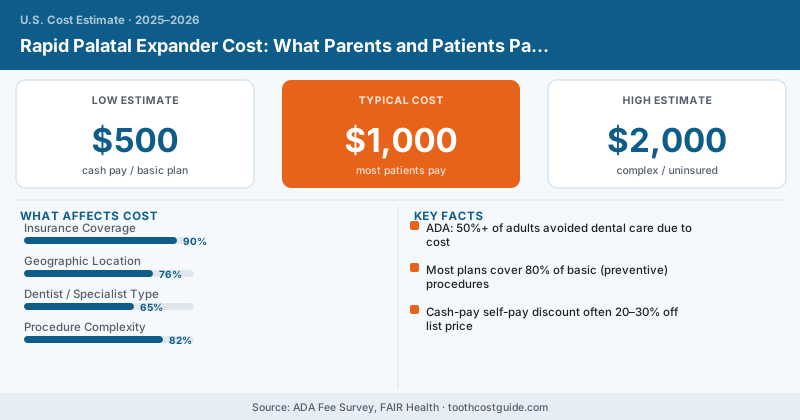
Here’s the straightforward answer: a rapid palatal expander (RPE) typically costs $1,000–$3,000 for the appliance and active treatment phase, and $2,000–$4,500 when bundled into a full Phase 1 treatment plan. Whether it’s worth it depends on your child’s specific situation — and pediatric orthodontists have varying opinions on that.
Types of Palate Expanders and Costs
| Appliance Type | Average Cost |
|---|---|
| Removable palate expander | $1,000–$2,500 |
| Fixed (bonded) RPE | $1,500–$3,000 |
| Hyrax expander (tooth-anchored) | $1,800–$3,500 |
| MARPE (for adults, mini-implant supported) | $3,000–$6,000 |
| Full Phase 1 treatment (includes RPE) | $2,000–$4,500 |
These costs typically include the appliance fabrication, insertion, activation appointments, and a retention period. They do not usually include Phase 2 (full braces or aligners), which is a separate cost.
What Insurance Covers
Most dental insurance plans that include orthodontic benefits cover palate expanders — but through the orthodontic benefit bucket, not the dental restorative bucket. That’s important because:
- Ortho benefits are a lifetime maximum (typically $1,000–$2,000)
- They usually apply to the whole treatment course, not per appliance
- Coverage is often 50% up to that lifetime max
So if your plan has a $1,500 ortho lifetime max and Phase 1 costs $2,500, insurance might pay $750–$1,250, leaving you with $1,250–$1,750 out of pocket. Then you’ll have little or no ortho benefit left for Phase 2.
Some FSA and HSA plans cover orthodontic appliances, but rules vary. Check with your plan administrator.
The American Association of Orthodontists recommends a first orthodontic evaluation by age 7 — but that doesn’t mean every child needs Phase 1 treatment. The AAPD notes that many skeletal issues can be addressed in a single comprehensive treatment phase during adolescence. Get a second opinion from another orthodontist before committing to Phase 1, especially if the treatment plan feels rushed or the fee seems high.
How Long Is Treatment?
The active expansion phase typically takes 3–6 months. During that time, you (or your child) activate the expander with a small key 1–2 times daily, widening the palate by 0.25mm per turn. After active expansion, the expander stays in place for 6–12 months as a retainer while new bone fills in the expanded suture.
Most orthodontists include all activation appointments in the quoted fee. Post-expansion retention visits are usually included too, but confirm this — some offices charge per visit.
Adults and Palate Expanders
Traditional RPEs work by separating the mid-palatal suture, which fuses between ages 14–25. In adults with a fused suture, conventional expanders don’t work.
Adult options include:
- MARPE (Mini-implant Assisted Rapid Palatal Expansion) — uses four small titanium implants to apply force directly to bone; $3,000–$6,000
- Surgically Assisted Rapid Palatal Expansion (SARPE) — combines surgery with an expander; $4,000–$10,000+ including surgical fees
Adult palate expansion is more complex, more expensive, and less commonly recommended unless there’s a genuine medical need (nasal obstruction, severe crossbite, sleep apnea consideration).
Some orthodontic practices advertise Phase 1 treatment heavily as a revenue driver. The evidence for interceptive treatment is strongest for posterior crossbites with true skeletal origin. For mild crowding that’s likely to self-correct, watchful waiting is a legitimate approach. Ask specifically: “What happens if we wait and do this in Phase 2?” A good orthodontist will give you an honest comparison.
Managing the Cost
- Bundle Phase 1 and Phase 2 fees upfront — many orthodontists offer a discounted total if you commit to both phases at the start
- Ask about in-house payment plans — most orthodontic offices offer 12–24 month no-interest installment plans
- Compare Phase 1 quotes from two orthodontists — fees vary by $500–$1,500 for the same appliance in the same market
- Use your FSA — orthodontic treatment is an eligible expense; you can contribute up to $3,050/year in 2025
The typical out-of-pocket with insurance is $500–$1,500 for Phase 1 alone. Without insurance, plan for $1,500–$3,000 depending on which expander type is prescribed.