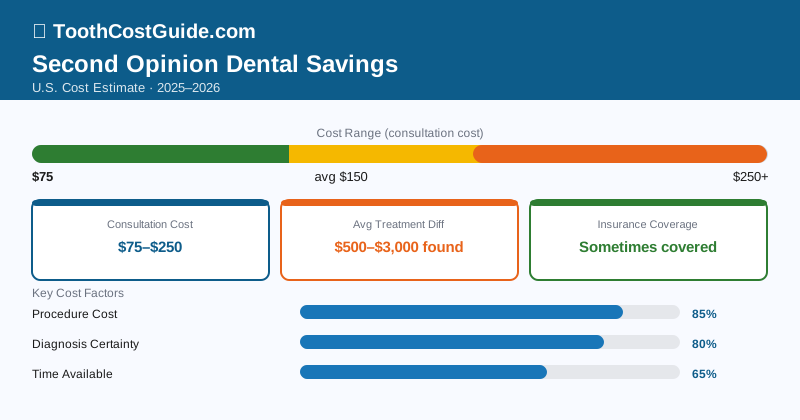
Getting a second dental opinion costs $50–$150 but can save $500–$5,000 — studies show that 10–30% of expensive dental treatment recommendations are either not needed, not urgent, or have less expensive alternatives that weren’t presented. Knowing when to seek a second opinion is one of the most underused money-saving tools in dental care.
| Situation | Second Opinion Cost | Potential Savings | Risk of Not Getting One |
|---|---|---|---|
| Recommended root canal | $50–$125 | $800–$1,500 | Unnecessary treatment |
| Recommended crown | $50–$125 | $1,200–$1,800 | Could be treated with onlay or filling |
| Multiple crowns (3+) | $75–$150 | $3,000–$5,000+ | Significant over-treatment |
| Full mouth reconstruction quote | $100–$200 | $5,000–$15,000 | Major cost discrepancy |
| Implant recommendation | $75–$150 | $3,000–$5,000 | May not be necessary/timing |
| Periodontal surgery recommendation | $75–$150 | $1,500–$5,000 | Non-surgical alternatives may work |
| Orthodontic treatment plan | $0 (free consult) | $1,000–$4,000 | Wrong approach for your case |
How It Works
A second dental opinion involves visiting a different licensed dentist to review the same clinical information — X-rays, photos, and examination findings — and provide an independent assessment of whether the recommended treatment is appropriate.
In dentistry, clinical decision-making has a meaningful gray zone. Many dental conditions — cavities at the enamel-dentin border, hairline cracks, early gum disease, watch-and-wait versus treat immediately — involve judgment calls where two qualified dentists may reasonably reach different conclusions.
Second opinions are not accusatory. Good dentists understand and respect them. If a dentist reacts with offense or pressure when you mention wanting a second opinion, that itself is a warning sign.
What happens at a second opinion visit:
- You share your X-rays (you are legally entitled to a copy from any dentist you’ve seen)
- The second dentist examines you and reviews the records
- They provide their independent assessment in writing or verbally
- You are NOT obligated to continue treatment with either dentist
Costs & Savings Details
Research findings on dental over-treatment:
- A 2017 study in the British Dental Journal found that 30% of dental treatments recommended to a mystery shopper were unnecessary or could be delayed
- Consumer Reports investigations have documented significant variation in treatment recommendations for identical X-rays presented to multiple dentists
- The problem is not necessarily dishonesty — different training, clinical philosophies, and economic incentives lead to genuinely different opinions on the same case
Where second opinions save the most money:
Root canals: A tooth with reversible pulpitis (temporary inflammation) may be confused with irreversible pulpitis (requires root canal). A second opinion from an endodontist (root canal specialist) costs $75–$150 and can confirm or deny the diagnosis before you spend $800–$1,500.
Crowns: Many teeth recommended for crowns could instead be treated with an onlay ($600–$900) or even a large filling ($150–$300). A second opinion evaluating whether crown preparation can be avoided is frequently worth the consultation fee.
Multiple crowns: A treatment plan for 4–6 crowns with a total cost of $5,000–$8,000 deserves a second opinion. Studies show significant variation in the number of crowns recommended by different dentists examining the same patient.
Periodontal surgery: Non-surgical periodontal treatment (deep cleaning/scaling and root planing at $250–$400/quadrant) resolves many cases of moderate gum disease without surgery. A second opinion from a periodontist confirms whether surgery is truly indicated.
Eligibility / Who Qualifies
Anyone can get a dental second opinion — there are no eligibility criteria. You have the legal right to:
- Copies of your dental X-rays and treatment records at any time
- Seek treatment from any licensed dentist you choose
- Change dentists without explanation or penalty
Second opinions are most valuable (and most worth the consultation fee) when:
- The recommended procedure costs $800+
- You have never had a particular type of treatment before
- The treatment plan feels rushed or the dentist seemed primarily focused on upselling
- You’re unsure whether the condition is urgent or can wait
- You’re being told you need multiple major procedures at once
Pros and Cons
Pros
- Very low cost relative to potential savings
- Provides peace of mind even when the second opinion confirms the first
- Helps you understand your dental condition better
- May reveal less expensive treatment alternatives
- Protects against rare but real instances of unnecessary treatment
Cons
- Requires an additional appointment and the consultation fee
- Results may be inconsistent — two second opinions could differ
- Time delay before treatment can extend damage in urgent situations (active infection, severe decay)
- Some dentists may require new X-rays (adding cost), though your existing X-rays should usually suffice
If you have a dental emergency — active infection, abscess, or severe pain — do NOT delay treatment to get a second opinion. Dental infections can become life-threatening. Seek treatment immediately. Second opinions are for non-urgent situations where you have time to evaluate options.
Step-by-Step Guide
Request your X-rays and records: Before leaving your dentist’s office after receiving an expensive treatment recommendation, ask for copies of all X-rays and a written treatment plan with CDT procedure codes. You are entitled to these. Most offices can provide digital X-rays via email or on a USB drive.
Research qualified second opinion providers: For root canal second opinions, seek a board-certified endodontist. For gum disease treatment, a periodontist. For implants or full mouth reconstruction, a prosthodontist. Specialists bring expertise specific to the recommended procedure.
Book the second opinion consultation: Call the office and explain you’re seeking a second opinion on a specific recommendation. Most dentists and specialists accommodate second opinion visits readily. Ask the consultation fee upfront — typically $50–$150.
Bring everything: Bring your X-rays (or share the digital file), the written treatment plan, and any written notes you have about symptoms and history. The more complete your records, the more accurate the second opinion.
Ask specific questions at the second opinion:
- “Is this treatment necessary right now, or could it be monitored?”
- “Is there a less expensive alternative that addresses the same issue?”
- “What happens if I wait 3–6 months?”
- “What is your treatment approach and estimated cost?”
Compare both opinions: If both dentists recommend the same treatment, you have high confidence it’s appropriate. If opinions differ significantly, consider a third opinion or request that both dentists explain their reasoning in more detail.
Choose your provider for treatment: You are not obligated to use either dentist who provided an opinion. You can choose based on cost, approach, confidence in the provider, or any other factor.
For any treatment plan over $2,000, request a written estimate with CDT procedure codes, then visit Fair Health Consumer (fairhealthconsumer.org) to benchmark each code against your local market. This tells you whether the fees are within the typical range for your area — and gives you informed talking points when seeking a second opinion or negotiating with your dentist.
Bottom Line
A second dental opinion is the highest-leverage, lowest-cost investment you can make before any major dental procedure. At $50–$150, it’s cheap insurance against unnecessary treatment. For procedures costing $800 or more, getting a second opinion is standard responsible healthcare decision-making — not an insult to your current dentist. The potential savings of $500–$5,000 make it worthwhile every time.